S2 Search · Reading list

S2 Actual reading list

Books from S2 Actual on Goodreads, organized by his shelves and topic buckets (intel lists, military history, logistics, etc.). Metadata filled via Open Library.

Not official S2 Underground. Independent fan index — not affiliated with or endorsed by S2. Official hub: linktr.ee/S2_underground. S2 materials are CC BY-NC-SA 4.0.

S2 topic buckets (Goodreads)

Subjects & genres

33 books · All shelves · subject Air power · page 2 of 2

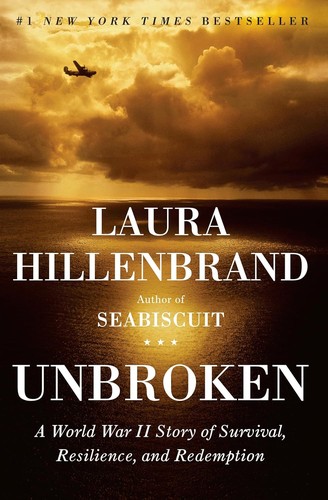
Unbroken: A World War II Story of Survival, Resilience and Redemption

Laura Hillenbrand

★★★☆☆
Read WWII Air power Biography ISBN 9781400064168

Random House · 2010

On a May afternoon in 1943, an Army Air Forces bomber crashed into the Pacific Ocean and disappeared, leaving only a spray of debris and a slick of oil, gasoline, and blood. Then, on the ocean surface, a face appeared. It was that of a young lieutenant, the plane's bombardier, who was struggling to a life raft and pulling himself aboard. So began one of the most extraordinary odysseys of the Second World War. The lieutenant’s name was Louis Zamperini. In boyhood, he'd been a cunning and incorrigible delinquent, breaking into houses, brawling, and fleeing his home to ride the rails. As a teenager, he had channeled his defiance into running, discovering a prodigious talent that had carried him to the Berlin Olympics and within sight of the four-minute mile. But when war had come, the athlete had become an airman, embarking on a journey that led to his doomed flight, a tiny raft, and a drift into the unknown. Ahead of Zamperini lay thousands of miles of open ocean, leaping sharks, a foundering raft, thirst and starvation, enemy aircraft, and, beyond, a trial even greater. Driven to the limits of endurance, Zamperini would answer desperation with ingenuity; suffering with hope, resolve, and humor; brutality with rebellion. His fate, whether triumph or tragedy, would be suspended on the fraying wire of his will.

No cover · Amazon

Behind the battle: Intelligence in the war with Germany, 1939-45

Ralph Bennett

unrated
Read Advanced intel Intel history WWII Espionage Naval Air power Intel history

By the end of 1942, Ultra had become the richest and most reliable of the many different sources of intelligence, however, the relation between their individual contributions requires analysis. Ralph Bennett's study aims to present a succinct survey and analysis of the military intelligence available to Britain and her allies during World War II. When war began, Britain was as ill-prepared in intelligence as in armaments. Civilian scientists had discovered the principle of radar in the mid-1930s, but everything else had to be learned from scratch in the heat of emergency. In 1939, all three armed services lacked staff trained to appraise and distribute intelligence. Because it had so often been unreliable in the past, field commanders were reluctant to accept it and had to learn new ways. First signs of improvement came in mid-1941, when Ultra targeted naval vessels and bomber aircraft onto so many of Rommel's supply ships that the Afrika Korps almost withered on the vine. From then on intelligence played an increasingly indispensable part in final victory. Ultra won the Battle of the Atlantic, driving the U-boats back to coastal waters by June 1943. A lower grade code gave Montgomery the vital first news of the whereabouts of the German tanks as he planned the breakthrough at Alamein. Only "Bomber" Harris refused to give intelligence the credit it deserved, for reasons investigated in "Behind the Battle".

Desert Sniper: How One Ordinary Brit Went to War Against ISIS

Ed Nash

unrated
Read Advanced intel Military history Technical warfare Biographies GWOT Air power Middle East Intel history ISBN 9781408711330

Little, Brown Book Group Limited · 2018

What makes an ordinary but highly educated Englishman, with no previous military training, decide to travel and fight in one of the most brutal conflicts on the planet? Desert Sniper is an extraordinary, true account of one man's journey from well-meaning volunteer to battle-scarred combat sniper, placing himself daily in the line of fire to fight one of the greatest evils of this new century. Ed Nash has travelled across the globe, and is working with refugees in Burma, when he first becomes aware of the terrible atrocities being committed under ISIS's newly established 'Caliphate', covering vast tracts of Iraq and Syria. In June 2015, he chooses to undertake the hazardous journey, via Northern Iraq, to Syria, to join ill-equipped and poorly trained but battle-hardened Kurdish forces as they attempt to halt Daesh's relentless advance. Nash is an articulate, insightful and refreshingly honest companion as he unpacks the shifting complexities of the political and military situation in which he finds himself. As one of a motley band of foreign volunteer fighters - veterans of other conflicts, adventurers and misfits, from many different countries - we follow him through his rudimentary training and early combat operations as he and his companions slowly gain the trust and respect of their Kurdish colleagues. Nash shows us the realities of the war on the ground in Syria in fascinating detail; the privations of the ordinary Kurdish soldiers, the terrible price paid by civilians caught in the cross-fire, the ever-present danger of lethal suicide bombers and occasional moments of striking beauty in amongst the carnage. A modern classic in the making, Desert Sniper will prove to be one of the most unforgettable accounts to emerge from the war against ISIS.

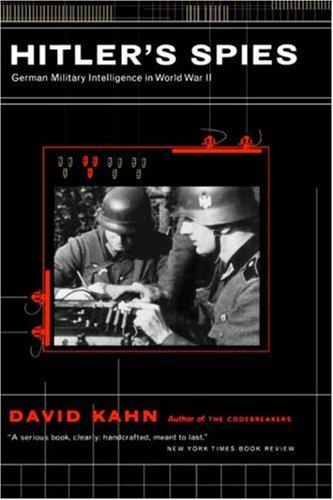
Hitler's Spies: German Military Intelligence In World War II

David Kahn

unrated
Read Intel history WWII Espionage Air power Russia / USSR Intel history ISBN 0306809494

Da Capo Press · 2000

A German patrol wiggles through Russian lines to return with details of Soviet defenses. An expert Luftwaffe interrogator teases secret information from downed Allied airmen. Two spies steal ashore in Maine and make their way into New York City. Filled with episodes of intrigue and adventure, Hitler's Spies reveals the workings of German intelligence—the famed Abwehr, the dreaded SD, the codebreakers, the spies, and the intelligence gatherers of the Foreign Office—and explains its failure to best the Allies. Draws on original documents and extensive interviews.

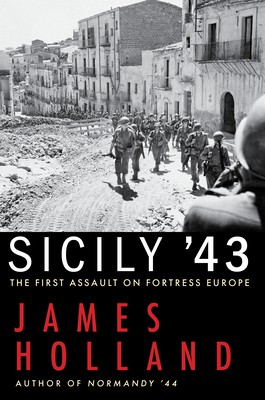
Sicily '43: The First Assault on Fortress Europe

James Holland

unrated
To read WWII Naval Air power Intel history ISBN 9780802157188

Atlantic Monthly Press · November 3, 2020

On July 10, 1943, the largest amphibious invasion ever mounted took place, larger even than the Normandy invasion eleven months later: 160,000 American, British, and Canadian troops came ashore or were parachuted onto Sicily, signaling the start of the campaign to defeat Nazi Germany on European soil. Operation HUSKY, as it was known, was enormously complex, involving dramatic battles on land, in the air, and at sea. Yet, despite its paramount importance to ultimate Allied victory, and its drama, very little has been written about the 38-day Battle for Sicily. Based on his own battlefield studies in Sicily and on much new research, James Holland's Sicily '43 offers a vital new perspective on a major turning point in World War II and a chronicle of a multi-pronged campaign in a uniquely diverse and contained geographical location. The characters involved--Generals George Patton and Bernard Montgomery among many--were as colorful as the air and naval battles and the fighting on the ground across the scorching plains and mountaintop of Sicily were brutal. But among Holland's great skills is incorporating the experience of on-the-ground participants on all sides--from American privates Tom and Dee Bowles and Tuskegee fighter pilot Charlie Dryden to British major Hedley Verity and Canadian lieutenant Farley Mowat (later a celebrated author), to German and Italian participants such as Wilhelm Schmalz, brigade commander in the Hermann G�ring Division, or Luftwaffe fighter pilot major Johannes "Macky" Steinhoff and to Italian combatants, civilians and mafiosi alike--which gives readers an intimate sense of what occurred in July and August 1943. Emphasizing the significance of Allied air superiority, Holland overturns conventional narratives that have criticized the Sicily campaign for the vacillations over the plan, the slowness of the Allied advance and that so many German and Italian soldiers escaped to the mainland; rather, he shows that clearing the island in 38 days against geographical challenges and fierce resistance was an impressive achievement. A powerful and dramatic account by a master military historian, Sicily '43 fills a major gap in the narrative history of World War II.

Strategy for Defeat: The Luftwaffe 1933-1945

Williamson Murray

unrated
Read Military history Logistics WWII Air power Logistics Strategy / theory ISBN 9780160021602

United States Government Printing Office · 1983

A penetrating and powerfully presented explanation of the successes and failures of the German air force in World War II. "Authoritative and thorough . . . an interesting and thought provoking book of real value to historians and military thinkers."--RUSI Journal.

The German Air War in Russia

Richard R. Muller

unrated
Read Advanced intel Military history Logistics WWII Air power Russia / USSR Logistics Strategy / theory ISBN 1877853135

Nautical & Aviation Pub. Co. of America · 1992

Dr. Richard Muller has produced a new interpretation of the longest continous air offensive waged by the Luftwaffe. He delineates the shifts in German air strategy as well as the relationship between operational art, aviation technology, and the strategy of the German air force's general staff.

The Luftwaffe over Germany: Defense of the Reich

Donald Caldwell

unrated
Read Military history Logistics WWII Air power Russia / USSR Logistics Strategy / theory ISBN 1853677124

GREENHILL · 2007

The Luftwaffe over Germany tells the story of one of the longest and most intense air battles in history. The daylight air struggles over Germany during World War II involved thousands of aircraft, dozens of units, and hundreds of aerial engagements. Until now, there has been no single book that covers the complete story, from the highest levels of air strategy to the individual tales of Fw 190s, Bf 109s and Me 262s in air combat against the American bomber streams. This work explores the German air defense system until its collapse in 1945. It examines the detrimental effect of Luftwaffe theory and doctrine on the German air arms ability to defend the homeland once the Allied Combined Bomber Offensive began in earnest. The hard-pressed Luftwaffe leadership attempted to cobble together an air-defense network while at the same time tending to the combat fronts in Russia and the Mediterranean. Units developed specialized tactics and weapons for dealing with heavily defended bomber formations, while senior commanders sought to construct an elaborate command and control system integrating radar, observers, anti-aircraft guns, and fighters. By mid-1944, they had lost the battle - but had exacted a terrible price from the Americans in the process. The product of a ten-year collaboration between two noted Luftwaffe historians, this work fills a major gap in the literature of World War II. The authors have examined original war diaries, logbooks, doctrine manuals, after-action reports, and interviews with many combat veterans to produce a richly detailed account. Illustrated with nearly two hundred photographs, as well as new maps and diagrams, Luftwaffe Over Germany is certain to become the standard work on the subject.

Under the Bombs: The German Home Front, 1942-1945

Earl R. Beck

unrated
Read Economics Military history Logistics WWII Air power Logistics Economics ISBN 0813109779

University Pressof Kentucky · 1986

Under the Bombs tells the story of the civilian population of German cities devastated by Allied bombing in World War II. These people went to work, tried to keep a home (though in many cases it was just a pile of rubble where a house once stood), and attempted to live life as normally as possible amid the chaos of war. Earl Beck also looks at the food and fuel rationing the German people endured and the problems of trying to make a public complaint while living in a totalitarian state.