S2 Search · Reading list

S2 Actual reading list

Books from S2 Actual on Goodreads, organized by his shelves and topic buckets (intel lists, military history, logistics, etc.). Metadata filled via Open Library.

Not official S2 Underground. Independent fan index — not affiliated with or endorsed by S2. Official hub: linktr.ee/S2_underground. S2 materials are CC BY-NC-SA 4.0.

S2 topic buckets (Goodreads)

Subjects & genres

44 books · Intel history · subject WWII · page 2 of 2

Tigers In The Mud: The Combat Career of German Panzer Commander Otto Carius

Otto Carius

★★★★★
Read Intel history Military history WWII Armor Intel history Biography ISBN 0811729117

Stackpole Books · 2003

WWII began with a metallic roar as the German Blitzkrieg raced across Europe, spearheaded by the most dreaded weapon of the 20th century: the Panzer. No German tank better represents that thundering power than the infamous Tiger, and Otto Carius was one of the most successful commanders to ever take a Tiger into battle, destroying well over 150 enemy tanks during his incredible career.
No cover · Amazon

Weaving the Tangled Web: Military Deception in Large-Scale Combat Operations (Large-Scale Combat Operations Series Book 1)

Christopher M. Rein

★★★★★
Read Basic intel Military history Intel history WWII Korea Cold War GWOT Guerrilla / COIN China Russia / USSR Middle East Intel history Strategy / theory

This book is from Army University Press and is Volume 1 in it's Large-Scale Combat Operations Series. It has footnotes, maps, and pictures, and was originally published in 2018. “Since the Soviet Union’s fall in 1989, the specter of large-scale ground combat against a peer adversary was remote. During the years following, the US Army found itself increasingly called upon to lead multinational operations in the lower to middle tiers of the range of military operations and conflict continuum. The events of 11 September 2001 led to more than 15 years of intense focus on counterterrorism, counterinsurgency, and stability operations in Iraq and Afghanistan. An entire generation of Army leaders and Soldiers were culturally imprinted by this experience. We emerged as an Army more capable in limited contingency operations than at any time in our nation’s history, but the geopolitical landscape continues to shift and the risk of great power conflict is no longer a remote possibility. “While our Army focused on limited contingency operations in the Middle East and Southwest Asia, other regional and peer adversaries scrutinized US military processes and methods and adapted their own accordingly. As technology has proliferated and become accessible in even the most remote corners of the world, the US military’s competitive advantage is being challenged across all of the warfighting domains. In the last decade, we have witnessed an emergent China, a revanchist and aggressive Russia, a menacing North Korea, and a cavalier Iranian regime. Each of these adversaries seeks to change the world order in their favor and contest US strategic interests abroad. The chance for war against a peer or regional near-peer adversary has increased exponentially, and we must rapidly shift our focus to successfully compete in all domains and across the full range of military operations." Includes: Introduction: Multi-Domain Deception (Christopher M. Rein, General Editor); Chapter 1: The Belfort Ruse the American Deception plan for the battle of st. Mihiel, 1918 (Mark E. Grotelueschen); Chapter 2: From Beersheba To Megiddo British Deception Operations During The Palestine Campaign, 1917-1918; (Major Brian J. Drohan); Chapter 3: Operation Bertram British Deception At El Alamein (Gary W. Linhart); Chapter 4: Operations Barclay, Cascade, And Mincemeat Allied Deception In The Mediterranean, 1943 (Gregory S. Hospodor); Chapter 5: Operation Kreml German Strategic Deception On The Eastern Front In 1942 (Alan P. Donohue); Chapter 6: Red Star Resurgent Soviet Deception Operations At Stalingrad, 1942-1943 (First Lieutenant Kyle B. Vautrinot); Chapter 7: Operation Bagration Maskirovka At Its Height, Summer 1944 (Curtis S. King); Chapter 8: Deceive, Divert, And Delay Operation Fortitude In Support Of D-Day (Scott C. Farquhar); Chapter 9: Chinese Deception And The 1950 Intervention In The Korean War (Joseph G.D. Babb); Chapter 10: From Maneuvers To War The Egyptian Deception Plan On The Eve Of The Yom-Kippur War (Tal Tovy); Chapter 11: Target San Carlos British Deception During The Repossession Of The Falkland Islands (Steven Paget); Chapter 12: Deception In The Desert Deceiving Iraq In Operation Desert Storm (Donald P. Wright); Conclusion: The Future Of Military Deception Operations (Conrad C. Crane)

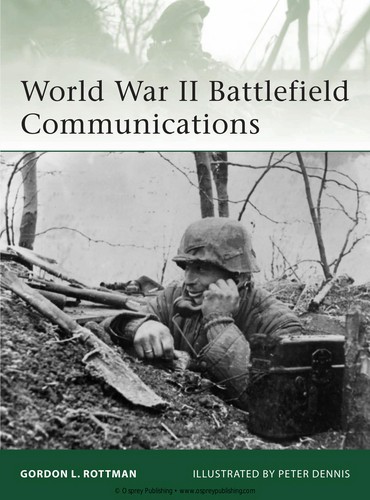
World War II Battlefield Communications (Elite, 181)

Gordon L. Rottman

★★★★★
Read Intel history Military history Technical warfare WWII ISBN 9781846038471

Osprey · 2010

Osprey's examination of technological advances in communications during World War II (1939-1945). Perhaps the biggest difference in the fighting between the two World Wars lay in the invention of the man-portable radio that allowed for a greater degree of tactical coordination than ever before. Gordon L. Rottman provides an informative study of the use of small radios, field telephones, signal flares and ground-to-air signaling that revolutionized the battlefield.

Destiny in the Desert: The Story Behind El Alamein - the Battle That Turned the Tide

Jonathan Dimbleby

★★★★
Read Logistics Intel history Military history Economics WWII Russia / USSR Logistics Strategy / theory Economics Orthodox / theology ISBN 9781846684449

Profile Books Ltd · 2012

This is a unique single-volume history of the road to El Alamein - 'the end of the beginning' - and the bloody battle that followed...It was the British victory at the Battle of El Alamein in November 1942 that inspired one of Churchill's most famous aphorisms: 'it is not the end nor is it the beginning of the end, but it is the end of the beginning'. And yet the true significance of this iconic episode remains unrecognised. In this thrilling historical account, Jonathan Dimbleby describes the political and strategic realities that lay behind the battle, charting the nail-biting months that led to the victory at El Alamein in November 1942. It is a story of high drama, played out both in the war capitals of London, Washington, Berlin, Rome and Moscow, and at the front, in the command posts and foxholes in the desert. "El Alamein" is about politicians and generals, diplomats, civil servants and soldiers. It is about forceful characters and the tensions and rivalries between them. Drawing on official records and the personal insights of those involved at every level, Dimbleby creates a vivid portrait of a struggle which for Churchill marked the turn of the tide - and which for the soldiers on the ground involved fighting and dying in a foreign land.

Legacy of Ashes: The History of the CIA

Tim Weiner

★★★☆☆
Read Military history Intel history WWII Cold War Espionage GWOT Intel history ISBN 9780385514453

Doubleday · 2007

For the last sixty years, the CIA has managed to maintain a formidable reputation in spite of its terrible record, burying its blunders in top-secret archives. Its mission was to know the world. When it did not succeed, it set out to change the world. Its failures have handed us, in the words of President Eisenhower, “a legacy of ashes.” Now Pulitzer Prize–winning author Tim Weiner offers the first definitive history of the CIA—and everything is on the record. LEGACY OF ASHES is based on more than 50,000 documents, primarily from the archives of the CIA itself, and hundreds of interviews with CIA veterans, including ten Directors of Central Intelligence. It takes the CIA from its creation after World War II, through its battles in the cold war and the war on terror, to its near-collapse after September 11th, 2001. Tim Weiner’s past work on the CIA and American intelligence was hailed as “impressively reported” and “immensely entertaining” in The New York Times. The Wall Street Journal called it “truly extraordinary . . . the best book ever written on a case of espionage.” Here is the hidden history of the CIA: why eleven presidents and three generations of CIA officers have been unable to understand the world; why nearly every CIA director has left the agency in worse shape than he found it; and how these failures have profoundly jeopardized our national security.

No cover · Amazon

Military Deception: Hiding The Real - Showing The Fake - Denial Operations, Propaganda, Disinformation, Joint Doctrine, Soviet Maskirovka, Desert Storm Persian Gulf War Examples

U.S. Government

★★★☆☆
Read Advanced intel Military history Intel history Technical warfare WWII Russia / USSR Middle East Strategy / theory

Professionally converted for accurate flowing-text e-book format reproduction, this book discusses military deception techniques and history. "Military deception" is an umbrella term that includes both denial and deception. Denial hides the real and deception shows the fake. Denial and deception are operations; propaganda and disinformation are the products. Joint doctrine says that military deception, as applied by a joint force commander (JFC), targets an adversary's decision-making process. Ultimately, the intent is to shape the adversary's behavior in the JFC's favor or to cause an adversary to form an inaccurate impression of the battlespace. Consequently, planning for deception operations depends on intelligence and security for success. Obviously, a commander wants to conceal deception efforts from the enemy, but often he'll conceal all or some of his efforts from his own troops to prevent confusion and/or compromise of the plan. During the early years of Soviet involvement in World War II, mishandling of information by soldiers and planners resulted in the compromise of many maskirovka (or deception) operations. As a result, the Soviets implemented aggressive security measures to protect their deception plans. Specifically, Soviet commanders restricted the number of planners and documents involved in the deception operations and communicated to subordinates only what they needed to know, when they needed to know it. The general enjoyed his breakfast while reading his morning paper and listening to the international news channel. Hearing the Balkans mentioned—his area of responsibility—he looked up as a foreign correspondent began to comment on the aftermath of an Allied bombing mission from the day before. The gruesome details suddenly made the general's scrambled eggs a bit less appealing. The graphic pictures showed what appeared to be the remnants of an orphanage. There in the rubble lay a bloodstained, tattered doll. Those images left him wondering about the carnage that lay beneath the collapsed brick and mortar. Had his staff miscalculated and inadvertently struck an orphanage? A similar misstep had occurred a few weeks ago when another bombing mission resulted in civilian casualties in a marketplace. As the general bemoaned the potential ramifications of accidentally bombing an orphanage, a memory surfaced. Years of flying high-performance aircraft had sharpened his senses, and something about the scene seemed familiar. Could that be the same bloodstained doll he had seen in photographs of the earlier marketplace mishap? The general had been briefed on the enemy's rather low-tech yet successful use of deception. Was he, along with the rest of the world, a target of military deception? As he pondered this, his pager went off. This fictitious example illustrates both how easy it is to manipulate the media in deception operations and how a thorough understanding of deception can help prevent a military leader from falling victim to it. The U.S. military is transforming itself with technological advancements in warfighting capability. Weapon systems, force structure and training have all improved. The amount and kind of information available to the warfighter is also improving. But even a technologically advanced nation like the United States is susceptible to deception. Analysis of friendly and enemy deception techniques in Operations DESERT STORM and ALLIED FORCE shows the main U.S. vulnerabilities to include its insatiable appetite for "news," the lack of deception-detection expertise in the military, and the tendency to believe that technological advancements make a nation deception-proof. Therefore, the key to mitigating the U.S. vulnerabilities to deception lies in educating the media about the military and common deception practices, giving the military intensive deception-detection training, and abandoning the notion that technolo

No cover · Amazon

My Commando Operations: The Memoirs of Hitler's Most Daring Commando

Otto Skorzeny

★★★☆☆
Read Advanced intel Biographies Intel history Military history WWII Special ops Russia / USSR Intel history Biography

The memoirs of the legendary Skorzeny appear here in its first unabridged English edition. Skorzeny's fame began with the successful raid to free Benito Mussolini from the Gran Sasso, Italy in 1943. His elite commandos surprised Italian guards in a daring daytime raid. Hitler presented Skorzeny with the Knight's Cross for this operation. Not only is this raid explained in minute detail, many of Skorzeny's previously unknown operations in all European and Russian theatres of World War II are given in detailed accounts. Operation Griffin - the innovative use of German Kommandos dressed as American soldiers working behind enemy lines - during the Ardennes Offensive in 1944 is given in-depth coverage, as is Skorzeny's rememberances on the Malmedy massacre. Skorzeny also offers his insights into the mysterious Rudolf Hess mission to England in May 1941, and offers a behind the scenes look at German and Russian secret military intelligence, and the workings of Canaris and Gehlen. ***This 1997 Schiffer edition has the same ISBN (0887407188. 9780887407185) as the 1995 edition from the same publisher, though the dust-jacket is completely different.***

Stopped at Stalingrad: The Luftwaffe and Hitler's Defeat in the East, 1942-1943 (Modern War Studies)

Joel S.A. Hayward

★★★☆☆
Read Intel history Military history Advanced intel Logistics WWII Cold War Air power Russia / USSR Logistics Strategy / theory ISBN 9780700611461

University Press of Kansas · September 2001

By the time Hitler declared war on the Soviet Union in 1941, he knew that his military machine was running out of fuel. In response, he launched Operation Blau, a campaign designed to protect Nazi oilfields in Rumania while securing new ones in the Caucasus. All that stood in the way was Stalingrad. Most accounts of the Battle of Stalingrad have focused on the dismal fate of the German Army. Joel Hayward now chronicles Luftwaffe operations during that campaign, focusing on Hitler's use of the air force as a tactical rather than strategic weapon in close support of ground forces. He vividly details the Luftwaffe's key role as flying artillery, showing that the army relied on Luftwaffe support to a far greater degree than has been previously revealed and that its successes in the East occurred largely because of the effectiveness of that support. Hayward analyzes this major German offensive from the standpoint of cooperation between ground and air forces to attain mutually agreed objectives. He draws on diaries of both key commanders and regular airmen to recreate crucial battles and convey the drama of Hitler's frustrations and reckless leadership. Ultimately, Hayward shows, the poorly conceived strategies of Hitler, Goering, and others in Berlin doomed the efforts of air commander Wolfram von Richthofen, a courageous and resolute leader attempting to come to grips with an increasingly impossible situation. Stopped at Stalingrad is a dynamic case study in combined arms warfare that fills in many of the gaps left by other studies of the eastern war. By reconsidering the campaign in the light of a wider body of documentary sources and analyzing many previously ignored events, Hayward provides military historians and general readers a much deeper and more complete understanding of the Battle of Stalingrad and its impact on World War II.

No cover · Amazon

Behind the battle: Intelligence in the war with Germany, 1939-45

Ralph Bennett

unrated
Read Advanced intel Intel history WWII Espionage Naval Air power Intel history

By the end of 1942, Ultra had become the richest and most reliable of the many different sources of intelligence, however, the relation between their individual contributions requires analysis. Ralph Bennett's study aims to present a succinct survey and analysis of the military intelligence available to Britain and her allies during World War II. When war began, Britain was as ill-prepared in intelligence as in armaments. Civilian scientists had discovered the principle of radar in the mid-1930s, but everything else had to be learned from scratch in the heat of emergency. In 1939, all three armed services lacked staff trained to appraise and distribute intelligence. Because it had so often been unreliable in the past, field commanders were reluctant to accept it and had to learn new ways. First signs of improvement came in mid-1941, when Ultra targeted naval vessels and bomber aircraft onto so many of Rommel's supply ships that the Afrika Korps almost withered on the vine. From then on intelligence played an increasingly indispensable part in final victory. Ultra won the Battle of the Atlantic, driving the U-boats back to coastal waters by June 1943. A lower grade code gave Montgomery the vital first news of the whereabouts of the German tanks as he planned the breakthrough at Alamein. Only "Bomber" Harris refused to give intelligence the credit it deserved, for reasons investigated in "Behind the Battle".

No cover · Amazon

Bracketing the Enemy: Forward Observers in World War II

John R. Walker

unrated
Read Advanced intel Intel history Military history Technical warfare WWII US Civil War

After the end of World War II, General George Patton declared that artillery had won the war. Yet howitzers did not achieve victory on their own. Crucial to the success of these big guns were forward observers, artillerymen on the front lines who directed the artillery fire. Until now, the vital role of forward observers in ground combat has received little scholarly attention. In Bracketing the Enemy, John R. Walker remedies this oversight by offering the first full-length history of forward observer teams during World War II. As early as the U.S. Civil War, artillery fire could reach as far as two miles, but without an “FO” (forward observer) to report where the first shot had landed in relation to the target, and to direct subsequent fire by outlining or “bracketing” the targeted range, many of the advantages of longer-range fire were wasted. During World War II, FOs accompanied infantrymen on the front lines. Now, for the first time, gun crews could bring deadly accurate fire on enemy positions immediately as advancing riflemen encountered these enemy strongpoints. According to Walker, this transition from direct to indirect fire was one of the most important innovations to have occurred in ground combat in centuries. Using the 37th Division in the Pacific Theater and the 87th in Europe as case studies, Walker presents a vivid picture of the dangers involved in FO duty and shows how vitally important forward observers were to the success of ground operations in a variety of scenarios. FO personnel not only performed a vital support function as artillerymen but often transcended their combat role by fighting as infantrymen, sometimes even leading soldiers into battle. And yet, although forward observers lived, fought, and bled with the infantry, they were ineligible to wear the Combat Infantryman’s Badge awarded to the riflemen they supported. Forward observers are thus among the unsung heroes of World War II. Bracketing the Enemy signals a long-overdue recognition of their distinguished service.

From Troy to Entebbe

John Arquilla

unrated
Read Advanced intel Intel history Military history WWII WWI Special ops China Strategy / theory US Civil War ISBN 9780761801863

Univ.P.of America · 1996

Special operations, though most commonly associated with the period from the Second World War to the present, have played a key role throughout the history of conflict from the Trojan War to the great arms struggles of the 20th century. This volume introduces the reader to the broad sweep of the history of special operations, and also includes several excerpts from the classic literature on the subject. Contents: Origins: Robert Graves, 'The Wooden Horse', 'The Sack of Troy'; Raiding in the Age of Sail: G.M. Thomson, 'The Damage Done by this Corsair', 'The Wind Commands Me Away'; Ian Grimble, 'The Imp,^Rrieuse'; The Early American Tradition: Kenneth Roberts, 'The Raid on St. Francis'; Fred Cook, 'Struggle for the South'; R.E. Dupuy and W.H. Baumer, 'Wars With the Barbary Pirates'; 19th Century Colonial Warfare; Leo Tolstoy, The Raid; Wyatt Blassingame, 'How the Legion Began', 'The Legion Fights in Algeria'; The Civil War: Archer Hines, 'Military Means, Political Ends'; Bruce Catton, 'Total War and an Election'; World War I: Lowell Thomas, 'Trapped by a G-Ship..'; T.E. Lawrence, 'The Raid Upon the Bridges'; World War II in Western Europe and North Africa: Cajus Bekker, 'The Coup de Main at Eben Emael', 'The Blood-Bath of Crete'; Paul Carell, 'A British Commando Attempt to Capture Rommel', 'The British Raid on Tobruk', 'Brandenburgers in Action Behind the Front'; John Lodwick, Raiders from the Sea, Chapters 16-18; The Pacific War: Walter Lord, 'A Very Private War';Ronald Spector, 'The Road to Myitkyina'; Milton E. Miles, 'Chinese Pirates and the SACO Dragon'; Algeria, Round II: Jean Lart,^Rguy, 'The Leap of Leucadia'; The Ultimate Rescue: Chaim Herzog, 'Entebbe'; Bibliography; Index.

Hitler's Spies: German Military Intelligence In World War II

David Kahn

unrated
Read Intel history WWII Espionage Air power Russia / USSR Intel history ISBN 0306809494

Da Capo Press · 2000

A German patrol wiggles through Russian lines to return with details of Soviet defenses. An expert Luftwaffe interrogator teases secret information from downed Allied airmen. Two spies steal ashore in Maine and make their way into New York City. Filled with episodes of intrigue and adventure, Hitler's Spies reveals the workings of German intelligence—the famed Abwehr, the dreaded SD, the codebreakers, the spies, and the intelligence gatherers of the Foreign Office—and explains its failure to best the Allies. Draws on original documents and extensive interviews.

No cover · Amazon

Huế 1968: A Turning Point of the American War in Vietnam

Mark Bowden

unrated
Read Advanced intel Basic intel Military history Intel history WWII Vietnam Intel history Strategy / theory

In the early hours of January 31, 1968, the North Vietnamese launched over one hundred attacks across South Vietnam in what would become known as the Tet Offensive. The lynchpin of Tet was the capture of Hue, Vietnam?s intellectual and cultural capital, by 10,000 National Liberation Front troops who descended from hidden camps and surged across the city of 140,000. Within hours the entire city was in their hands save for two small military outposts. American commanders refused to believe the size and scope of the Front?s presence, ordering small companies of marines against thousands of entrenched enemy troops. After several futile and deadly days, Lieutenant Colonel Ernie Cheatham would finally come up with a strategy to retake the city, block by block and building by building, in some of the most intense urban combat since World War II. With unprecedented access to war archives in the U.S. and Vietnam and interviews with participants from both sides, Bowden narrates each stage of this crucial battle through multiple viewpoints. Played out over 24 days and ultimately costing 10,000 lives, the Battle of Hue was by far the bloodiest of the entire war. When it ended, the American debate was never again about winning, only about how to leave. Hue 1968 is a gripping and moving account of this pivotal moment.

Japanese Intelligence in World War II (General Military)

Ken Kotani

unrated
Read Advanced intel Intel history WWII Espionage Naval China Russia / USSR Intel history ISBN 9781846034251

Osprey · 2009

In the eyes of history, Japanese intelligence in World War II has fared very poorly. However, these historians have most often concentrated on the later years of the war, when Japan was fighting a multi-front war against numerous opponents. In this groundbreaking new study, Japanese scholar Ken Kotani re-examines the Japanese Intelligence department, beginning with the early phase of the war. He points out that without the intelligence gathered by the Japanese Army and Navy they would have been unable to achieve their long string of victories against the forces of Russia, China, and Great Britain. Notable in these early campaigns were the successful strikes against both Singapore and Pearl Harbor. Yet as these victories expanded the sphere of Japanese control, they also made it harder for the intelligence services to gather accurate information about their growing list of adversaries. At the battle of Midway in 1942, Japanese intelligence suffered its worst mishap when the Americans broke their code and tricked the Japanese into revealing the target of their attack. It was a mistake from which they would never recover. As the military might of Japan was forced to retreat and her forces deteriorated, so too did her intelligence services.

Paths to Victory: Lessons from Modern Insurgencies

Christopher Paul

unrated
Read Technical warfare Military history Intel history Advanced intel WWII GWOT Guerrilla / COIN Intel history ISBN 9780833080547

RAND CORPORATION · 2013

Building on a 2010 RAND study of the 30 insurgencies begun and completed between 1978 and 2008, this study added 41 new cases to the data set, allowing comparisons across all 71 insurgencies begun and completed worldwide since World War II to distill the paths to victory. With many more cases to compare, the study was able to more rigorously test the previous findings and address several critical questions that the earlier study could not.

Secret Channel to Berlin: The Masson-Schellenberg Connection and Swiss Intelligence in World War II

Pierre-Th. Braunschweig

unrated
Read Intel history Advanced intel WWII Espionage Strategy / theory ISBN 1932033394

Casemate · 2004

This book focuses on the delicate connection between the head of Swiss Intelligence, Colonel Roger Masson, and the German Chief of Espionage, SS General Walter Schellenberg. The author had access to hitherto inaccessible documents, including newly discovered material in American archives, to fully illuminate this secret connection for the first time. The book also includes surprising new details about the alarming military threats Switzerland faced in March 1943. Masson's extraordinary secret channel to Berlin was not, of course, the only Swiss intelligence operation during the war. Braunschweig outlines in detail the gradual buildup, tasks and functions of Swiss Intelligence during World War II. He furthermore describes conflicts between Swiss Intelligence and the Federal government in Bern and within the Intelligence service itself. During World War II, Switzerland was famous as a center of spies and espionage fielded by Allies and Axis alike. Less has been known, however, about Switzerland's own Intelligence activities, including its secret sources in Hitler's councils and its counterespionage program at home. With this intensely researched, scholarly, yet exciting book, that gap in the history of wartime Intelligence operations has been filled. PIERRE-TH. BRAUNSCHWEIG earned a Ph.D. in history from the University of Bern and later served as an assistant to Hans Senn, the Chief of Staff of the Swiss Army. He is a member of the United States Strategic Institute in Washinton DC, the International Institute for Strategic Studies in London, and the National Intelligence Study Center in Washington.

SIGINT: The Secret History of Signals Intelligence in the World Wars

Peter F. Matthews

unrated
Read Intel history WWII WWI Espionage Russia / USSR Intel history ISBN 9780752487342

The History Press · 2013

From MORSE to ENIGMA, ULTRA to PURPLE, Room 40 to Bletchley—the story of secret signals in both of the World Wars Communicating in the chaos of war is complicated, but vital. Signals intelligence makes it possible. In World War I, a vast network of signals rapidly expanded across the globe, spawning a new breed of spies and intelligence operatives to code, decode, and analyze thousands of messages. Signalers and cryptographers in the Admiralty's famous Room 40 paved the way for the code breakers of Bletchley Park during World War II. In the ensuing war years, the world battled against a web of signals intelligence that gave birth to ENIGMA and ULTRA, and saw agents from Britain, France, Germany, Russia, America, and Japan race to outwit each other through infinitely complex codes. For the first time, the secret history of global signals intelligence in the world wars is revealed.

The Deceivers: Allied Military Deception in the Second World War

Thaddeus Holt

unrated
Read Military history Intel history Technical warfare Advanced intel WWII Espionage ISBN 0743250427

Scribner · 2004

A chronological analysis of the use of systematic deception by allied forces during World War II covers the development of deception techniques, explores the groundbreaking work of double agents, and reveals specific tactics that were used at key moments during the war. 30,000 first printing.

The Special Operations Executive in Burma: Jungle Warfare and Intelligence Gathering in World War II

Richard Duckett

unrated
Read Advanced intel Intel history WWII Special ops Guerrilla / COIN ISBN 9781784539122

I. B. Tauris & Company, Limited · 2017

In the mountains of occupied Burma during World War II, British special forces launched a series of secret operations, assisted by the native 'Karen' people. The men of the SOE, trained in sabotage and 'guerrilla' techniques, worked in the jungle, deep behind enemy lines, to obstruct the puppet Burmese government run by Ba Maw at the behest of Emperor Hirohito's Japan. Here, Richard Duckett uses newly declassified documents from the National Archives to reveal for the first time the extent of British special forces' involvement - from the 1941 operation until well beyond Burma's independence from the British Empire in 1948. Duckett argues convincingly that 'Operation Harlington' - the guerrilla campaign to liberate Burma - ranks amongst the most important of the SOE's secret missions. Featuring a wealth of photographs and accompanying material never before published, including direct testimony recorded by veterans of the campaign, detailed maps of covert operations and photographs of the officers involved, The SOE in Burma tells a compelling story of courage and of struggle in the last years of the Second World War.

Victims of Yalta

Nikolai Tolstoy

unrated
Read Intel history Military history Economics Logistics Basic intel WWII Russia / USSR Logistics Economics ISBN 0684156350

Gorgi Books · 1979

Stalinova "vojevůdcovská" nezpůsobilost vehnala v průběhu druhé světové války do německého zajetí miliony vojáků. Jeho nelítostná decimace všech vrstev národa, dokonce celých komunit, vedla generála Vlasova k rozhodnutí vytvořit armádu, která by ze dvou zel - Stalin a Hitler - porazila nejprve to větší, kterým se mu jevil Stalin. Stalin například po celou válku nepřistoupil k haagským konvencím o zacházení s válečnými zajatci a svým odmítavým postojem tak nepřímo způsobil tragický osud zajatců. Kromě vlasovců se proti bolševismu postavil také národ kozáků. Další skupinou stojící proti Stalinovi byli někteří příslušníci rozsáhlé bílé emigrace, jejichž potomci se mnohdy narodili již na Západě. Vedle nich se na konci války ocitlo v britském zajetí mnoho protikomunistických Jugoslávců. Více než dva miliony těchto lidí byly v letech 1944-1947 násilně navráceny do Sovětského svazu - podle dohod, jež Britové a Američané se Stalinem stvrdili na konferenci v Jaltě - v rozporu s řadou britských zákonů a ustanovení mezinárodního práva. Osudem těchto ubožáků byla buď okamžitá smrt zastřelením po návratu, či pomalejší umírání v táborech Gulagu. Vyvázli jen nemnozí......