S2 Search · Reading list

S2 Actual reading list

Books from S2 Actual on Goodreads, organized by his shelves and topic buckets (intel lists, military history, logistics, etc.). Metadata filled via Open Library.

Not official S2 Underground. Independent fan index — not affiliated with or endorsed by S2. Official hub: linktr.ee/S2_underground. S2 materials are CC BY-NC-SA 4.0.

S2 topic buckets (Goodreads)

Subjects & genres

86 books · All shelves · subject Strategy / theory · page 4 of 4

Reset: Iran, Turkey, and America's Future

Stephen Kinzer

unrated
Read Advanced intel Military history Espionage Middle East Strategy / theory ISBN 9780805091274

Times Books · 2010

The bestselling author of Overthrow offers a new and surprising vision for rebuilding America's strategic partnerships in the Middle East What can the United States do to help realize its dream of a peaceful, democratic Middle East? Stephen Kinzer offers a surprising answer in this paradigm-shifting book. Two countries in the region, he argues, are America's logical partners in the twenty-first Turkey and Iran. Besides proposing this new "power triangle," Kinzer also recommends that the United States reshape relations with its two traditional Middle East allies, Israel and Saudi Arabia. This book provides a penetrating, timely critique of America's approach to the world's most volatile region, and offers a startling alternative. Kinzer is a master storyteller with an eye for grand characters and illuminating historical detail. In this book he introduces us to larger-than-life figures, like a Nebraska schoolteacher who became a martyr to democracy in Iran, a Turkish radical who transformed his country and Islam forever, and a colorful parade of princes, politicians, women of the world, spies, oppressors, liberators, and dreamers. Kinzer's provocative new view of the Middle East is the rare book that will richly entertain while moving a vital policy debate beyond the stale alternatives of the last fifty years.
Secret Channel to Berlin: The Masson-Schellenberg Connection and Swiss Intelligence in World War II

Pierre-Th. Braunschweig

unrated
Read Intel history Advanced intel WWII Espionage Strategy / theory ISBN 1932033394

Casemate · 2004

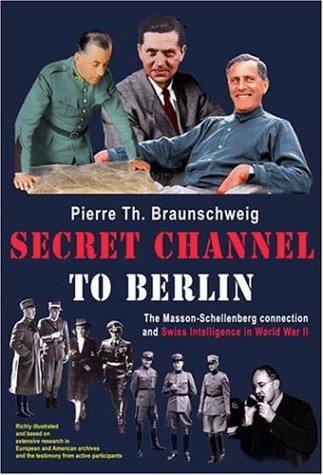
This book focuses on the delicate connection between the head of Swiss Intelligence, Colonel Roger Masson, and the German Chief of Espionage, SS General Walter Schellenberg. The author had access to hitherto inaccessible documents, including newly discovered material in American archives, to fully illuminate this secret connection for the first time. The book also includes surprising new details about the alarming military threats Switzerland faced in March 1943. Masson's extraordinary secret channel to Berlin was not, of course, the only Swiss intelligence operation during the war. Braunschweig outlines in detail the gradual buildup, tasks and functions of Swiss Intelligence during World War II. He furthermore describes conflicts between Swiss Intelligence and the Federal government in Bern and within the Intelligence service itself. During World War II, Switzerland was famous as a center of spies and espionage fielded by Allies and Axis alike. Less has been known, however, about Switzerland's own Intelligence activities, including its secret sources in Hitler's councils and its counterespionage program at home. With this intensely researched, scholarly, yet exciting book, that gap in the history of wartime Intelligence operations has been filled. PIERRE-TH. BRAUNSCHWEIG earned a Ph.D. in history from the University of Bern and later served as an assistant to Hans Senn, the Chief of Staff of the Swiss Army. He is a member of the United States Strategic Institute in Washinton DC, the International Institute for Strategic Studies in London, and the National Intelligence Study Center in Washington.

Spying for Wellington: British Military Intelligence in the Peninsular War

Huw J. Davies

unrated
Read Intel history Advanced intel Espionage Intel history Strategy / theory ISBN 9780806161730

University of Oklahoma Press · Nov 08, 2018

Intelligence is often the critical factor in a successful military campaign. This was certainly the case for Arthur Wellesley, the Duke of Wellington, in the Peninsular War. In this book, author Huw J. Davies offers the first full account of the scope, complexity, and importance of Wellington’s intelligence department, describing a highly organized, multifaceted series of networks of agents and spies throughout Spain and Portugal—an organization that is at once a microcosm of British intelligence at the time and a sophisticated forebear to intelligence developments in the twentieth century. Spying for Wellington shows us an organization that was, in effect, two parallel networks: one made up of Foreign Office agents “run” by British ambassadors in Spain and Portugal, the other comprising military spies controlled by Wellington himself. The network of agents supplied strategic intelligence, giving the British army advance warning of the arrival, destinations, and likely intentions of French reinforcements. The military network supplied operational intelligence, which confirmed the accuracy of the strategic intelligence and provided greater detail on the strengths, arms, and morale of the French forces. Davies reveals how, by integrating these two forms of intelligence, Wellington was able to develop an extremely accurate and reliable estimate of French movements and intentions not only in his own theater of operations but also in other theaters across the Iberian Peninsula. The reliability and accuracy of this intelligence, as Davies demonstrates, was central to Wellington’s decision-making and, ultimately, to his overall success against the French. Correcting past, incomplete accounts, this is the definitive book on Wellington’s use of intelligence. As such, it contributes to a clearer, more comprehensive understanding of Wellington at war and of his place in the history of British military intelligence.

Strategy for Defeat: The Luftwaffe 1933-1945

Williamson Murray

unrated
Read Military history Logistics WWII Air power Logistics Strategy / theory ISBN 9780160021602

United States Government Printing Office · 1983

A penetrating and powerfully presented explanation of the successes and failures of the German air force in World War II. "Authoritative and thorough . . . an interesting and thought provoking book of real value to historians and military thinkers."--RUSI Journal.

Swarming and the Future of Conflict

John Arquilla

unrated
Read Advanced intel Strategy / theory ISBN 0833028855

RAND · 2000

Swarming is a seemingly amorphous, but deliberately structured, coordinated, strategic way to perform military strikes from all directions. It employs a sustainable pulsing of force and/or fire that is directed from both close-in and stand-off positions. It will work best—perhaps it will only work—if it is designed mainly around the deployment of myriad, small, dispersed, networked maneuver units. This calls for an organizational redesign—involving the creation of platoon-like pods joined in company-like clusters—that would keep but retool the most basic military unit structures. It is similar to the corporate redesign principle of flattening, which often removes or redesigns middle layers of management. This has proven successful in the ongoing revolution in business affairs and may prove equally useful in the military realm.

The Accidental Guerrilla: Fighting Small Wars in the Midst of a Big One

David Kilcullen

unrated
Read Advanced intel GWOT Guerrilla / COIN Middle East Intel history Strategy / theory ISBN 9780195368345

Oxford University Press · 2009

David Kilcullen is one of the world's most influential experts on counterinsurgency and modern warfare. A Senior Counterinsurgency Advisor to General David Petraeus in Iraq, his vision of war dramatically influenced America's decision to rethink its military strategy in Iraq and implement "the surge." Now, in The Accidental Guerrilla , Kilcullen provides a remarkably fresh perspective on the War on Terror. Kilcullen takes us "on the ground" to uncover the face of modern warfare, illuminating both the big global war (the "War on Terrorism") and its relation to the associated "small wars" across the Iraq, Afghanistan, the Philippines, Indonesia, Thailand, Chechnya, Pakistan and North Africa. Kilcullen sees today's conflicts as a complex pairing of contrasting local social networks and worldwide movements; traditional and postmodern culture; local insurgencies seeking autonomy and a broader pan-Islamic campaign. He warns that America's actions in the war on terrorism have tended to conflate these trends, blurring the distinction between local and global struggles and thus enormously complicating our challenges. Indeed, the US had done a poor job of applying different tactics to these very different situations, continually misidentifying insurgents with limited aims and legitimate grievances (whom he calls "accidental guerrillas") as part of a coordinated worldwide terror network. We must learn how to disentangle these strands, develop strategies that deal with global threats, avoid local conflicts where possible, and win them where necessary. Colored with gripping battlefield experiences that range from the jungles and highlands of Southeast Asia to the mountains of the Afghanistan-Pakistan border to the dusty towns of the Middle East, The Accidental Guerrilla will, quite simply, change the way we think about war. This much anticipated book will be a must read for everyone concerned about the war on terror.

The Art and Science of Military Deception (Artech House Intelligence and Information Operations)

Hy Rothstein

unrated
Read Basic intel Advanced intel Military history Intel history Technical warfare Strategy / theory ISBN 9781608075515

Artech House Publishers · 2013

It is said that deception among people in a civilized society is something to be loathed even though it seems to be part of human nature; but deception in war is a virtue. This title provides the reader with sufficient knowledge to pursue General Eisenhower's vision for the proper role of deception in support of the national interest.

The Battle of Guadalcanal: Land and Sea Warfare in the South Pacific (Graphic Battles of World War II)

Larry Hama

unrated
Read Military history Logistics WWII Logistics Strategy / theory ISBN 9781404274266

Rosen Publishing Group · 2006

America’s “island hopping” strategy to inch closer and closer to the Japanese mainland was kicked into high gear after the Allied victory on and around the island of Guadalcanal in the southern Solomon Islands in early 1943. The six-month campaign was the first important combined arms Allied victory in the Pacific, putting Japan on the defensive for the rest of the war, resulting in repeated victories for America and its allies, until the Japan’s surrender in August 1945.

The German Air War in Russia

Richard R. Muller

unrated
Read Advanced intel Military history Logistics WWII Air power Russia / USSR Logistics Strategy / theory ISBN 1877853135

Nautical & Aviation Pub. Co. of America · 1992

Dr. Richard Muller has produced a new interpretation of the longest continous air offensive waged by the Luftwaffe. He delineates the shifts in German air strategy as well as the relationship between operational art, aviation technology, and the strategy of the German air force's general staff.

The Luftwaffe over Germany: Defense of the Reich

Donald Caldwell

unrated
Read Military history Logistics WWII Air power Russia / USSR Logistics Strategy / theory ISBN 1853677124

GREENHILL · 2007

The Luftwaffe over Germany tells the story of one of the longest and most intense air battles in history. The daylight air struggles over Germany during World War II involved thousands of aircraft, dozens of units, and hundreds of aerial engagements. Until now, there has been no single book that covers the complete story, from the highest levels of air strategy to the individual tales of Fw 190s, Bf 109s and Me 262s in air combat against the American bomber streams. This work explores the German air defense system until its collapse in 1945. It examines the detrimental effect of Luftwaffe theory and doctrine on the German air arms ability to defend the homeland once the Allied Combined Bomber Offensive began in earnest. The hard-pressed Luftwaffe leadership attempted to cobble together an air-defense network while at the same time tending to the combat fronts in Russia and the Mediterranean. Units developed specialized tactics and weapons for dealing with heavily defended bomber formations, while senior commanders sought to construct an elaborate command and control system integrating radar, observers, anti-aircraft guns, and fighters. By mid-1944, they had lost the battle - but had exacted a terrible price from the Americans in the process. The product of a ten-year collaboration between two noted Luftwaffe historians, this work fills a major gap in the literature of World War II. The authors have examined original war diaries, logbooks, doctrine manuals, after-action reports, and interviews with many combat veterans to produce a richly detailed account. Illustrated with nearly two hundred photographs, as well as new maps and diagrams, Luftwaffe Over Germany is certain to become the standard work on the subject.

The Pentagon's Brain: An Uncensored History of DARPA, America's Top-Secret Military Research Agency

Annie Jacobsen

unrated
To read Cold War Espionage Strategy / theory ISBN 9780316371766

2015

The definitive history of DARPA, the Defense Advanced Research Project Agency, from the author of the New York Times bestseller Area 51 No one has ever written the history of the Defense Department's most secret, most powerful, and most controversial military science R&D agency. In the first-ever history about the organization, New York Times bestselling author Annie Jacobsen draws on inside sources, exclusive interviews, private documents, and declassified memos to paint a picture of DARPA, or "the Pentagon's brain," from its Cold War inception in 1958 to the present. This is the book on DARPA--a compelling narrative about this clandestine intersection of science and the American military and the often frightening results.

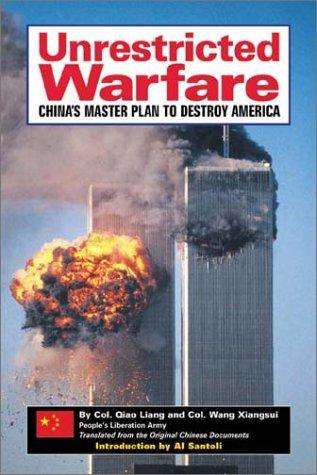
Unrestricted Warfare: China's Master Plan to Destroy America

Qiao Liang

unrated
Read Advanced intel Military history Logistics Technical warfare Espionage GWOT Cyber China Logistics Strategy / theory Economics Orthodox / theology ISBN 9780971680722

Pan American Publishing Company · August 22, 2002

As incredible as it may be to believe, three years before the Sept. 11 bombing of the World Trade Center a Chinese military manual titled Unrestricted Warfare touted such an attack – suggesting it would be difficult for the U.S. military to cope with. Here is an excerpt from Unrestricted "Whether it be the intrusions of hackers, a major explosion at the World Trade Center, or a bombing attack by bin Laden, all of these greatly exceed the frequency bandwidths understood by the American military..." Surprisingly, Osama bin Laden is mentioned frequently in this book. Now NewsMax.com is making the CIA translation of this shocking book available to all Americans. On Sept. 11, 2001, Americans and the world witnessed one of the most horrific acts ever to take place on American soil. Our media and government were quick to declare the acts of that day as simply terrorism by a nationless group known as al-Qaeda. In reading China’s military manual Unrestricted Warfare, you will learn that the events of Sept. 11 were not a random act perpetrated by independent agents. Instead, Chinese military planners believe that terrorism is just one of the many tools at the hands of nations and their terrorist allies to wage total war against the United States. You will be surprised to · The two PLA colonels who authored Unrestricted Warfare have been hailed as heroes in China since Sept. 11 · The Chinese state-run propaganda machine is cashing in on the terror attacks ... producing books, films and video games glorifying the strikes as a humbling blow against an arrogant nation. · Chinese Communist Party officials are saying that President Jiang Zemin has obsessively and gleefully watched and re-watched pictures of the aircraft crashing into the World Trade Center. · The CIA’s own translation agency reported that this book identifies the U.S. as China’s main enemy, and details how a weak nation can destroy America using unorthodox attacks – like the 9-11 attacks. · China is preparing itself and encouraging others to engage the U.S. in total war. The book is chock full of plans and strategies, from using computers, to smuggling illegal immigrants, to manipulating the stock markets, to influencing the U.S. media, to using weapons of mass destruction – all to destroy America. Recent press reports indicate that China has assisted and continues to assist militarily and economically the Taliban and al-Qaeda – even after Sept. 11. The doctrine of total war outlined in Unrestricted Warfare clearly demonstrates that the People’s Republic of China is preparing to confront the United States and our allies by conducting "asymmetrical" or multidimensional attacks on almost every aspect of our social, economic and political life. The media and Congress are keeping a lid on this book because of the implications of U.S.-China economic and trade relations. But now you can bypass them by getting a copy yourself!

Worst Enemy: The Reluctant Transformation of the American Military

John Arquilla

unrated
Read Military history GWOT Naval Armor Guerrilla / COIN Strategy / theory ISBN 9781566637503

320 · May 25, 2008

Despite staggering defense costs, the U.S. military has not learned how to confront terrorist and insurgent networks. Traditional thinking and special interests have concentrated on potentially outdated systems, like aircraft carriers and heavily armored vehicles. Our ability to wage irregular warfare against networked forces has been stunted. Meanwhile other nations have innovated and developed techniques that will surpass the capabilities of the hidebound American armed forces.... Worst Enemy offers an inside analysis of the events that have derailed our efforts to transform the nation's military into a leaner, lighter, and much more "networked" force. Mr. Arquilla places these events in historical context and assesses Donald Rumsfeld's role as secretary of defense of the post-9/11 era.