S2 Search · Reading list

S2 Actual reading list

Books from S2 Actual on Goodreads, organized by his shelves and topic buckets (intel lists, military history, logistics, etc.). Metadata filled via Open Library.

Not official S2 Underground. Independent fan index — not affiliated with or endorsed by S2. Official hub: linktr.ee/S2_underground. S2 materials are CC BY-NC-SA 4.0.

S2 topic buckets (Goodreads)

Subjects & genres

12 books · Basic intel · subject Biography

Agent Zigzag: A True Story of Nazi Espionage, Love, and Betrayal

Ben Macintyre

★★★★★
Read Basic intel Intel history WWII Espionage Intel history Biography ISBN 9780307353405

Harmony Books · 2007

Eddie Chapman was a charming criminal, a con man, and a philanderer. He was also one of the most remarkable double agents Britain has ever produced. Inside the traitor was a man of loyalty; inside the villain was a hero. The problem for Chapman, his spymasters, and his lovers was to know where one persona ended and the other began. In 1941, after training as a German spy in occupied France, Chapman was parachuted into Britain with a revolver, a wireless, and a cyanide pill, with orders from the Abwehr to blow up an airplane factory. Instead, he contacted MI5, the British Secret Service. For the next four years, Chapman worked as a double agent, a lone British spy at the heart of the German Secret Service who at one time volunteered to assassinate Hitler for his countrymen. Crisscrossing Europe under different names, all the while weaving plans, spreading disinformation, and, miraculously, keeping his stories straight under intense interrogation, he even managed to gain some profit and seduce beautiful women along the way. The Nazis feted Chapman as a hero and awarded him the Iron Cross. In Britain, he was pardoned for his crimes, becoming the only wartime agent to be thus rewarded. Both countries provided for the mother of his child and his mistress. Sixty years after the end of the war, and ten years after Chapman’s death, MI5 has now declassified all of Chapman’s files, releasing more than 1,800 pages of top secret material and allowing the full story of Agent Zigzag to be told for the first time. A gripping story of loyalty, love, and treachery, Agent Zigzag offers a unique glimpse into the psychology of espionage, with its thin and shifting line between fidelity and betrayal.
Eastern Approaches

Fitzroy Maclean

★★★★★
Read Basic intel Intel history Biographies WWII Cold War Special ops Russia / USSR Middle East Biography Orthodox / theology ISBN 9780140132717

Penguin Global · September 1, 2004

70th Anniversary Edition with a New Foreword by Sunday Times Bestselling Author Simon Sebag Montefiore 'A classic' Observer | 'A legend' Washington Post | 'The best book you will read this year' Colonel Tim Collins Posted to Moscow as a young diplomat before the Second World War, Fitzroy Maclean travelled widely, with or without permission, in some of the wildest and remotest parts of the Soviet Union, then virtually closed to foreigners. In 1942 he fought as a founder member of the SAS in North Africa. There Maclean specialised in hair-raising commando raids behind enemy lines, including the daring and outrageous kidnapping of the German Consul in Axis-controlled Iraq. In 1943 he parachuted into German-occupied Yugoslavia as Winston Churchill's personal representative to Josip Broz Tito and remained there until 1945, all enemy attempts to capture him proving unsuccessful. Eastern Approaches is Maclean's classic, gripping account of the sybaritic delights of diplomatic life, the thrill of remote travel in the then-forbidden zones of Central Asia, and the violence and adventure of world-changing tours in North Africa and Yugoslavia. Maclean is the original British action hero and this is blistering reading. 'This book literally changed my life' Simon Sebag Montefiore 'A man of daring character' Winston Churchill 'An absorbing mixture of military adventure, political judgement, urbane wit, cool humour and surprising incident' Financial Times 'One of the bravest men in the British army, and one of the funniest' Ben Macintyre 'Entertaining, important, the model for James Bond' New York Times

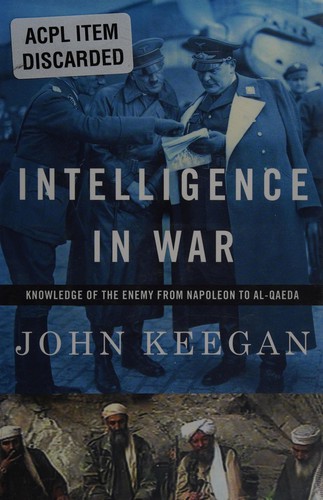
Intelligence in War: Knowledge of the Enemy from Napoleon to Al-Qaeda

John Keegan

★★★★★
Read Basic intel Intel history WWII Espionage GWOT Naval Air power Intel history Biography ISBN 0375400532

Knopf · 2003

In fiction, the spy is a glamorous figure whose secrets make or break peace, but, historically, has intelligence really been a vital step to military victories? In this breakthrough study, the preeminent war historian John Keegan goes to the heart of a series of important conflicts to develop a powerful argument about military intelligence. In his characteristically wry and perceptive prose, Keegan offers us nothing short of a new history of war through the prism of intelligence. He brings to life the split-second decisions that went into waging war before the benefit of aerial surveillance and electronic communications. The English admiral Horatio Nelson was hot on the heels of Napoleon’s fleet in the Mediterranean and never knew it, while Stonewall Jackson was able to compensate for the Confederacy’s disadvantage in firearms and manpower with detailed maps of the Appalachians. In the past century, espionage and decryption have changed the face of the Japanese surprise attack at the Battle of the Midway was thwarted by an early warning. Timely information, however, is only the beginning of the surprising and disturbing aspects of decisions that are made in war, where brute force is often more critical. Intelligence in War is a thought-provoking work that ranks among John Keegan’s finest achievements.

Nancy Wake

Peter FitzSimons

★★★★★
Read Biographies Basic intel Intel history WWII Espionage Special ops Intel history Biography ISBN 9780732269197

HarperCollins Publishers · 28 January 2001

'Freedom is the only thing worth living for. While I was doing that work I used to think that it didn't matter if I died, because without freedom there was no point in living'. Nancy Wake In the early 1930's, Nancy Wake was a young woman enjoying a bohemian life in Paris. By the end of the Second World War she was the Gestapo's most wanted person. As a naive, young journalist, Nancy Wake witnessed a horrific scene of Nazi violence in a Viennese street. From that moment, she declared that she would do everything in her power to rid Europe of the Nazi presence. What began as a courier job here and there, became a highly successful escape network for Allied soldiers, perfectly camouflaged by Nancy's high-society life in Marseille. Her network was soon so successful - and so notorious - that he had to flee France to escape the Gestapo who had dubbed her 'the white mouse' for her knack of slipping through its traps. But Nancy was a passionate enemy of the Nazis and refused to stay away. She trained with the British Special Operations Executive and parachuted back into France behind enemy lines. Again, this singular woman rallied to the cause, helping to lead a powerful underground fighting force, the Maquis. Supplying weapons and training the civilian Maquis, organising Allied parachute drops, cycling four hundred kilometres across a mountain range to find a new transmitting radio - nothing seemed too difficult in her fight against the Nazis. Peter FitzSimons reveals Nancy Wake's compelling story, a tale of an ordinary woman doing extraordinary things.

Operation Mincemeat: How a Dead Man and a Bizarre Plan Fooled the Nazis and Assured an Allied Victory

Ben Macintyre

★★★★★
Read Basic intel Intel history WWII Espionage Naval Biography Orthodox / theology ISBN 9780747598688

Bloomsbury · 2010

In 1943, from a windowless London basement office, two intelligence officers conceived a plan that was both simple & complicated—Operation Mincemeat. Purpose? To deceive the Nazis into thinking the Allies were planning to attack Europe by way of Greece or Sardinia, rather than Sicily, as the Nazis had assumed & the Allies ultimately chose. Charles Cholmondeley of MI5 and the British naval intelligence officer Ewen Montagu were very different. Cholmondeley was a dreamer seeking adventure. Montagu was an aristocratic, detail-oriented barrister. A perfect team, they created an ingenious plan: equip a corpse with secret (but false) papers concerning the invasion, then drop it off the coast of Spain where German spies would hopefully take the bait. The idea was approved by British intelligence officials, including Ian Fleming (007's creator). Winston Churchill believed it might ring true to the Axis & help bring victory. Filled with spies, double agents, rogues, heroes & a corpse, the story of Operation Mincemeat reads like an international thriller. Unveiling never-before-released material, Macintyre goes into the minds of intelligence officers, their moles & spies, & the German Abwehr agents who suffered the “twin frailties of wishfulness & yesmanship.” He weaves together the eccentric personalities of Cholmondeley & Montagu & their improbable feats into an adventure that saved thousands & paved the way for the conquest of Sicily.

Seven Pillars of Wisdom: A Triumph

T.E. Lawrence

★★★★★
Read Intel history Basic intel WWI Espionage Middle East Biography ISBN 0385418957

Anchor Books · 1991

In his classic book, T.E. Lawrence—forever known as Lawrence of Arabia—recounts his role in the origin of the modern Arab world. At first a shy Oxford scholar and archaeologist with a facility for languages, he joined and went on to lead the Arab revolt against the Ottoman Turks while the rest of the world was enmeshed in World War I. With its richly detailed evocation of the land and the people Lawrence passionately believed in, its incisive portraits of key players, from Faisal ibn Hussein, the future Hashemite king of Syria and Iraq, to General Sir Edmund Allenby and other members of the British imperial forces, The Seven Pillars of Wisdom is an indispensible primary historical source. It helps us to understand today’s Middle East, while giving us thrilling accounts of military exploits (including the liberation of Aqaba and Damascus), clandestine activities, and human foibles.

Storm of Steel

Ernst Jünger

★★★★★
Read Advanced intel Basic intel Military history WWI Biography ISBN 9780141186917

Penguin Books Ltd · June 3, 2004

A memoir of astonishing power, savagery, and ashen lyricism, 'Storm of Steel' illuminates not only the horrors but also the fascination of total war, seen through the eyes of an ordinary German soldier. Young, tough, patriotic, but also disturbingly self-aware, Jünger exulted in the Great War, which he saw not just as a great national conflict, but more importantly as a unique personal struggle. Leading raiding parties, defending trenches against murderous British incursions, simply enduring as shells tore his comrades apart, Jünger kept testing himself, braced for the death that will mark his failure. Published shortly after the war's end, 'Storm of Steel' was a worldwide bestseller and can now be rediscovered through Michael Hofmann's brilliant new translation.

The Spy and the Traitor: The Greatest Espionage Story of the Cold War

Ben Macintyre

★★★★★
Read Basic intel Intel history Cold War Espionage Nuclear Russia / USSR Biography ISBN 9780771060335

Signal · Sep 18, 2018

If anyone could be considered a Russian counterpart to the infamous British double-agent Kim Philby, it was Oleg Gordievsky. The son of two KGB agents and the product of the best Soviet institutions, the savvy, sophisticated Gordievsky grew to see his nation’s communism as both criminal and philistine. He took his first posting for Russian intelligence in 1968 and eventually became the Soviet Union’s top man in London, but from 1973 on he was secretly working for MI6. For nearly a decade, as the Cold War reached its twilight, Gordievsky helped the West turn the tables on the KGB, exposing Russian spies and helping to foil countless intelligence plots, as the Soviet leadership grew increasingly paranoid at the United States’s nuclear first-strike capabilities and brought the world closer to the brink of war. Desperate to keep the circle of trust close, MI6 never revealed Gordievsky’s name to its counterparts in the CIA, which in turn grew obsessed with figuring out the identity of Britain’s obviously top-level source. Their obsession ultimately doomed Gordievsky: the CIA officer assigned to identify him was none other than Aldrich Ames, the man who would become infamous for secretly spying for the Soviets. Unfolding the delicious three-way gamesmanship between America, Britain, and the Soviet Union, and culminating in the gripping cinematic beat-by-beat of Gordievsky’s nail-biting escape from Moscow in 1985, Ben Macintyre has crafted an electrifying account of an international hero. Like the greatest novels of John le Carré, The Spy and the Traitor brings readers deep into a world of treachery and betrayal, where the lines bleed between the personal and the professional, and one man’s hatred of communism had the power to change the future of nations.

No cover · Amazon

Barren SEAD: USAF Defense Suppression Doctrine, 1953-1972

James L. Young Jr.

★★★★
Read Basic intel Military history Intel history Technical warfare Vietnam Cold War Special ops Naval Air power Cyber Biography Strategy / theory

Since 1972, the United States Air Force has argued that its operations against North Vietnam were unsuccessful primarily through a combination of civilian interference and poor strategic choices. Often citing the “success” of Operation Linebacker II as an example of what might have been had its leaders been given free rein, for almost fifty years the Air Force has maintained that its proper employment is the key to winning America’s wars. In Barren SEAD, award winning historian James L. Young Jr. propagates a different Instead of being a sign of what the Air Force was capable of, Linebacker II was a bitter failure that starkly outlined the USAF’s limitations. Furthermore, the meddling of the Johnson and Nixon Administrations played a minor role in this outcome. The USAF's defeat was not brought about by civilian meddling, but resulted from Air Force leaders’ refusal to develop a Suppression of Enemy Air Defenses (SEAD) doctrine from 1953-1972. Relying primarily on Air Force archival documents, memoirs, and contemporary doctrinal publications, Dr. Young illustrates just how dangerous the Air Force’s inability to nurture its SEAD capability was during this period of the Cold War. James L. Young Jr. holds a doctorate in U.S. History from Kansas State University and is a graduate of the United States Military Academy. Barren SEAD is his first non-fiction book. Previously he has won the United States Naval Institute's 2016 Cyberwarfare Essay Contest, runner up in the 2011 James Adams Cold War Essay Contest, and has had an essay selected by the U.S. Naval Heritage Command for its professional reading list. Dr. Young's other professional articles can be found in Armor Magazine, The Journal of Military History, and Proceedings. For those who prefer fiction, Dr. Young also writes alternate history (Usurper's War series / Phases of Mars anthologies) and military science fiction (Vergassy Universe).

One Bullet Away: The Making of a Marine Officer

Nathaniel Fick

★★★★
Read Basic intel Military history Vietnam GWOT Middle East Biography ISBN 9780618773435

Mariner Books · September 7, 2006

If the Marines are “the few, the proud,” Recon Marines are the fewest and the proudest. Nathaniel Fick’s career begins with a hellish summer at Quantico, after his junior year at Dartmouth. He leads a platoon in Afghanistan just after 9/11 and advances to the pinnacle—Recon— two years later, on the eve of war with Iraq. His vast skill set puts him in front of the front lines, leading twenty-two Marines into the deadliest conflict since Vietnam. He vows to bring all his men home safely, and to do so he’ll need more than his top-flight education. Fick unveils the process that makes Marine officers such legendary leaders and shares his hard-won insights into the differences between military ideals and military practice, which can mock those ideals. In this deeply thoughtful account of what it’s like to fight on today’s front lines, Fick reveals the crushing pressure on young leaders in combat. Split-second decisions might have national consequences or horrible immediate repercussions, but hesitation isn’t an option. One Bullet Away never shrinks from blunt truths, but ultimately it is an inspiring account of mastering the art of war.

Night Letters: Gulbuddin Hekmatyar and the Afghan Islamists Who Changed the World

Chris Sands

unrated
Read Advanced intel Basic intel Biographies Intel history Military history GWOT Guerrilla / COIN Russia / USSR Intel history Biography Strategy / theory ISBN 9781787381964

C. Hurst and Company (Publishers) Limited · 2019

In 1969, several young men met on a rainy night in Kabul to form an Islamist student group. Their aim was laid out in a simple typewritten statement: to halt the spread of Soviet and American influence in Afghanistan. They went on to change the world. 'Night Letters' tells the extraordinary story of the group’s most notorious member, Gulbuddin Hekmatyar, and the guerrilla organisation he came to lead, Hizb-e Islami. By the late 1980s, tens of thousands were drawn to Hekmatyar’s vision of a radical Islamic state that would sow unrest from Kashmir to Jerusalem. His doctrine of violent global jihad culminated in 9/11 and the birth of ISIS, yet he never achieved his dream of ruling Afghanistan. The peace deal he signed with Kabul in 2016 was yet another controversial twist in an astonishing life. Sands and Qazizai delve into the secret history of Hekmatyar and Hizb-e Islami: their wars against Russian and American troops, and their bloody and bitter feuds with domestic enemies. Based on hundreds of exclusive interviews carried out across the region and beyond, this is the definitive account of the most important, yet poorly understood, international Islamist movement of the last fifty years.

No cover · Amazon

Team of Rivals: The Political Genius of Abraham Lincoln

Doris Kearns Goodwin

unrated
Read Basic intel Military history Biographies Biography US Civil War

Winner of the Lincoln Prize Acclaimed historian Doris Kearns Goodwin illuminates Lincoln's political genius in this highly original work, as the one-term congressman and prairie lawyer rises from obscurity to prevail over three gifted rivals of national reputation to become president. On May 18, 1860, William H. Seward, Salmon P. Chase, Edward Bates, and Abraham Lincoln waited in their hometowns for the results from the Republican National Convention in Chicago. When Lincoln emerged as the victor, his rivals were dismayed and angry. Throughout the turbulent 1850s, each had energetically sought the presidency as the conflict over slavery was leading inexorably to secession and civil war. That Lincoln succeeded, Goodwin demonstrates, was the result of a character that had been forged by experiences that raised him above his more privileged and accomplished rivals. He won because he possessed an extraordinary ability to put himself in the place of other men, to experience what they were feeling, to understand their motives and desires. It was this capacity that enabled Lincoln as president to bring his disgruntled opponents together, create the most unusual cabinet in history, and marshal their talents to the task of preserving the Union and winning the war. We view the long, horrifying struggle from the vantage of the White House as Lincoln copes with incompetent generals, hostile congressmen, and his raucous cabinet. He overcomes these obstacles by winning the respect of his former competitors, and in the case of Seward, finds a loyal and crucial friend to see him through. This brilliant multiple biography is centered on Lincoln's mastery of men and how it shaped the most significant presidency in the nation's history.