S2 Search · Reading list

S2 Actual reading list

Books from S2 Actual on Goodreads, organized by his shelves and topic buckets (intel lists, military history, logistics, etc.). Metadata filled via Open Library.

Not official S2 Underground. Independent fan index — not affiliated with or endorsed by S2. Official hub: linktr.ee/S2_underground. S2 materials are CC BY-NC-SA 4.0.

S2 topic buckets (Goodreads)

Subjects & genres

6 books · Basic intel · subject US Civil War

Out of Nowhere: A History of the Military Sniper

Martin Pegler

★★★★
Read Military history Technical warfare Advanced intel Basic intel Vietnam Russia / USSR US Civil War Revolution ISBN 9781846031403

Osprey Publishing · October 31, 2006

From the American Revolution to World War Two, the history of the military combat marksman is one of indifference, unpreparedness and cost cutting. Despite the proven effectiveness of the rifleman in battle, the sniper in the 20th century has been regarded as little more than a paid assassin, whose life if captured was forfeit. However, since the Vietnam War the undeniably effective use of such men in combat means that the value of the sniper has gradually become more appreciated by the military, and their prominence on the modern battlefield has increased significantly. In the 21st century they are now regarded as one of the most vital battlefield specialists. Illustrated throughout with colour and black and white photographs, this is a chronological study of snipers, detailing their evolution, training, weaponry and actions. There are also unique contributions from the men and women whose skill and extraordinary courage have made them the most greatly feared specialist in warfare. From the Foreword by Harry Furness, decorated Sniper-Sergeant, British Army Wold War II We will always need to deploy our new age warrior, that highly trained specialist, the military sniper.... Factual books on snipers are few and far between, so I find it refreshing and timely that this new book has been published which will provide the reader with the true facts about these unique soldiers; and readers of this excellent, deeply researched book will now be more knowledgeable about a rarely discussed subject. You have to dig deep to bypass the many half truths in order to reach any conclusion as to why manking continues to wage wars that kill off the cream of our young society, but it might be said that if it is the fate of a soldier to die in battle, then a sniper's swift killing bullet must be preferable to dying from devastating wounds. Chapter Heads The sniper in perspective. The rifleman emerges 1500-1854. The American Civil War and European wars 1854-1914. The First World War, the watershed 1914-16. The First World War, the fight back 1916-18. Russian sniping 1936-45. The German sniper and the war with Russia 1941-45. The war against Japan 1941-45. The war in Western Europe 1940-45. Limited wars 1945-85. Vietnam, America's nemesis. Into the 21st century.

No cover · Amazon

Black Flags: The Rise of ISIS

Joby Warrick

★★★☆☆
Read Basic intel Intel history Espionage GWOT Guerrilla / COIN Middle East Intel history US Civil War

Pulitzer Prize-winning reporter Joby Warrick reveals how the strain of militant Islam now raising its banner across Iraq and Syria spread from a remote Jordanian prison with the unwitting aid of American military intervention.      When he succeeded his father in 1999, King Abdullah of Jordan released a batch of political prisoners in the hopes of smoothing his transition to power. Little did he know that among those released was Abu Musab al-Zarqawi, a man who would go on to become a terrorist mastermind too dangerous even for al-Qaeda and give rise to an Islamist movement bent on dominating the Middle East.      Zarqawi began by directing hotel bombings and assassinations in Jordan from a base in northern Iraq, but it was the American invasion of that country in 2003 that catapulted him to the head of a vast insurgency. By identifying him as the link between Saddam and bin Laden, the CIA inadvertently created a monster. Like-minded radicals saw him as a hero resisting the infidel occupiers and rallied to his cause. Their wave of brutal beheadings and suicide bombings continued for years until Jordanian intelligence provided the Americans with the crucial intelligence needed to eliminate Zarqawi in a 2006 airstrike.      But his movement endured, first called al-Qaeda in Iraq, then renamed Islamic State of Iraq and Syria, or ISIS, seeking refuge in unstable, ungoverned pockets on the Iraq-Syria border. And as the Syrian civil war broke out in 2011, ISIS seized its chance to pursue Zarqawi's dream of a sweeping, ultra-conservative Islamic caliphate.       Drawing on unique access to CIA and Jordanian sources, Joby Warrick weaves together heart-pounding, moment-by-moment operational details with overarching historical perspectives to reveal the long trajectory of today's most dangerous Islamic extremist threat. From the Hardcover edition.

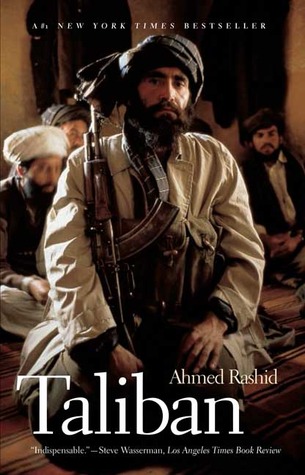
Taliban: Militant Islam, Oil and Fundamentalism in Central Asia

Ahmed Rashid

★★★☆☆
Read Basic intel Intel history GWOT Russia / USSR Middle East US Civil War ISBN 0300089023

Yale Nota Bene · 2001

Shrouding themselves and their aims in deepest secrecy, the leaders of the Taliban movement control Afghanistan with an inflexible, crushing fundamentalism. The most extreme and radical of all Islamic organizations, the Taliban inspires fascination, controversy, and especially fear in both the Muslim world and the West. Correspondent Ahmed Rashid brings the shadowy world of the Taliban into sharp focus in this enormously interesting and revealing book. It is the only authoritative account of the Taliban and modern day Afghanistan available to English language readers. Based on his experiences as a journalist covering the civil war in Afghanistan for twenty years, traveling and living with the Taliban, and interviewing most of the Taliban leaders since their emergence to power in 1994, Rashid offers unparalleled firsthand information. He explains how the growth of Taliban power has already created severe instability in Russia, Iran, Pakistan, and five Central Asian republics. He describes the Taliban's role as a major player in a new "Great Game"—a competition among Western countries and companies to build oil and gas pipelines from Central Asia to Western and Asian markets. The author also discusses the controversial changes in American attitudes toward the Taliban—from early support to recent bombings of Osama Bin Laden's hideaway and other Taliban-protected terrorist bases—and how they have influenced the stability of the region.

The Bottom Billion: Why the Poorest Countries Are Failing and What Can Be Done About It

Paul Collier

★★★☆☆
Read Basic intel Economics US Civil War ISBN 9780195311457

Oxford University Press · 2007

In the universally acclaimed and award-winning The Bottom Billion, Paul Collier reveals that fifty failed states--home to the poorest one billion people on Earth--pose the central challenge of the developing world in the twenty-first century. The book shines much-needed light on this group of small nations, largely unnoticed by the industrialized West, that are dropping further and further behind the majority of the world's people, often falling into an absolute decline in living standards. A struggle rages within each of these nations between reformers and corrupt leaders--and the corrupt are winning. Collier analyzes the causes of failure, pointing to a set of traps that ensnare these countries, including civil war, a dependence on the extraction and export of natural resources, and bad governance. Standard solutions do not work, he writes; aid is often ineffective, and globalization can actually make matters worse, driving development to more stable nations. What the bottom billion need, Collier argues, is a bold new plan supported by the Group of Eight industrialized nations. If failed states are ever to be helped, the G8 will have to adopt preferential trade policies, new laws against corruption, new international charters, and even conduct carefully calibrated military interventions. Collier has spent a lifetime working to end global poverty. In The Bottom Billion, he offers real hope for solving one of the great humanitarian crises facing the world today.

No cover · Amazon

Team of Rivals: The Political Genius of Abraham Lincoln

Doris Kearns Goodwin

unrated
Read Basic intel Military history Biographies Biography US Civil War

Winner of the Lincoln Prize Acclaimed historian Doris Kearns Goodwin illuminates Lincoln's political genius in this highly original work, as the one-term congressman and prairie lawyer rises from obscurity to prevail over three gifted rivals of national reputation to become president. On May 18, 1860, William H. Seward, Salmon P. Chase, Edward Bates, and Abraham Lincoln waited in their hometowns for the results from the Republican National Convention in Chicago. When Lincoln emerged as the victor, his rivals were dismayed and angry. Throughout the turbulent 1850s, each had energetically sought the presidency as the conflict over slavery was leading inexorably to secession and civil war. That Lincoln succeeded, Goodwin demonstrates, was the result of a character that had been forged by experiences that raised him above his more privileged and accomplished rivals. He won because he possessed an extraordinary ability to put himself in the place of other men, to experience what they were feeling, to understand their motives and desires. It was this capacity that enabled Lincoln as president to bring his disgruntled opponents together, create the most unusual cabinet in history, and marshal their talents to the task of preserving the Union and winning the war. We view the long, horrifying struggle from the vantage of the White House as Lincoln copes with incompetent generals, hostile congressmen, and his raucous cabinet. He overcomes these obstacles by winning the respect of his former competitors, and in the case of Seward, finds a loyal and crucial friend to see him through. This brilliant multiple biography is centered on Lincoln's mastery of men and how it shaped the most significant presidency in the nation's history.

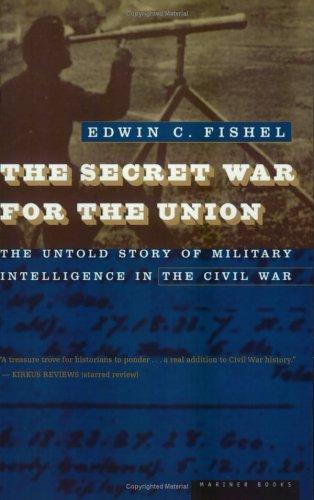
The Secret War For The Union: The Untold Story of Military Intelligence in the Civil War – How Intelligence Shaped Victory, Defeat, and the Decisions of Commanders

Edwin C. Fishel

unrated
Read Basic intel Intel history Espionage Intel history US Civil War ISBN 9780395901366

Mariner Books · June 22, 1998

Most histories of the Civil War explain victory and defeat in terms of the skill of commanders and their troops. Intelligence records disappeared after the war, and thus a critically important element has largely been ignored. Fishel has unearthed substantial collections of such records, and his "intelligence explanation" radically alters history's understanding of the campaigns. The Secret War for the Union is one of the most important Civil War works ever published.