S2 Search · Reading list

S2 Actual reading list

Books from S2 Actual on Goodreads, organized by his shelves and topic buckets (intel lists, military history, logistics, etc.). Metadata filled via Open Library.

Not official S2 Underground. Independent fan index — not affiliated with or endorsed by S2. Official hub: linktr.ee/S2_underground. S2 materials are CC BY-NC-SA 4.0.

S2 topic buckets (Goodreads)

Subjects & genres

9 books · Logistics · subject Armor

No cover · Amazon

Death of the Leaping Horseman: 24 Panzer-Division in Stalingrad 12th August-20th November 1942

Jason D. Mark

★★★★★
Read Military history Logistics WWII Air power Armor Russia / USSR Logistics Intel history

The gripping story of an elite panzer division and its battles in the shattered streets of Stalingrad. In "Death of the Leaping Horseman: 24th Panzer-Division in Stalingrad," the untold story of 24th Panzer-Division's savage fighting on Stalingrad's outskirts - and in the devastated ruins of the city itself - is revealed in a detailed day-by-day account. Beginning in the heady days of the victorious march toward Stalingrad in August 1942, the book follows the Division into Stalingrad's suburbs as it is slowly and inexorably suked into the fiery crucible that was Stalingrad. Panzer losses and casualties increased daily until finally, after three months of draining combat, the Division was reduced to a battlegroup consisting of a couple of panzers and a few hundred men. Woven through official combat reports and entries from the Division's war diaries are gripping accounts from the few remaining veterans - including an Oakleaves winner and several Knight's Cross winners. Contains over 200 photos and 85 maps and aerial photos.
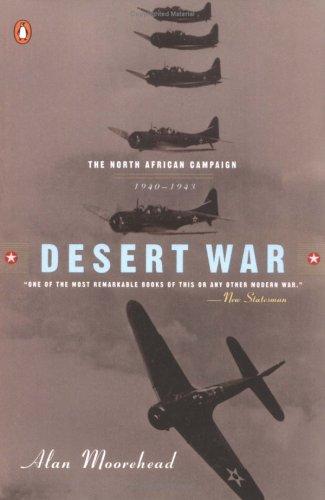
Desert War: The North African Campaign 1940-43

Alan Moorehead

★★★★★
Read Intel history Military history Advanced intel Logistics WWII Armor Logistics Biography ISBN 0140275142

Penguin Books · 2001

The seminal account of the battle between Montgomery’s Eighth Army and Rommel’s Afrika Corps, amidst the endless harsh wastes of the Western Desert. In 1940, Alan Moorehead was sent to cover the North Africa campaign by the Daily Express, and he followed its dramatic course all the way to 1943. The three books he subsequently wrote about the Desert War – later collected as his ‘African Trilogy’ – were swiftly acclaimed as a classic account of the tussle between Montgomery’s Eighth Army and Rommel’s Afrika Corps, under the beating sun of the Egyptian Sahara's Western Desert. Moorehead was responsible for the celebrated insight that tank battles in the desert are like battles at sea, the lumbering tanks like ships lost in a vast ocean of sand. The New Statesman could not have put it better when it described his achievement with this riveting book: ‘There is something of genius in the breadth and penetration of his vision , which encompasses the whole panorama of war and then narrows it down to the particular: the soldier stubbing out his cigarette before going into action, the expression on a tank commander’s face as he is hit… The story of the African campaigns will go down in history as one of the great epics of mankind, largely thanks to Mr Moorehead’s account.’

No cover · Amazon

Fast Tanks and Heavy Bombers: Innovation in the U.S. Army, 1917-1945

David E. Johnson

★★★★★
Read Basic intel Military history Intel history Logistics WWII Air power Armor Guerrilla / COIN Logistics Strategy / theory

The U.S. Army entered World War II unprepared. In addition, lacking Germany's blitzkrieg approach of coordinated armor and air power, the army was organized to fight two wars: one on the ground and one in the air. Previous commentators have blamed Congressional funding and public apathy for the army's unprepared state. David E. Johnson believes instead that the principal causes were internal: army culture and bureaucracy, and their combined impact on the development of weapons and doctrine. Johnson examines the U.S. Army's innovations for both armor and aviation between the world wars, arguing that the tank became a captive of the conservative infantry and cavalry branches, while the airplane's development was channeled by air power insurgents bent on creating an independent air force. He maintains that as a consequence, the tank's potential was hindered by the traditional arms, while air power advocates focused mainly on proving the decisiveness of strategic bombing, neglecting the mission of tactical support for ground troops. Minimal interaction between ground and air officers resulted in insufficient cooperation between armored forces and air forces. Fast Tanks and Heavy Bombers makes a major contribution to a new understanding of both the creation of the modern U.S. Army and the Army's performance in World War II. The book also provides important insights for future military innovation.

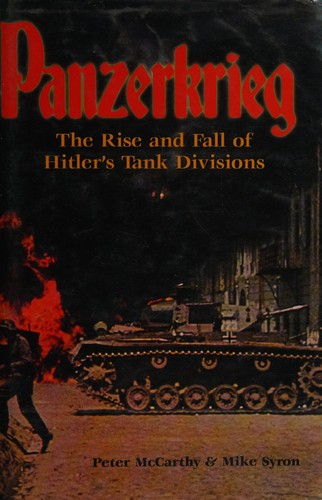
Panzerkrieg: The Rise and Fall of Hitler's Tank Divisions

Peter McCarthy

★★★★★
Read Advanced intel Intel history Logistics Technical warfare Military history WWII Cold War Armor Russia / USSR Logistics Biography ISBN 0786710098

Carroll & Graf Publishers · 2002

The image that defines the Nazis’ Blitzkrieg is that of the Panzerwaffe’s massed columns of tanks sweeping through Europe, all resistance smashed in their wake. The Panzers’ achievements in battle were largely responsible for Germany’s early successes in World War II, and once the tide had turned against the Reich, the Panzers became the backbone of its defense. But the dramatic story of Hitler’s tank divisions is more than one of mere mechanical efficiency. It hangs, too, on those who commanded and fought in them, and believed in their near invincibility. These are the men who come to life in this immensely readable narrative. Great generals like Guderian, Rommel, and Manstein, tank masters like Wittmann and Bake, and inspired commanders like Balck and Bayerlein dominate the story of Panzerkreig. Dispensing with jargon, but including explanatory maps, rare illustrations, and fascinating detail on uniforms, crew members, and the mechanical features of the machines, the authors give a comprehensive overview of all aspects of the subject, both human and technical. They have also benefited from new information available since the opening of Cold War archives. Emerging from the narrative is the whole vast canvas of the war, as it follows the titanic struggles that raged between France’s bocage country, North Africa’s desert wastes, and Russia’s limitless steppes. The development of German fighting vehicles and tactics is fully charted, and the many myths and misconceptions of the Panzerwaffe are exploded. Extensive research, maps, illustrations throughout, reference to the leading participants’ memoirs, and original new conclusions all contribute to this finely measured assessment of the evolution, exploits, and eventual destruction of this superlative fighting force.

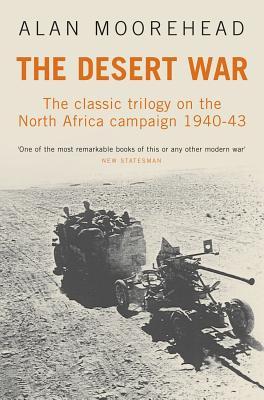
The Desert War Trilogy

Alan Moorehead

★★★★★
Read Advanced intel Intel history Military history Logistics Armor Logistics ISBN 9781845133917

Quarto Publishing Group UK · 2009

The seminal account of the battle between Montgomery’s Eighth Army and Rommel’s Afrika Corps, amidst the endless harsh wastes of the Western Desert. In 1940, Alan Moorehead was sent to cover the North Africa campaign by the Daily Express, and he followed its dramatic course all the way to 1943. The three books he subsequently wrote about the Desert War – later collected as his ‘African Trilogy’ – were swiftly acclaimed as a classic account of the tussle between Montgomery’s Eighth Army and Rommel’s Afrika Corps, under the beating sun of the Egyptian Sahara's Western Desert. Moorehead was responsible for the celebrated insight that tank battles in the desert are like battles at sea, the lumbering tanks like ships lost in a vast ocean of sand. The New Statesman could not have put it better when it described his achievement with this riveting book: ‘There is something of genius in the breadth and penetration of his vision , which encompasses the whole panorama of war and then narrows it down to the particular: the soldier stubbing out his cigarette before going into action, the expression on a tank commander’s face as he is hit… The story of the African campaigns will go down in history as one of the great epics of mankind, largely thanks to Mr Moorehead’s account.’

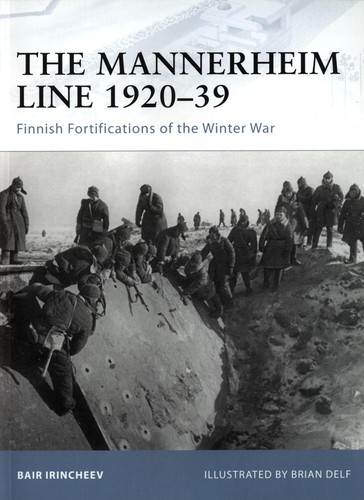
The Mannerheim Line 1920–39: Finnish Fortifications of the Winter War (Fortress, 88)

Bair Irincheev

★★★★
Read Advanced intel Military history Logistics Technical warfare Cold War Armor Russia / USSR Logistics Intel history US Civil War ISBN 9781846033841

Osprey · 2009

In the wake of the bloody civil war that followed Finland's independence from Russia in 1917, the border between the two countries was established across the Karelian Isthmus, an area long fought over by Russia, Finland and Sweden in their attempts to dominate the northern tip of Europe. Neither the Soviets nor the Finnish were comfortable with such a divide, which provided an open route for a potential invader to Helsinki on the Finnish side, and was only 32km from the important military and industrial city of Petrograd in Russia. As such, both sides began an intensive period of fortification and defensive planning. As the Winter War broke out in November 1939, the complex and heavily defended Mannerheim Line suffered intense bombardment and armored assaults. The armistice of May 1940 saw Finland cede control of the entire Karelian Isthmus to the USSR however, and a propaganda war ensued; the Russians emphasizing the strength of the line, and the Finnish downplaying its importance, accentuating instead the heroism and bravery of the common Finnish soldier. Through a detailed analysis of the background, design and operational history of the Mannerheim Line, Bair Irincheev attempts to dispel such myths and provide an accurate assessment of its immense historical importance.

No cover · Amazon

Book of the Blockade

Alieś Adamovič

unrated
Read Logistics Armor Russia / USSR Logistics Biography

Leningrad was under siege for almost three years, and the first winter of that siege was one of the coldest on record. The Russians had been taken by surprise by the Germans' sudden onslaught in June 1941. This book tells the story of that long, bitter siege in the words of those who were there. It vividly describes how ordinary Leningraders struggled to stay alive and to defend their beloved city in the most appalling conditions. They were bombed, shelled, starved and frozen. They dug tank-traps and trenches, built shelters and fortifications, fought fires, cleared rubble, tended the wounded and, for as long as they had strength to do so, buried their dead. Many were killed by German bombs or shells, but most of them died of hunger and cold. Based on interviews with survivors of the siege and on contemporary diaries and personal memoirs. The primary focus is on three a young mother with two small children, a boy of sixteen at the outbreak of war, and an elderly academic. We see the siege through their eyes as its horrors unfold and as they struggle to survive.

Supplying the British Army in the Second World War

Janet MacDonald

unrated
Read Military history Logistics WWII Armor Logistics ISBN 9781526725356

Pen & Sword Books Limited · 2020

The noted military historian reveals the fascinating history of British Army logistics during WWII in this scholarly study.Armies have always required large amounts of material, but by the Second World War the numbers of men involved had grown exponentially, their equipment had become mechanized, and their deployment was global. Elaborate planning and administration at every level had to ensure that items of all kinds were collected, transported and handed out in every theatre of the war. But how were these items selected, ordered, produced, and delivered? Following her previous volume, Supplying the British Army in the First World War, Janet MacDonald continues her study of how the British Army kept its soldiers fed, clothed, and ready to fight. The scale of the operation was enormous, and it had to be performed to critical timetables. Often threatened by enemy action, it was vital to the army’s success. MacDonald describes the necessity for central advanced planning for each expeditionary force as well as those engaged in home defense. She then elucidates the complex organization of personnel who performed these tasks, from the government and military command in London to those who distributed the equipment on the battlefield.

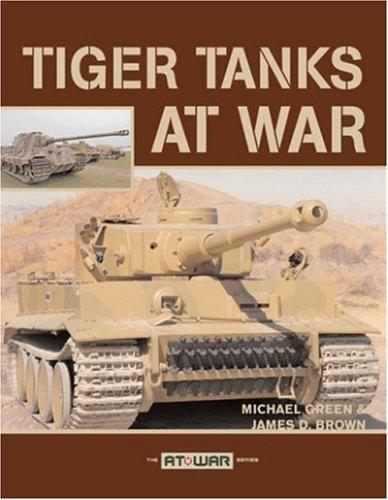
Tiger Tanks at War

Michael Green

unrated
Read Advanced intel Military history Logistics WWII Armor Russia / USSR Logistics ISBN 9780760331125

Zenith Press · February 15, 2008

The first prototype for the Tiger tank was set to be ready for Hitlers birthday on April 20, 1942. The Henschel Company, competing with Porsche, produced the superior model, and by August of that year the formidable Tiger-or Panzerkampfwagen VI Tiger Ausf. H. -was in full production. This book takes us behind the scenes with the Tiger tank, reviewing the full history, the design and mechanics, and the mixed record of this machine, which was designed to outgun its Russian counterparts. Military writer Michael Green offers a close-up account-accompanied by photographs, diagrams, and maps-of how the Tiger tank operated, how it was armed, and where it succeeded brilliantly, as well as where it failed miserably. His book fills a fascinating niche in the history of military technology, and of the impact of technology on history itself.