S2 Search · Reading list

S2 Actual reading list

Books from S2 Actual on Goodreads, organized by his shelves and topic buckets (intel lists, military history, logistics, etc.). Metadata filled via Open Library.

Not official S2 Underground. Independent fan index — not affiliated with or endorsed by S2. Official hub: linktr.ee/S2_underground. S2 materials are CC BY-NC-SA 4.0.

S2 topic buckets (Goodreads)

Subjects & genres

30 books · Logistics · subject Economics · page 1 of 2

Historical Dynamics: Why States Rise and Fall (Princeton Studies in Complexity)

Peter Turchin

★★★★★
Read Logistics Logistics Economics ISBN 0691116695

Princeton University Press · 2003

Many historical processes are dynamic. Populations grow and decline. Empires expand and collapse. Religions spread and wither. Natural scientists have made great strides in understanding dynamical processes in the physical and biological worlds using a synthetic approach that combines mathematical modeling with statistical analyses. Taking up the problem of territorial dynamics--why some polities at certain times expand and at other times contract--this book shows that a similar research program can advance our understanding of dynamical processes in history. Peter Turchin develops hypotheses from a wide range of social, political, economic, and demographic geopolitics, factors affecting collective solidarity, dynamics of ethnic assimilation/religious conversion, and the interaction between population dynamics and sociopolitical stability. He then translates these into a spectrum of mathematical models, investigates the dynamics predicted by the models, and contrasts model predictions with empirical patterns. Turchin's highly instructive empirical tests demonstrate that certain models predict empirical patterns with a very high degree of accuracy. For instance, one model accounts for the recurrent waves of state breakdown in medieval and early modern Europe. And historical data confirm that ethno-nationalist solidarity produces an aggressively expansive state under certain conditions (such as in locations where imperial frontiers coincide with religious divides). The strength of Turchin's results suggests that the synthetic approach he advocates can significantly improve our understanding of historical dynamics.
Hitler's Beneficiaries: Plunder, Racial War, and the Nazi Welfare State

Götz Aly

★★★★★
Read Advanced intel Military history Logistics WWII Logistics Economics ISBN 9780805079265

Metropolitan · 2007

A "provocative" account of great "intellectual significance," illuminating the economic workings of the Third Reich—and the reasons ordinary Germans supported the Nazi state (The New York Times Book Review) In this groundbreaking book, historian Götz Aly addresses one of modern history's greatest conundrums: How did Hitler win the allegiance of ordinary Germans? The answer is as shocking as it is persuasive: by engaging in a campaign of theft on an almost unimaginable scale—and by channeling the proceeds into generous social programs—Hitler literally "bought" his people's consent. Drawing on secret files and financial records, Aly shows that while Jews and citizens of occupied lands suffered crippling taxation, mass looting, enslavement, and destruction, most Germans enjoyed an improved standard of living. Buoyed by millions of packages soldiers sent from the front, Germans also benefited from the systematic plunder of Jewish possessions. Any qualms were swept away by waves of tax breaks and government handouts. Hitler's Beneficiaries has been hailed as "startling" by Richard Evans, and as "fascinating and important" by Christopher Browning. Above all, as Omer Bartov testifies, this remarkable book "irreversibly transforms our understanding of the Third Reich."

The Myth of the Robber Barons: A New Look at the Rise of Big Business in America

Burton W. Folsom Jr.

★★★★★
Read Logistics Logistics Intel history Economics ISBN 0963020307

Young America's Foundation · 1991

The Myth of the Robber Barons describes the role of key entrepreneurs in the economic growth of the United States from 1850 to 1910. The entrepreneurs studied are Cornelius Vanderbilt, John D. Rockefeller, James J. Hill, Andrew Mellon, Charles Schwab, and the Scranton family. Most historians argue that these men, and others like them, were Robber Barons. The story, however, is more complicated. The author, Burton Folsom, divides the entrepreneurs into two groups market entrepreneurs and political entrepreneurs. The market entrepreneurs, such as Hill, Vanderbilt, and Rockefeller, succeeded by producing a quality product at a competitive price. The political entrepreneurs such as Edward Collins in steamships and in railroads the leaders of the Union Pacific Railroad were men who used the power of government to succeed. They tried to gain subsidies, or in some way use government to stop competitors. The market entrepreneurs helped lead to the rise of the U. S. as a major economic power. By 1910, the U. S. dominated the world in oil, steel, and railroads led by Rockefeller, Schwab (and Carnegie), and Hill. The political entrepreneurs, by contrast, were a drain on the taxpayers and a thorn in the side of the market entrepreneurs. Interestingly, the political entrepreneurs often failed without help from government they could not produce competitive products. The author describes this clash of the market entrepreneurs and the political entrepreneurs. In the Mellon chapter, the author describes how Andrew Mellon an entrepreneur in oil and aluminum became Secretary of Treasury under Coolidge. In office, Mellon was the first American to practice supply-side economics. He supported cuts on income tax rates for all groups. The rate cut on the wealthiest Americans, from 73 percent to 25 percent, freed up investment capital and led to American economic growth during the 1920s. Also, the amount of revenue into the federal treasury increased sharply after tax rates were cut. The Myth of the Robber Barons has separate chapters on Vanderbilt, Hill, Schwab, Mellon, and the Scrantons. The author also has a conclusion, in which he looks at the textbook bias on the subject of Robber Barons and the rise of the U. S. in the late 1800s. This chapter explores three leading college texts in U. S. history and shows how they misread American history and disparage market entrepreneurs instead of the political entrepreneurs. This book is in its fifth edition, and is widely adopted in college and high school classrooms across the U. S.

The Winter War: Russia's Invasion Of Finland, 1939-40

Robert Edwards

★★★★★
Read Advanced intel Basic intel Military history Intel history Logistics WWII Cold War Russia / USSR Logistics Economics ISBN 9781933648507

Pegasus Books · December 30, 2007

On November 30, 1939, the Soviet Union's Red Army invaded the young nation-state of Finland, in the full expectation of routing the small, ill-equipped Finnish army and annexing the former Russian territory by the end of the year. But Finland held out for 105 bitterly cold, fiercely combative days, until March 15, 1940, when a peace agreement ended the short, savage Winter War. At the stirring center of the story lie the resourcefulness and resolve of the Finnish people, who against all military odds—in want of ammunition, food, sleep, and troops—fought a blundering, ineptly commanded Red Army to a standstill. On March 15, they ceded to the Soviet 11 percent of their territory and 30 percent of their economic assets, but none of their national pride. The Russians meanwhile had markedly damaged their international standing and effectively ruined their military reputation-to such an extent, as this probing chapter in World War II history demonstrates, that Germany, with proud-blooded Finland as an ally, dared to launch its 1940 invasion of Russia. At the same time, though, the fiasco of the Winter War forced Stalin to acknowledge the shortcomings of the Red Army and to reform it: Germany would fall at Stalingrad in 1941. With authority, this skillfully narrated military history unfolds its story of the four-month Soviet-Finnish war and explores its consequences from London to Moscow, from Helsinki to Paris, to Washington, DC.

When Money Dies: The Nightmare of the Weimar Hyper-inflation

Adam Fergusson

★★★★★
Read Advanced intel Military history Logistics Logistics Economics ISBN 9781906964443

Old Street Publishing · Apr 23, 2010

When Money Dies is the classic history of what happens when a nation’s currency depreciates beyond recovery. In 1923, with its currency effectively worthless (the exchange rate in December of that year was one dollar to 4,200,000,000,000 marks), the German republic was all but reduced to a barter economy. Expensive cigars, artworks, and jewels were routinely exchanged for staples such as bread; a cinema ticket could be bought for a lump of coal; and a bottle of paraffin for a silk shirt. People watched helplessly as their life savings disappeared and their loved ones starved. Germany’s finances descended into chaos, with severe social unrest in its wake.Money may no longer be physically printed and distributed in the voluminous quantities of 1923. However, “quantitative easing,” that modern euphemism for surreptitious deficit financing in an electronic era, can no less become an assault on monetary discipline. Whatever the reason for a country’s deficit necessity or profligacy, unwillingness to tax or blindness to expenditure it is beguiling to suppose that if the day of reckoning is postponed economic recovery will come in time to prevent higher unemployment or deeper recession. What if it does not? Germany in 1923 provides a vivid, compelling, sobering moral tale.

Destiny in the Desert: The Story Behind El Alamein - the Battle That Turned the Tide

Jonathan Dimbleby

★★★★
Read Logistics Intel history Military history Economics WWII Russia / USSR Logistics Strategy / theory Economics Orthodox / theology ISBN 9781846684449

Profile Books Ltd · 2012

This is a unique single-volume history of the road to El Alamein - 'the end of the beginning' - and the bloody battle that followed...It was the British victory at the Battle of El Alamein in November 1942 that inspired one of Churchill's most famous aphorisms: 'it is not the end nor is it the beginning of the end, but it is the end of the beginning'. And yet the true significance of this iconic episode remains unrecognised. In this thrilling historical account, Jonathan Dimbleby describes the political and strategic realities that lay behind the battle, charting the nail-biting months that led to the victory at El Alamein in November 1942. It is a story of high drama, played out both in the war capitals of London, Washington, Berlin, Rome and Moscow, and at the front, in the command posts and foxholes in the desert. "El Alamein" is about politicians and generals, diplomats, civil servants and soldiers. It is about forceful characters and the tensions and rivalries between them. Drawing on official records and the personal insights of those involved at every level, Dimbleby creates a vivid portrait of a struggle which for Churchill marked the turn of the tide - and which for the soldiers on the ground involved fighting and dying in a foreign land.

Economics in One Lesson

Henry Hazlitt

★★★★
Read Basic intel Logistics Economics Logistics Intel history Economics Orthodox / theology ISBN 9780870004278

Blackstone Audiobooks · 1946

A million copy seller, Henry Hazlitt’s Economics in One Lesson is a classic economic primer. But it is also much more, having become a fundamental influence on modern “libertarian” economics of the type espoused by Ron Paul and others. Considered among the leading economic thinkers of the “Austrian School,” which includes Carl Menger, Ludwig von Mises, Friedrich (F.A.) Hayek, and others, Henry Hazlitt (1894-1993), was a libertarian philosopher, an economist, and a journalist. He was the founding vice-president of the Foundation for Economic Education and an early editor of The Freeman magazine, an influential libertarian publication.  Hazlitt wrote Economics in One Lesson, his seminal work, in 1946. Concise and instructive, it is also deceptively prescient and far-reaching in its efforts to dissemble economic fallacies that are so prevalent they have almost become a new orthodoxy. Many current economic commentators across the political spectrum have credited Hazlitt with foreseeing the collapse of the global economy which occurred more than 50 years after the initial publication of Economics in One Lesson. Hazlitt’s focus on non-governmental solutions, strong — and strongly reasoned — anti-deficit position, and general emphasis on free markets, economic liberty of individuals, and the dangers of government intervention make Economics in One Lesson, every bit as relevant and valuable today as it has been since publication.

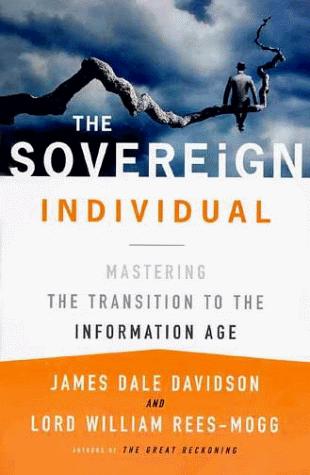
The Sovereign Individual: Mastering the Transition to the Information Age

James Dale Davidson

★★★★
Read Advanced intel Logistics Technical warfare Cold War Russia / USSR Logistics Economics US Civil War ISBN 9780684832722

Touchstone · 1999-08-26

Two renowned investment advisors and authors of the bestseller The Great Reckoning bring to light both currents of disaster and the potential for prosperity and renewal in the face of radical changes in human history as we move into the next century. The Sovereign Individual details strategies necessary for adapting financially to the next phase of Western civilization. Few observers of the late twentieth century have their fingers so presciently on the pulse of the global political and economic realignment ushering in the new millennium as do James Dale Davidson and Lord William Rees-Mogg. Their bold prediction of disaster on Wall Street in Blood in the Streets was borne out by Black Tuesday. In their ensuing bestseller, The Great Reckoning, published just weeks before the coup attempt against Gorbachev, they analyzed the pending collapse of the Soviet Union and foretold the civil war in Yugoslavia and other events that have proved to be among the most searing developments of the past few years. In The Sovereign Individual, Davidson and Rees-Mogg explore the greatest economic and political transition in centuries—the shift from an industrial to an information-based society. This transition, which they have termed "the fourth stage of human society," will liberate individuals as never before, irrevocably altering the power of government. This outstanding book will replace false hopes and fictions with new understanding and clarified values.

No cover · Amazon

The Vampire Economy: Doing Business Under Fascism

Günter Reimann

★★★★
Read Logistics Advanced intel WWII Logistics Economics

Here is a study of the actual workings of business under national socialism. Written in 1939, Reimann discusses the effects of heavy regulation, inflation, price controls, trade interference, national economic planning, and attacks on private property, and what consequences they had for human rights and economic development. This is a subject rarely discussed and for reasons that are discomforting,: as much as the left hated the social and cultural agenda of the Nazis, the economic agenda fit straight into a pattern of statism that had emerged in Europe and the United States, and in this area, the world has not be de-Nazified. This books makes for alarming reading, as one discovers the extent to which the Nazi economic agenda of totalitarian control--without finally abolishing private property--has become the norm. The author is by no means an Austrian but his study provides historical understanding and frightening look at the consequences of state economic management.

The Wages of Destruction: The Making and Breaking of the Nazi Economy

Adam Tooze

★★★★
Read Advanced intel Logistics WWII Russia / USSR Logistics Intel history Economics ISBN 9780670038268

Viking · 2006

The idea that Nazi Germany was an unstoppable juggernaut, backed by an efficient, highly industrialized economy, has been central to all accounts of World War II. But what if this was not the case? What if the war had its roots in Germany's weakness, not its strength? This is the radical argument in this pathbreaking book, the first account of the Nazi era for the twenty-first century and our globalized world. There was no aspect of Nazi power untouched by economics, yet Adam Tooze is the first to place economics alongside race and politics at the heart of the story of the Third Reich. And America, in Tooze's view, is the true pivot for Hitler's epic challenge to a shift in the world order. Hitler intuitively understood how Germany's relative poverty in the 1930s was the result not just of global depression, but also of Germany's limited resources. He predicted the dawning of a globalized world in which Europe would be crushed by America's overwhelming power, against which he saw only one last chance: a German super-state dominating Europe. Doing what Europeans had done for three centuries, he sought to carve out an imperial hinterland through one last land grab to the east, to give him the self-sufficiency to prevail in the coming superpower competition. With the odds stacked against him, he launched his underresourced armies on their unprecedented and ultimately futile rampage across Europe. Hitler knew by the summer of 1939 that his efforts to prepare for a long war with the West were doomed to failure. Ideology drove him forward. Hitler became convinced that Jewish elements in Washington, London, and Paris were circling round him, and from 1938, the international "Jewish question: was synonymous with America in his mind. Even in the summer of 1940, at the moment of Germany's greatest triumphs, Hitler was still haunted by the looming threat of Anglo-American air and sea power, orchestrated by, he believed, the world Jewish conspiracy. Tooze also casts a stark new light on Albert Speer's role in sustaining the Third Reich to its bloody end, after the catastrophe of the Soviet invasion. Speer, Tooze proposes, was no apolitical agent of technocratic efficiency but a Hitler loyalist who would stop at nothing to continue a hopeless battle of attrition, at the cost of tens of millions of lives. The Wages of Destruction is a chilling work of originality and tremendous scholarship that will fundamentally change the way in which we view Nazi Germany and the Second World War.

Nazi Economics: Ideology, Theory, and Policy

Avraham Barkai

★★★☆☆
Read Advanced intel Logistics WWII Middle East Logistics Economics ISBN 0300044666

Yale University Press · 1990

This respected Israeli scholar argues that fundamental ideological and political goals of Nazi leaders made them receptive to revolutionary economic theories such as those of J. M. Keynes. He examines how the economic system of the Third Reich was based on an anti-liberal philosophy that proved extraordinarily effective in bringing about the 'German Economic Miracle' by 1937.

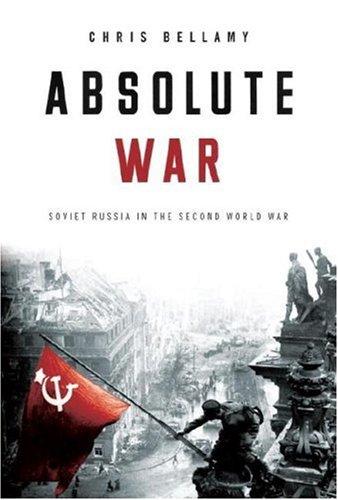
Absolute War: Soviet Russia in the Second World War

Christopher Bellamy

unrated
Read Economics Military history Logistics WWII Cold War Russia / USSR Logistics Economics ISBN 9780375410864

Knopf · October 30, 2007

The battle on the Eastern Front between 1941 and 1945 was arguably the single most decisive factor of World War II, fixing the course of world history over the next half century. Now, drawing on sources newly available since the collapse of the Soviet Union and the reunification of Germany, historian and journalist Chris Bellamy presents the first full account of this deadly conflict. Bellamy outlines the lead-up to the war—in which the fragile alliance between Hitler and Stalin was unceremoniously broken—and takes us headlong into the hostilities. He presents a shocking picture of battle in which the traditional restraints of “civilized” warfare were shed. He makes clear how the Soviets quickly rallied against Hitler, choosing homegrown despotism over foreign domination in a struggle that the Russian people call the Great Patriotic War. Bellamy charts the early gains of the German army, whose advances into Soviet territory were brought to a halt in Moscow in the winter of 1941, and whose defeat was sealed in the Battle of Stalingrad, the most merciless campaign of the bloodiest front. He shows how Soviet men—and women—joined to fight a war whose casualties were later steeply underestimated by their government, and how even the true death toll, at 27 million, does not take into account the millions of lives on both sides that lay shattered in the aftermath. Finally, Bellamy examines the far-reaching consequences of the battle’s outcome—the reverberations of which are still felt today—and argues that the cost of victory was ultimately too much for the Soviet Union to bear. A magisterial study, and an essential addition to our understanding of contemporary world history.

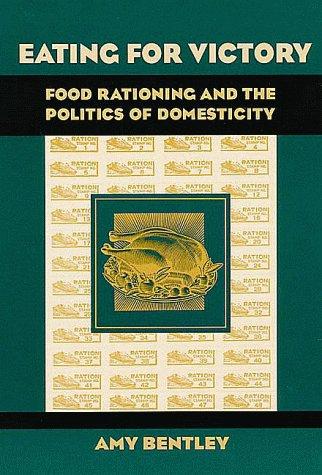
Eating for Victory: Food Rationing and the Politics of Domesticity

Amy Bentley

unrated
Read Economics Military history Logistics WWII Logistics Economics ISBN 0252024192

University of Illinois Press · 1998

      Victory gardens, ration books.         While men fought overseas, women fought the war at home, by going to work         and, more subtly, by feeding their families. Mandatory food rationing         during World War II challenged, for the first time, the image of the United         States as a land of plenty and collapsed the boundaries between women's         public and private lives by declaring home production and consumption         to be political activities.       In this fascinating cultural         history, Amy Bentley examines the food-related propaganda surrounding         rationing. She also explores the dual message purveyed by government and         the media that while mandatory rationing was necessary (enabling enough         food to be sent to the U.S. military and Allies overseas), women, black         and white, were also "required" to provide their families with nutritious         food.       Eating for Victory         explores the role of the Wartime Homemaker (media counterpart to the more         familiar Rosie the Riveter) as a pivotal component not only of World War         II but of the development of the United States into a superpower.

No cover · Amazon

Eating for Victory: Healthy Home Front Cooking on War Rations

Jill Norman

unrated
Read Logistics Economics Naval Logistics Economics

Food rationing was introduced in England in January 1940 after supply ships were attacked by German U-boats. The first food items to be rationed were butter, sugar, bacon, and ham, though restrictions were also eventually placed on meat, fish, jam, biscuits, cheese, eggs, and milk. In response, the Ministry of Food produced a series of "Eating for Victory" pamphlets that advised the general public on how to cope with these shortages. Designed to lift spirits in a time of shortage, these jolly leaflets contained a variety of recipes and cooking advice ranging from how to make steamed and boiled puddings and hints on how to reconstitute dried eggs. For all the hardship that rationing brought, the food restrictions resulted in many people eating more healthily than ever before. A nostalgic look back at one of the most difficult and yet healthiest times in history, this quaint collection is also a relevant guide to good eating today.

Fire & Steam: How the Railways Transformed Britain

Christian Wolmar

unrated
Read Logistics Military history Logistics Economics Orthodox / theology ISBN 9781843546290

Atlantic · 2007

Now in paperback, Fire and Steam tells the dramatic story of the people and events that shaped the world’s first railway network, one of the most impressive engineering achievements in history. The opening of the pioneering Liverpool and Manchester Railway in 1830 marked the beginning of the railways’ vital role in changing the face of Britain. Fire and Steam celebrates the vision and determination of the ambitious Victorian pioneers who developed this revolutionary transport system and the navvies who cut through the land to enable a country-wide network to emerge. The rise of the steam train allowed goods and people to circulate around Britain as never before, stimulating the growth of towns and industry, as well many of the facets of modern life, from fish and chips to professional football. From the early days of steam to electrification, via the railways’ magnificent contribution in two world wars, the checkered history of British Rail, and the buoyant future of the train, Fire and Steam examines the social and economical importance of the railway and how it helped to form the Britain of today.

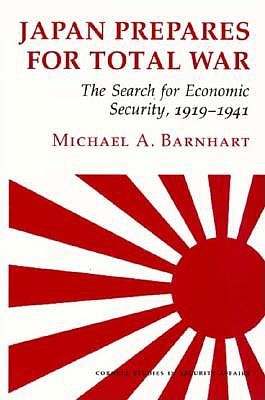
Japan Prepares for Total War: The Search for Economic Security, 1919-1941

Michael A. Barnhart

unrated
Read Logistics Military history WWII Naval Logistics Economics ISBN 0801419158

Cornell University Press · 1991

The roots of Japan's aggressive, expansionist foreign policy have often been traced to its concern over acute economic vulnerability. Historian Michael Barnhart tests this assumption by examining the events leading up to World War II in the context of Japan's quest for economic security. Drawing on a wide array of Japanese and American sources, this is the first English-language book on the war's origins to be based on research in archives on both sides of the Pacific. Barnhart focuses on the critical years from 1938 to 1941 as he investigates the development of Japan's drive for national economic self-sufficiency and independence and the way in which this drive shaped its internal and external policies. He also explores American economic pressure on Tokyo and assesses its impact on Japan's foreign policy and domestic economy. He concludes that Japan's internal political dynamics, especially the bitter rivalry between its army and navy, played a far greater role in propelling the nation into war with the United States than did its economic condition or even pressure from Washington. Japan Prepares for Total War sheds new light on prewar Japan and confirms the opinions of those in Washington who advocated economic pressure against Japan. At a time of growing interest in U.S.-Japanese economic relations, this book will be stimulating and provocative reading for scholars and students of international relations and American and Asian history.

No cover · Amazon

Merchant Shipping and the Demands of War

C.B.A. Behrens

unrated
Read Economics Military history Logistics WWII Logistics Strategy / theory Economics

This book is perhaps the most little read and yet at the same time the most important official history you will read about WW2. If you really want to understand the nature of second world war an understanding of how management of merchant shipping and the control of port clearance is essential. In most areas of the war FDR relegated management to his military commanders. The only aspect of the war which he maintained direct control of was the 'War Shipping Administration, such was its importance to Allied strategy. The 'Germany First' strategy was not a choice, but something forced upon the US Army. Eisehnower pointed out in a very influential paper that a campaign in the Pacific would take 4 times as many ships as a campaign Europe and that it was the shortage of shipping load that determined strategy. Many of the highly complex tables and appedencies have been removed from this edition to make it readable on smaller, A5 size readers

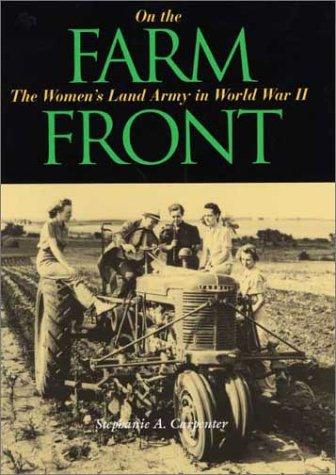
On the Farm Front: The Women's Land Army in World War II

Stephanie A. Carpenter

unrated
Read Economics Military history Logistics WWII Logistics Intel history Economics ISBN 0875803148

Northern Illinois University Press · 2003

Rosie the Riveter is an icon for women's industrial contribution to World War II, but history has largely overlooked the three million women who served on America's agricultural front. The Women's Land Army sent volunteers to farms, canneries, and dairies across the country, accounting for the majority of wartime agricultural labor. On the Farm Front tells for the first time the remarkable story of these women who worked to ensure both "Freedom from Want" at home and victory abroad. Formed in 1943 as part of the Emergency Farm Labor Program, the WLA placed its workers in areas where American farmers urgently needed assistance. Many farmers in even the most desperate areas, however, initially opposed women working their land. Rural administrators in the Midwest and the South yielded to necessity and employed several hundred thousand women as farm laborers by the end of the war, but those in the Great Plains and eastern Rocky Mountains remained hesitant, suffering serious agricultural and financial losses as a consequence. Carpenter reveals for the first time how the WLA revolutionized the national view of farming. By accepting all available women as agricultural workers, farmers abandoned traditional labor and stereotypical social practices. When the WLA officially disbanded in 1945, many of its women chose to remain in their agricultural jobs rather than return to a full-time home life or prewar employment. On the Farm Front illuminates the Women's Land Army's unique contribution to prosperity and victory, showing how this landmark organization changed the role of women in American society.

Ostkrieg: Hitler's War of Extermination in the East

Stephen G. Fritz

unrated
Read Basic intel Advanced intel Military history Logistics WWII Cold War Russia / USSR Logistics Economics ISBN 9780813134161

University Press of Kentucky · 2011

On June 22, 1941, Germany launched the greatest land assault in history on the Soviet Union, an attack that Adolf Hitler deemed crucial to ensure German economic and political survival. As the key theater of the war for the Germans, the eastern front consumed enormous levels of resources and accounted for 75 percent of all German casualties. Despite the significance of this campaign to Germany and to the war as a whole, few English-language publications of the last thirty-five years have addressed these pivotal events. In Ostkrieg: Hitler's War of Extermination in the East , Stephen G. Fritz bridges the gap in scholarship by incorporating historical research from the last several decades into an accessible, comprehensive, and coherent narrative. His analysis of the Russo-German War from a German perspective covers all aspects of the eastern front, demonstrating the interrelation of military events, economic policy, resource exploitation, and racial policy that first motivated the invasion. This in-depth account challenges accepted notions about World War II and promotes greater understanding of a topic that has been neglected by historians.

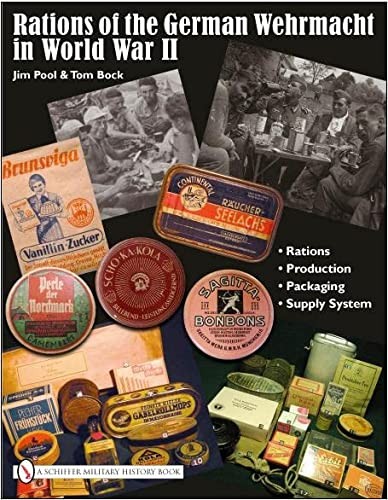
Rations of the German Wehrmacht in World War II

Jim Pool

unrated
Read Economics Military history Logistics WWII Logistics Economics ISBN 9780764335204

Schiffer Pub. · 2010

This book is the definitive reference on the topic. Lavishly illustrated with over 600 photographs and over 200 charts, wartime advertisements and other educational aids, it represents the most accurate and detailed look at the rations provided to the German soldier in World War II. Relying mainly on wartime German and American references, most unknown to the general public, this book dispels the many myths associated with German rations of World War II. Covering all the major food groups Emergency and Special rations, Scho-ka-kola, the supply system and wartime packaging materials and construction this book is a must for every serious collector and historian of the German military in World War II.

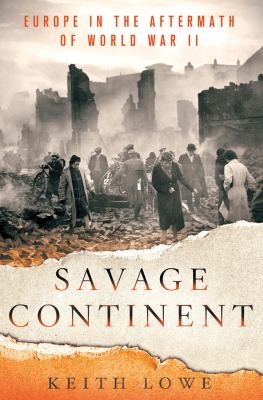
Savage Continent: Europe in the Aftermath of World War II

Keith Lowe

unrated
Read Advanced intel Military history Logistics WWII Logistics Intel history Economics US Civil War ISBN 9781250000200

St. Martin's Press · 2012

The Second World War might have officially ended in May 1945, but in reality it rumbled on for another ten years... The end of the Second World War in Europe is one of the twentieth century’s most iconic moments.  It is fondly remembered as a time when cheering crowds filled the streets, danced, drank and made love until the small hours.  These images of victory and celebration are so strong in our minds that the period of anarchy and civil war that followed has been forgotten.  Across Europe, landscapes had been ravaged, entire cities razed and more than thirty million people had been killed in the war. The institutions that we now take for granted - such as the police, the media, transport, local and national government - were either entirely absent or hopelessly compromised. Crime rates were soaring, economies collapsing, and the European population was hovering on the brink of starvation.  In Savage Continent, Keith Lowe describes a continent still racked by violence, where large sections of the population had yet to accept that the war was over.  Individuals, communities and sometimes whole nations sought vengeance for the wrongs that had been done to them during the war. Germans and collaborators everywhere were rounded up, tormented and summarily executed.  Concentration camps were reopened and filled with new victims who were tortured and starved.  Violent anti-Semitism was reborn, sparking murders and new pogroms across Europe.  Massacres were an integral part of the chaos and in some places – particularly Greece, Yugoslavia and Poland, as well as parts of Italy and France – they led to brutal civil wars. In some of the greatest acts of ethnic cleansing the world has ever seen, tens of millions were expelled from their ancestral homelands, often with the implicit blessing of the Allied authorities. Savage Continent is the story of post WWII Europe, in all its ugly detail, from the end of the war right up until the establishment of an uneasy stability across Europe towards the end of the 1940s.  Based principally on primary sources from a dozen countries, Savage Continent is a frightening and thrilling chronicle of a world gone mad, the standard history of post WWII Europe for years to come.

The Downfall of Money: Germany’s Hyperinflation and the Destruction of the Middle Class

Frederick Taylor

unrated
Read Economics Logistics Logistics Economics ISBN 9781620402368

2013

A hundred years ago, many theorists believed-just as they did at the beginning of our twenty-first century-that the world had reached a state of economic perfection, a never before seen human interdependence that would lead to universal growth and prosperity. Then, as now, the German mark was one of the most trusted currencies in the world. Yet the early years of the Weimar Republic in Germany witnessed the most calamitous meltdown of a developed economy in modern times. The Downfall of Money will tell anew the dramatic story of the hyperinflation that saw the mark-worth 4.2 to the dollar in 1914-plunge until it traded at over 4 trillion to 1 by the autumn of 1923. The story of the Weimar Republic's financial crisis clearly resonates today, when the world is again anxious about what money is, what it means, and how we can judge if its value is true. It is a trajectory of events uncomfortably relevant for our own uncertain world. Frederick Taylor-one of the leading historians of Germany writing today- explores the causes of the crisis and what the collapse meant to ordinary people and traces its connection to the dark decades that followed. Drawing on a wide range of sources and accessibly presenting vast amounts of research, The Downfall of Money is a timely and chilling exploration of a haunting episode in history.

The Gulag at War: Stalin's Forced Labour System in the Light of the Archives

Edwin Bacon

unrated
Read Military history Logistics WWII Cold War Russia / USSR Logistics Economics ISBN 0814712436

New York University Press · 1994

Throughout the Stalin era and after, the Gulag system of forced labor blighted the Soviet Union. Millions were incarcerated in its camps, some to be eventually released, many to die imprisoned and faceless. For decades, histories of the camp system have relied on the experiences of those who suffered within them for their main source of information. Though these accounts have been supplemented with officially sanctioned Soviet publications, the details of the forced labor system have for decades remained hidden by state secrecy. But with the collapse of the Soviet empire, the archives of the Gulag are now opening. Drawing on the archival records kept by Gulag authorities themselves, The Gulag at War traces the development of this system in the Soviet Union from 1920 through 1960. The volume describes the state's perceptions of the camps and their tasks and addresses long-held questions concerning the motives behind the system. Specific attention is given to the World War II years; the information found in the archives shows the importance of forced labor to Soviet, and therefore Allied, victory. The Gulag at War offers a close investigation of different aspects of camp life during this time, supplying data concerning the numbers and backgrounds of the prisoners, the economic tasks and achievements, the camp conditions, and the effectiveness of camp security which have previously been unavailable.