S2 Search · Reading list

S2 Actual reading list

Books from S2 Actual on Goodreads, organized by his shelves and topic buckets (intel lists, military history, logistics, etc.). Metadata filled via Open Library.

Not official S2 Underground. Independent fan index — not affiliated with or endorsed by S2. Official hub: linktr.ee/S2_underground. S2 materials are CC BY-NC-SA 4.0.

S2 topic buckets (Goodreads)

Subjects & genres

22 books · Advanced intel · subject Middle East

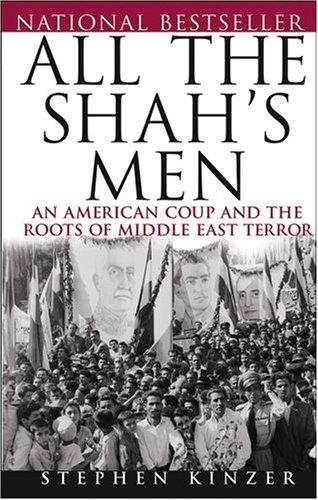
All the Shah's Men: An American Coup and the Roots of Middle East Terror

Stephen Kinzer

★★★★★
Read Advanced intel Intel history Military history Espionage GWOT Middle East Intel history Orthodox / theology ISBN 9780471678786

Wiley · August 12, 2004

Half a century ago, the United States overthrew a Middle Eastern government for the first time. The victim was Mohammad Mossadegh, the democratically elected prime minister of Iran. Although the coup seemed a success at first, today it serves as a chilling lesson about the dangers of foreign intervention.In this book, veteran New York Times correspondent Stephen Kinzer gives the first full account of this fateful operation. His account is centered around an hour-by-hour reconstruction of the events of August 1953, and concludes with an assessment of the coup's "haunting and terrible legacy." Operation Ajax, as the plot was code-named, reshaped the history of Iran, the Middle East, and the world. It restored Mohammad Reza Shah to the Peacock Throne, allowing him to impose a tyranny that ultimately sparked the Islamic Revolution of 1979. The Islamic Revolution, in turn, inspired fundamentalists throughout the Muslim world, including the Taliban and terrorists who thrived under its protection."It is not far-fetched," Kinzer asserts in this book, "to draw a line from Operation Ajax through the Shah's repressive regime and the Islamic Revolution to the fireballs that engulfed the World Trade Center in New York."Drawing on research in the United States and Iran, and using material from a long-secret CIA report, Kinzer explains the background of the coup and tells how it was carried out. It is a cloak-and-dagger story of spies, saboteurs, and secret agents. There are accounts of bribes, staged riots, suitcases full of cash, and midnight meetings between the Shah and CIA agent Kermit Roosevelt, who was smuggled in and out of the royal palace under a blanket in the back seat of a car. Roosevelt,the grandson of President Theodore Roosevelt, was a real-life James Bond in an era when CIA agents operated mainly by their wits. After his first coup attempt failed, he organized a second attempt that succeeded three days later.The colorful cast of characters includes the terrified young Shah, who fled his country at the first sign of trouble; General H. Norman Schwarzkopf, father of the Gulf War commander and the radio voice of "Gang Busters," who flew to Tehran on a secret mission that helped set the coup in motion; and the fiery Prime Minister Mossadegh, who outraged the West by nationalizing the immensely profitable Anglo-Iranian Oil Company. The British, outraged by the seizure of their oil company, persuaded President Dwight Eisenhower that Mossadegh was leading Iran toward Communism. Eisenhower and Prime Minister Winston Churchill of Great Britain became the coup's main sponsors. Brimming with insights into Middle Eastern history and American foreign policy, this book is an eye-opening look at an event whose unintended consequences - Islamic revolution and violent anti-Americanism--have shaped the modern world. As the United States assumes an ever-widening role in the Middle East, it is essential reading.

No cover · Amazon

Crusade: The Untold Story of the Persian Gulf War

Rick Atkinson

★★★★★
Read Basic intel Advanced intel Technical warfare Logistics Intel history Military history Middle East Logistics Strategy / theory

A definitive account of the Gulf War told by Pulitzer Prize–winning correspondent Rick Atkinson. This previously untold story of the US war with Iraq in the early 1990s, Atkinson follows the 42-day war from the first night to the final day, providing vivid accounts of bombing runs, White House strategy sessions, firefights, and bitter internal conflicts.

No cover · Amazon

Dragon Days: Time for "Unconventional" Tactics

H. John Poole

★★★★★
Read Advanced intel Vietnam Korea Guerrilla / COIN Middle East Strategy / theory

This book shows how to control a contested region with squad-sized outposts . North Vietnam and Iran have done it. Now, North Korea may try to consolidate the South with such a strategy. Scores of tiny Western outposts could do this too. After a short threat assessment, Dragon Days describes what a single U.S. rifle squad must do to safely accomplish such a mission in Asia. It will need the following Unconventional Warfare (UW) (1) some police procedure; (2) obscurely defending; (3) finding an enemy weakness; (4) making a secret approach; (5) disguising the attack; (6) precluding a counterstroke; (7) rural E&E; (8) enhancing rural terrain (9) urban E&E; and (10) enhancing urban terrain . Because of Asia's bottom-up culture, the little picture is where such an ability originates. This heavily illustrated book contains more small-unit perspective than any U.S. govt. publication. In fact, it may still constitute America's only UW tactical-technique manual .

Militant Tricks: Battlefield Ruses of the Islamic Insurgent

H. John Poole

★★★★★
Read Advanced intel GWOT Guerrilla / COIN China Middle East Strategy / theory ISBN 9780963869586

Posterity Press · October 17, 2005

THIS BOOK WAS ON THE U.S. ARMY'S MOST PRESTIGIOUS READING LIST. Since 9/11, our deployed troops have learned many things. Though the war in Afghanistan has just ended, many of their hard-won lessons have yet to be assimilated by the Stateside bureaucracy. To help, "Militant Tricks" has recounted America's progress in Iraq and Afghanistan from the standpoint of East Asian BATTLEFIELD DECEPTION. Both countries were part of the Mongol Empire for over 200 years and thus prone to every sort of ancient Chinese illusion. "Militant Tricks" also contains the TACTICAL TECHNIQUES WITH WHICH TO COUNTER AN ISLAMIC EXTREMIST'S URBAN OFFENSIVE. While some of these nontraditional techniques were risked during the Baghdad Surge, they may soon be forgotten.

Relentless Strike: The Secret History of Joint Special Operations Command

Sean Naylor

★★★★★
Read Basic intel Advanced intel Military history Intel history Technical warfare GWOT Special ops Naval Air power Nuclear Middle East ISBN 9781250014542

St. Martin's Press · 2015

The New York Times Bestseller and Winner of the 2015 Army Historical Foundation Distinguished Writing Award for Unit History Since the attacks of September 11, one organization has been at the forefront of America's military response. Its efforts turned the tide against al-Qaida in Iraq, killed Bin Laden and Zarqawi, rescued Captain Phillips and captured Saddam Hussein. Its commander can direct cruise missile strikes from nuclear submarines and conduct special operations raids anywhere in the world. Relentless Strike tells the inside story of Joint Special Operations Command, the secret military organization that during the past decade has revolutionized counterterrorism, seamlessly fusing intelligence and operational skills to conduct missions that hit the headlines, and those that have remained in the shadows-until now. Because JSOC includes the military's most storied special operations units-Delta Force, SEAL Team 6, the 75th Ranger Regiment-as well as America's most secret aviation and intelligence units, this is their story, too. Relentless Strike reveals tension-drenched meetings in war rooms from the Pentagon to Iraq and special operations battles from the cabin of an MH-60 Black Hawk to the driver's seat of Delta Force's Pinzgauer vehicles as they approach their targets. Through exclusive interviews, reporter Sean Naylor uses his unique access to reveal how an organization designed in the 1980s for a very limited mission set transformed itself after 9/11 to become the military's premier weapon in the war against terrorism and how it continues to evolve today.

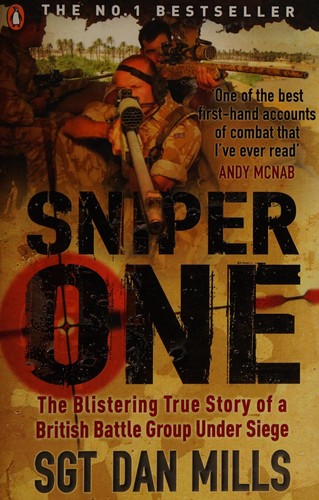
Sniper One: The Blistering True Story Of A British Battle Group Under Siege

Dan Mills

★★★★★
Read Biographies Intel history Technical warfare Advanced intel Military history GWOT Middle East Biography ISBN 9780141029016

Penguin · 2008

Sniper One is the gritty, awe-inspiring true story that takes you right into the heart of the Iraq war from Sunday Times No.1 bestseller Sgt. Dan Mills. 'One of the best first-hand accounts of combat that I've ever read' Andy McNab We all saw it at once. Half a dozen voices screamed 'Grenade!' simultaneously. Then everything went into slow motion. The grenade took an age to travel through its 20 metre arc. A dark, small oval-shaped package of misery the size of a peach ... April 2004: Dan Mills and his platoon of snipers fly into southern Iraq, part of an infantry battalion sent to win hearts and minds. They were soon fighting for their lives. Back home we were told they were peacekeeping. But there was no peace to keep. Because within days of arriving in theatre, Mills and his men were caught up in the longest, most sustained fire fight British troops had faced for over fifty years. This awe-inspiring account tells of total war in throat-burning winds and fifty-degree heat, blasted by mortars and surrounded by heavily armed militias. For six months, they fought isolated, besieged and under constant enemy fire. Their heroic stand a modern-day Rorke's Drift. ************** Dan Mills served for 24 years as an Infantry Soldier reaching the rank of Warrant Officer Class 2. During his long military career he served on operations in Northern Ireland, Bosnia, Kosovo, Iraq and Afghanistan. Dan was awarded a 'Mention In Despatches' for Gallantry for his services during The Iraq War. Since leaving the Army in 2010, he has forged a career as a writer and security consultant, amongst other things. Sniper One is his first book.

No cover · Amazon

The Crucible of War: The Complete Volumes

Barrie Pitt

★★★★★
Read Advanced intel WWII Middle East Strategy / theory

‘The definitive work on the Desert War.’ Manchester Evening News WAVELL’S Volume 1 of The Crucible of War trilogy covers General Wavell’s command, a period that began triumphantly with the rout of the Italian Army and ended in catastrophe with the devastating entry of Rommel into the conflict. On 11th June 1940, Mussolini declared war on Britain and France. From their colony in Libya, the Italians began invading Egypt in an attempt to expand their African Empire. Thus began the Desert War – a battle to secure critical Middle East oil supplies which would last for three years. Commander-in-Chief of the Middle East was General Sir Archibald Wavell. By 1940, and with limited resources, he was responsible for all British land forces in Egypt, the Sudan, Palestine, Transjordan and Cyprus, as well as the Army formations in British Somaliland, Aden, Iraq and along the shores of the Persian Gulf. Attack was the only form of defence and under field commander General Richard O’Connor, an immensely successful and exhilarating campaign was carried out against Marshal Graziani’s forces. The Italians were pushed back hundreds of miles and 130,000 prisoners were taken. By February 1941 nearly all Axis forces had been expelled from North Africa. It was a remarkable triumph in one of the most dramatic theatres of the Second World War. AUCHINLECK’S Volume Two of The Crucible of War trilogy covers General Auchinleck’s command — a period of disaster and defeat for the British Army, driven back towards Cairo by the Africa Korps under the tactical genius of Rommel. The book ends however with the replacing of Auchinleck by Montgomery in August 1942. Auchinleck's Command is essential reading for anyone interested in WW2, the British Army (it's strengths and weaknesses) and military leadership. MONTGOMERY AND Throughout the first half of the Second World War, control of the inhospitable North African desert was strategically vital for the Allies. In the middle of 1942, the outcome hung in the balance. Rommel and his Afrika Korps had been fought to a standstill at the first battle of Alamein and were desperately short of fuel and equipment. The next encounter between the two armies would be decisive. The scene was set for a second, and bludgeoning, encounter at El Alamein in October. It was to prove Britain’s first decisive victory of the war. Praise for the Crucible of War ‘Barrie Pitt tells this exciting history well. He has assembled a mass of information and organised it with admirable clarity. His narrative is scrupulously accurate in detail. The whole work will have great appeal for the general reader.’ Times Literary Supplement ‘Masterly and lucid in its descriptions not only of the fighting and strategy, but of the political machinations’ Sunday Telegraph ‘A magnificent book, Barrie Pitt has almost a novelist’s skill and perception of character.’ Daily Telegraph ‘Comes as close as any work yet published to being a definitive account of the battles between German and Allied armies in the Sahara.’ Financial Times Barrie Pitt (1918-2006) was well known as a military historian and editor of Purnell’s History of the Second Wor

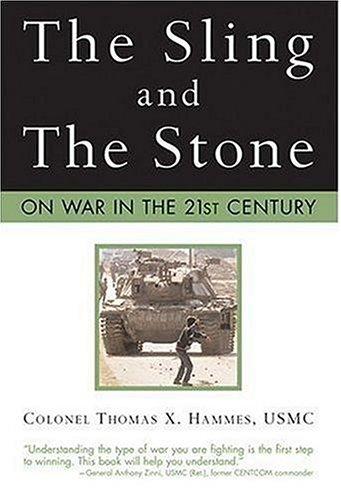
The Sling and the Stone: On War in the 21st Century

Thomas X. Hammes

★★★★★
Read Basic intel Advanced intel Military history Intel history Vietnam Cold War GWOT Guerrilla / COIN Russia / USSR Middle East Strategy / theory ISBN 9780760324073

Zenith Press · February 17, 2006

4GW (Fourth Generation Warfare) is the only kind of war America has ever lost. And we have done so three times - in Vietnam, Lebanon, and Somalia. This form of warfare has also defeated the French in Vietnam and Algeria, and the USSR in Afghanistan.As the only Goliath left in the world, we should be worried that the world's Davids have found a sling and stone that work." - Chapter 1, The Sling and the Stone: On War in the 21st Century. The War in Iraq. The War on Terror. These types of "asymmetrical" warfare are the conflicts of the 21st century - and show how difficult it is for the world's remaining superpower to battle insurgents and terrorists who will fight unconventionally in the face of superior military power. This change in military conflict may seem sudden.

Stealth: The Secret Contest to Invent Invisible Aircraft

Peter Westwick

★★★★
Read Advanced intel Military history Intel history Cold War Russia / USSR Middle East Strategy / theory ISBN 9780190677442

Oxford University Press, Incorporated · 2020

The story behind the technology that revolutionized both aeronautics, and the course of history On a moonless night in January 1991, a dozen airplanes appeared in the skies over Baghdad. Or, rather, didn't appear. They arrived in the dark, their black outlines cloaking them from sight. More importantly, their odd, angular shapes, which made them look like flying origami, rendered them undetectable to Iraq's formidable air defenses. Stealth technology, developed during the decades before Desert Storm, had arrived. To American planners and strategists at the outset of the Cold War, this seemingly ultimate way to gain ascendance over the USSR was only a question. What if the United States could defend its airspace while at the same time send a plane through Soviet skies undetected? A craft with such capacity would have to be essentially invisible to radar - an apparently miraculous feat of physics and engineering. In Stealth, Peter Westwick unveils the process by which the impossible was achieved. At heart, Stealth is a tale of two aerospace companies, Lockheed and Northrop, and their fierce competition - with each other and with themselves - to obtain what was estimated one of the largest procurement contracts in history. Westwick's book fully explores the individual and collective ingenuity and determination required to make these planes and in the process provides a fresh view of the period leading up to the end of the Soviet Union. Taking into account the role of technology, as well as the art and science of physics and engineering, Westwick offers an engaging narrative, one that immerses readers in the race to produce a weapon that some thought might save the world, and which certainly changed it.

The Longest War: A History of the War on Terror and the Battles with Al Qaeda Since 9/11

Peter L. Bergen

★★★★
Read Advanced intel Military history Intel history Espionage GWOT Middle East Strategy / theory ISBN 9780743278935

Free Press · 2011

TEN YEARS HAVE PASSED since the shocking attacks on the World Trade Center, and after seven years of conflict, the last U.S. combat troops left Iraq—only to move into Afghanistan, where the ten-year-old fight the war on terror rages with no clear end in sight. In The Longest War Peter Bergen offers a comprehensive history of this war and its evolution, from the strategies devised in the wake of the 9/11 attacks to the fighting in Afghanistan, Pakistan, and beyond. Unlike any other book on this subject, here Bergen tells the story of this shifting war’s failures and successes from the perspectives of both the United States and al-Qaeda and its allies. He goes into the homes of al-Qaeda members, rooting into the source of their devotion to terrorist causes, and spends time in the offices of the major players shaping the U.S. strategic efforts in the region. At a time when many are frustrated or fatigued with what has become an enduring multigenerational conflict, this book will provide an illuminating narrative that not only traces the arc of the fight but projects its likely future. Weaving together internal documents from al-Qaeda and the U.S. offices of counterterrorism, first-person interviews with top-level jihadists and senior Washington officials, along with his own experiences on the ground in the Middle East, Bergen balances the accounts of each side, revealing how al-Qaeda has evolved since 9/11 and the specific ways the U.S. government has responded in the ongoing fight. Bergen also uncovers the strategic errors committed on both sides—the way that al-Qaeda’s bold attack on the United States on 9/11 actually undermined its objective and caused the collapse of the Taliban and the destruction of the organization’s safe haven in Afghanistan, and how al-Qaeda is actually losing the war of ideas in the Muslim world. The book also shows how the United States undermined its moral position in this war with its actions at Guantánamo and coercive interrogations—including the extraordinary rendition of Abu Omar, who was kidnapped by the CIA in Milan in 2003 and was tortured for four years in Egyptian prisons; his case represents the first and only time that CIA officials have been charged and convicted of the crime of kidnapping. In examining other strategic blunders the United States has committed, Bergen offers a scathing critique of the Clinton and Bush administrations’ inability to accurately assess and counter the al-Qaeda threat, Bush’s deeply misguided reasons for invading Iraq—including the story of how the invasion was launched based, in part, on the views of an obscure academic who put forth theories about Iraq’s involvement with al-Qaeda—and the Obama administration’s efforts in Afghanistan. At a critical moment in world history The Longest War provides the definitive account of the ongoing battle against terror.

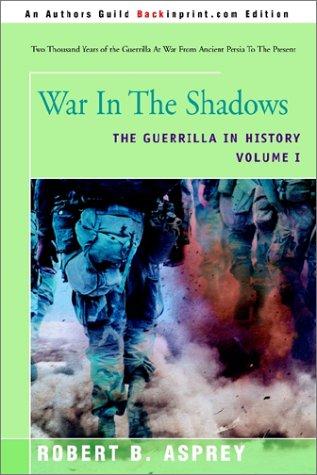
War In The Shadows: The Guerrilla in History

Robert B. Asprey

★★★★
Read Intel history Advanced intel Vietnam Cold War Guerrilla / COIN Russia / USSR Middle East Strategy / theory Economics Revolution ISBN 9780595225934

Backinprint.com · May 2002

Ranging from Alexander the Great's battles with Asiatic Scythians, through the Russian Revolution, and on up to the turmoil in the Middle East and the battle in Northern Ireland, War in the Shadows is a book of monumental sweep and singular perspective. It also contains a comprehensive and hard-hitting strategic evaluation of the Vietnam War-one of the most significant analyses of "the war that won't go away." War in the Shadows tells the story of the countries currently torn by armed insurgencies and clarifies the causes of each conflict. It provides the broad viewpoint necessary for understanding them in the historical terms of guerilla warfare. With the collapse of the Soviet Union, the end of the Cold War, and a highly unstable "new world order," this brand of rebellion has never been more powerful and potentially disruptive. As the author states in his Foreword, "For a number of reasons guerilla warfare has evolved into an ideal instrument for the realization of social-political-economic aspirations of underprivileged peoples. This is so patently true as to allow one to suggest that we may be witnessing a transition to a new era in warfare, an era as radically different as those of which followed the writings of Sun Tzu, Machiavelli, Clausewitz, and Mahan." War in the Shadows is crucial to understanding the complex challenges of our new and dangerous era.

No cover · Amazon

Military Deception: Hiding The Real - Showing The Fake - Denial Operations, Propaganda, Disinformation, Joint Doctrine, Soviet Maskirovka, Desert Storm Persian Gulf War Examples

U.S. Government

★★★☆☆
Read Advanced intel Military history Intel history Technical warfare WWII Russia / USSR Middle East Strategy / theory

Professionally converted for accurate flowing-text e-book format reproduction, this book discusses military deception techniques and history. "Military deception" is an umbrella term that includes both denial and deception. Denial hides the real and deception shows the fake. Denial and deception are operations; propaganda and disinformation are the products. Joint doctrine says that military deception, as applied by a joint force commander (JFC), targets an adversary's decision-making process. Ultimately, the intent is to shape the adversary's behavior in the JFC's favor or to cause an adversary to form an inaccurate impression of the battlespace. Consequently, planning for deception operations depends on intelligence and security for success. Obviously, a commander wants to conceal deception efforts from the enemy, but often he'll conceal all or some of his efforts from his own troops to prevent confusion and/or compromise of the plan. During the early years of Soviet involvement in World War II, mishandling of information by soldiers and planners resulted in the compromise of many maskirovka (or deception) operations. As a result, the Soviets implemented aggressive security measures to protect their deception plans. Specifically, Soviet commanders restricted the number of planners and documents involved in the deception operations and communicated to subordinates only what they needed to know, when they needed to know it. The general enjoyed his breakfast while reading his morning paper and listening to the international news channel. Hearing the Balkans mentioned—his area of responsibility—he looked up as a foreign correspondent began to comment on the aftermath of an Allied bombing mission from the day before. The gruesome details suddenly made the general's scrambled eggs a bit less appealing. The graphic pictures showed what appeared to be the remnants of an orphanage. There in the rubble lay a bloodstained, tattered doll. Those images left him wondering about the carnage that lay beneath the collapsed brick and mortar. Had his staff miscalculated and inadvertently struck an orphanage? A similar misstep had occurred a few weeks ago when another bombing mission resulted in civilian casualties in a marketplace. As the general bemoaned the potential ramifications of accidentally bombing an orphanage, a memory surfaced. Years of flying high-performance aircraft had sharpened his senses, and something about the scene seemed familiar. Could that be the same bloodstained doll he had seen in photographs of the earlier marketplace mishap? The general had been briefed on the enemy's rather low-tech yet successful use of deception. Was he, along with the rest of the world, a target of military deception? As he pondered this, his pager went off. This fictitious example illustrates both how easy it is to manipulate the media in deception operations and how a thorough understanding of deception can help prevent a military leader from falling victim to it. The U.S. military is transforming itself with technological advancements in warfighting capability. Weapon systems, force structure and training have all improved. The amount and kind of information available to the warfighter is also improving. But even a technologically advanced nation like the United States is susceptible to deception. Analysis of friendly and enemy deception techniques in Operations DESERT STORM and ALLIED FORCE shows the main U.S. vulnerabilities to include its insatiable appetite for "news," the lack of deception-detection expertise in the military, and the tendency to believe that technological advancements make a nation deception-proof. Therefore, the key to mitigating the U.S. vulnerabilities to deception lies in educating the media about the military and common deception practices, giving the military intensive deception-detection training, and abandoning the notion that technolo

Nazi Economics: Ideology, Theory, and Policy

Avraham Barkai

★★★☆☆
Read Advanced intel Logistics WWII Middle East Logistics Economics ISBN 0300044666

Yale University Press · 1990

This respected Israeli scholar argues that fundamental ideological and political goals of Nazi leaders made them receptive to revolutionary economic theories such as those of J. M. Keynes. He examines how the economic system of the Third Reich was based on an anti-liberal philosophy that proved extraordinarily effective in bringing about the 'German Economic Miracle' by 1937.

The Muqaddimah: An Introduction to History

Ibn Khaldun

★★★☆☆
Read Advanced intel Military history Middle East Biography Economics ISBN 9789953432540

Commission internationale pour la traduction des chefs-d'oeuvre · 1858

كتاب في التاريخ وعلم الإجتماع، هذا الكتاب مقدمة لكتاب في التاريخ، أراد فيه ابن خلدون أن يشرح علم التاريخ وأحوال المجتمعات وسياستها وأسباب نشوئها، فإن كان علم الإجتماع يعود لمؤسس فلا شك أنه يعود لابن خلدون، وتعتبر المقدمة مرجعا مهما لكل باحث في التاريخ أو علم الإجتماع أو باحث في أسباب نشوء الأمم أو جغرافية وحدود كثير من الدول في تلك الفترة، سواء كان الباحث عربي أو أجنبي

Blood Year: The Unraveling of Western Counterterrorism

David Kilcullen

unrated
Read Advanced intel Cold War GWOT Russia / USSR Middle East Strategy / theory US Civil War ISBN 9780190600549

Oxford University Press · 2016

2014 has the potential to go down as a crucial year in modern world history. A resurgent and bellicose Russia took over Crimea and fueled a civil war in Eastern Ukraine. Post-Saddam Iraq, in many respects a creature of the United States because of the war that began in 2003, lost a third of its territory to an army of hyper-violent millennialists. The peace process in Israel seemed to completely collapse. Finally, after coalescing in Syria as a territorial entity, the Islamic State swept into northern Iraq and through northeastern Syria, attracting legions of recruits from Europe and the Middle East. In short, the post-Cold War security order that the US had constructed after 1991 seemed to be coming apart at the seams. David Kilcullen was one of the architects of America's strategy in the late phases of the second Gulf War, and also spent time in Afghanistan and other hotspots. In Blood Year, he provides a wide-angle view of the current situation in the Middle East and analyzes how America and the West ended up in such dire circumstances. Whereas in 2008 it appeared that the U.S. might pull a modest stalemate from the jaws of defeat in Iraq, six years later the situation had reversed. After America pulled out of Iraq completely in 2011, the Shi'ite president cut Sunnis out of the power structure and allowed Iranian influence to grow. And from the debris of Assad's Syria arose an extremist Sunni organization even more radical than Al Qaeda. Unlike Al Qaeda, ISIS was intent on establishing its own state, and within a remarkably short time they did. Interestingly, Kilcullen highlights how embittered former Iraqi Ba'athist military officers were key contributors to ISIS's military successes. Kilcullen lays much of the blame on Bush's initial decision to invade Iraq (which had negative secondary effects in Afghanistan), but also takes Obama to task for simply withdrawing and adopting a "leading from behind" strategy. As events have proven, Kilcullen contends, withdrawal was a fundamentally misguided plan. The U.S. had uncorked the genie, and it had a responsibility to at least attempt to keep it under control. Instead, the U.S. is at a point where administration officials state that the losses of Ramadi and Palmyra are manageable setbacks. Kilcullen argues that the U.S. needs to re-engage in the region, whether it wants to or not, because it is largely responsible for the situation that is now unfolding. Blood Year is an essential read for anyone interested in understanding not only why the region that the U.S. invaded a dozen years ago has collapsed into utter chaos, but also what it can do to alleviate the grim situation.

No cover · Amazon

COUNTERINSURGENCY

David Kilcullen

unrated
Read Advanced intel GWOT Guerrilla / COIN Middle East Strategy / theory

David Kilcullen is one of the world's most influential experts on counterinsurgency and modern warfare, a ground-breaking theorist whose ideas "are revolutionizing military thinking throughout the west" ( Washington Post ). Indeed, his vision of modern warfare powerfully influenced the United States' decision to rethink its military strategy in Iraq and implement "the Surge," now recognized as a dramatic success. In Counterinsurgency , Kilcullen brings together his most salient writings on this vitally important topic. Here is a picture of modern warfare by someone who has had his boots on the ground in some of today's worst trouble spots-including Iraq and Afghanistan-and who has been studying counterinsurgency since 1985. Filled with down-to-earth, common-sense insights, this book is the definitive account of counterinsurgency, indispensable for all those interested in making sense of our world in an age of terror.

Desert Sniper: How One Ordinary Brit Went to War Against ISIS

Ed Nash

unrated
Read Advanced intel Military history Technical warfare Biographies GWOT Air power Middle East Intel history ISBN 9781408711330

Little, Brown Book Group Limited · 2018

What makes an ordinary but highly educated Englishman, with no previous military training, decide to travel and fight in one of the most brutal conflicts on the planet? Desert Sniper is an extraordinary, true account of one man's journey from well-meaning volunteer to battle-scarred combat sniper, placing himself daily in the line of fire to fight one of the greatest evils of this new century. Ed Nash has travelled across the globe, and is working with refugees in Burma, when he first becomes aware of the terrible atrocities being committed under ISIS's newly established 'Caliphate', covering vast tracts of Iraq and Syria. In June 2015, he chooses to undertake the hazardous journey, via Northern Iraq, to Syria, to join ill-equipped and poorly trained but battle-hardened Kurdish forces as they attempt to halt Daesh's relentless advance. Nash is an articulate, insightful and refreshingly honest companion as he unpacks the shifting complexities of the political and military situation in which he finds himself. As one of a motley band of foreign volunteer fighters - veterans of other conflicts, adventurers and misfits, from many different countries - we follow him through his rudimentary training and early combat operations as he and his companions slowly gain the trust and respect of their Kurdish colleagues. Nash shows us the realities of the war on the ground in Syria in fascinating detail; the privations of the ordinary Kurdish soldiers, the terrible price paid by civilians caught in the cross-fire, the ever-present danger of lethal suicide bombers and occasional moments of striking beauty in amongst the carnage. A modern classic in the making, Desert Sniper will prove to be one of the most unforgettable accounts to emerge from the war against ISIS.

Failed States and Fragile Societies: A New World Disorder? (Baker Series in Peace and Conflict Stud)

Ingo Trauschweizer

unrated
Read Advanced intel Cold War Middle East Economics ISBN 9780821420904

Ohio University Press · 2014

Since the end of the Cold War, a new dynamic has arisen within the international system, one that does not conform to established notions of the state’s monopoly on war. In this changing environment, the global community must decide how to respond to the challenges posed to the state by military threats, political and economic decline, and social fragmentation. This insightful work considers the phenomenon of state failure and asks how the international community might better detect signs of state decay at an early stage and devise legally and politically legitimate responses. This collection of essays brings military and social historians into conversation with political and social scientists and former military officers. In case studies from the former Yugoslavia, Somalia, Iraq, and Colombia, the distinguished contributors argue that early intervention to stabilize social, economic, and political systems offers the greatest promise, whereas military intervention at a later stage is both costlier and less likely to succeed. Contributors : David Carment, Yiagadeesen Samy, David Curp, Jonathan House, James Carter, Vanda Felbab-Brown, Robert Rotberg, and Ken Menkhaus.

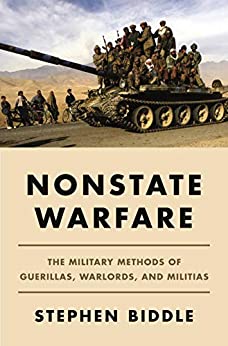
Nonstate Warfare: The Military Methods of Guerillas, Warlords, and Militias

Stephen D. Biddle

unrated
Read Advanced intel Military history Logistics Technical warfare GWOT Guerrilla / COIN Middle East Logistics ISBN 9780691207513

Princeton University Press · 2021

Since September 11th, 2001, armed nonstate actors have received increased attention and discussion from scholars, policymakers, and the military. Underlying debates about nonstate warfare and how it should be countered is one crucial assumption: that state and nonstate actors fight very differently. In Nonstate Warfare, Stephen Biddle upturns this distinction, arguing that there is actually nothing intrinsic separating state or nonstate military behavior. Through an in-depth look at nonstate military conduct, Biddle shows that many nonstate armies now fight more conventionally than many state armies. Biddle frames nonstate and state methods along a continuum, spanning Fabian-style irregular warfare to Napoleonic-style warfare involving massed armies, and he presents a systematic theory to explain any given nonstate actor's position on this spectrum. Showing that most warfare for at least a century has kept to the blended middle of the spectrum, Biddle argues that material and tribal culture explanations for nonstate warfare methods do not adequately explain observed patterns of warmaking. Investigating a range of historical examples from Lebanon and Iraq to Somalia, Croatia, and the Vietcong, Biddle demonstrates that viewing state and nonstate warfighting as mutually exclusive can lead to errors in policy and scholarship.

Reset: Iran, Turkey, and America's Future

Stephen Kinzer

unrated
Read Advanced intel Military history Espionage Middle East Strategy / theory ISBN 9780805091274

Times Books · 2010

The bestselling author of Overthrow offers a new and surprising vision for rebuilding America's strategic partnerships in the Middle East What can the United States do to help realize its dream of a peaceful, democratic Middle East? Stephen Kinzer offers a surprising answer in this paradigm-shifting book. Two countries in the region, he argues, are America's logical partners in the twenty-first Turkey and Iran. Besides proposing this new "power triangle," Kinzer also recommends that the United States reshape relations with its two traditional Middle East allies, Israel and Saudi Arabia. This book provides a penetrating, timely critique of America's approach to the world's most volatile region, and offers a startling alternative. Kinzer is a master storyteller with an eye for grand characters and illuminating historical detail. In this book he introduces us to larger-than-life figures, like a Nebraska schoolteacher who became a martyr to democracy in Iran, a Turkish radical who transformed his country and Islam forever, and a colorful parade of princes, politicians, women of the world, spies, oppressors, liberators, and dreamers. Kinzer's provocative new view of the Middle East is the rare book that will richly entertain while moving a vital policy debate beyond the stale alternatives of the last fifty years.

Soldier Spies: Israeli Military Intelligence

Samuel M. Katz

unrated
Read Advanced intel Espionage Middle East Intel history ISBN 089141357X

Presidio Press · 1992

Chronicling the spectacular successes of Israel's often overlooked military intelligence service, the first full length history of A'man discusses the agency's role in Israel's history, from the War of Independence to the present. 10,000 first printing.

The Accidental Guerrilla: Fighting Small Wars in the Midst of a Big One

David Kilcullen

unrated
Read Advanced intel GWOT Guerrilla / COIN Middle East Intel history Strategy / theory ISBN 9780195368345

Oxford University Press · 2009

David Kilcullen is one of the world's most influential experts on counterinsurgency and modern warfare. A Senior Counterinsurgency Advisor to General David Petraeus in Iraq, his vision of war dramatically influenced America's decision to rethink its military strategy in Iraq and implement "the surge." Now, in The Accidental Guerrilla , Kilcullen provides a remarkably fresh perspective on the War on Terror. Kilcullen takes us "on the ground" to uncover the face of modern warfare, illuminating both the big global war (the "War on Terrorism") and its relation to the associated "small wars" across the Iraq, Afghanistan, the Philippines, Indonesia, Thailand, Chechnya, Pakistan and North Africa. Kilcullen sees today's conflicts as a complex pairing of contrasting local social networks and worldwide movements; traditional and postmodern culture; local insurgencies seeking autonomy and a broader pan-Islamic campaign. He warns that America's actions in the war on terrorism have tended to conflate these trends, blurring the distinction between local and global struggles and thus enormously complicating our challenges. Indeed, the US had done a poor job of applying different tactics to these very different situations, continually misidentifying insurgents with limited aims and legitimate grievances (whom he calls "accidental guerrillas") as part of a coordinated worldwide terror network. We must learn how to disentangle these strands, develop strategies that deal with global threats, avoid local conflicts where possible, and win them where necessary. Colored with gripping battlefield experiences that range from the jungles and highlands of Southeast Asia to the mountains of the Afghanistan-Pakistan border to the dusty towns of the Middle East, The Accidental Guerrilla will, quite simply, change the way we think about war. This much anticipated book will be a must read for everyone concerned about the war on terror.