S2 Search · Reading list

S2 Actual reading list

Books from S2 Actual on Goodreads, organized by his shelves and topic buckets (intel lists, military history, logistics, etc.). Metadata filled via Open Library.

Not official S2 Underground. Independent fan index — not affiliated with or endorsed by S2. Official hub: linktr.ee/S2_underground. S2 materials are CC BY-NC-SA 4.0.

S2 topic buckets (Goodreads)

Subjects & genres

137 books · Advanced intel · page 1 of 6

No cover · Amazon

Alexander Dolgun's story: An American in the Gulag

Alexander Dolgun

★★★★★
Read Advanced intel Biographies Privacy Russia / USSR

Alexander Dolgun, from embassy employee, to prisoner, then falsely convicted of being a terrorist against Russia and sentenced to hard labor. Released after eight long years he is finally able to recount the experience of being transported to and between prisons, interactions and friendships with other prisoners, the day to day drudgery of trying to stay alive under horrendous conditions which involved trying to meet ridiculously high work quotas for extremely strenuous jobs while in a constant state of starvation and often, sickness.
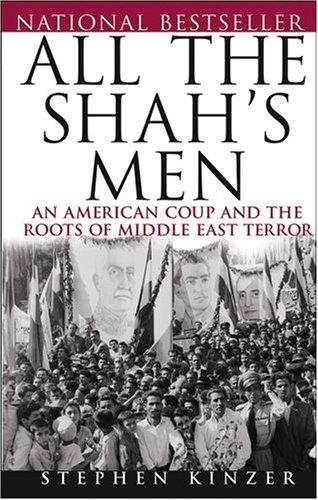

All the Shah's Men: An American Coup and the Roots of Middle East Terror

Stephen Kinzer

★★★★★
Read Advanced intel Intel history Military history Espionage GWOT Middle East Intel history Orthodox / theology ISBN 9780471678786

Wiley · August 12, 2004

Half a century ago, the United States overthrew a Middle Eastern government for the first time. The victim was Mohammad Mossadegh, the democratically elected prime minister of Iran. Although the coup seemed a success at first, today it serves as a chilling lesson about the dangers of foreign intervention.In this book, veteran New York Times correspondent Stephen Kinzer gives the first full account of this fateful operation. His account is centered around an hour-by-hour reconstruction of the events of August 1953, and concludes with an assessment of the coup's "haunting and terrible legacy." Operation Ajax, as the plot was code-named, reshaped the history of Iran, the Middle East, and the world. It restored Mohammad Reza Shah to the Peacock Throne, allowing him to impose a tyranny that ultimately sparked the Islamic Revolution of 1979. The Islamic Revolution, in turn, inspired fundamentalists throughout the Muslim world, including the Taliban and terrorists who thrived under its protection."It is not far-fetched," Kinzer asserts in this book, "to draw a line from Operation Ajax through the Shah's repressive regime and the Islamic Revolution to the fireballs that engulfed the World Trade Center in New York."Drawing on research in the United States and Iran, and using material from a long-secret CIA report, Kinzer explains the background of the coup and tells how it was carried out. It is a cloak-and-dagger story of spies, saboteurs, and secret agents. There are accounts of bribes, staged riots, suitcases full of cash, and midnight meetings between the Shah and CIA agent Kermit Roosevelt, who was smuggled in and out of the royal palace under a blanket in the back seat of a car. Roosevelt,the grandson of President Theodore Roosevelt, was a real-life James Bond in an era when CIA agents operated mainly by their wits. After his first coup attempt failed, he organized a second attempt that succeeded three days later.The colorful cast of characters includes the terrified young Shah, who fled his country at the first sign of trouble; General H. Norman Schwarzkopf, father of the Gulf War commander and the radio voice of "Gang Busters," who flew to Tehran on a secret mission that helped set the coup in motion; and the fiery Prime Minister Mossadegh, who outraged the West by nationalizing the immensely profitable Anglo-Iranian Oil Company. The British, outraged by the seizure of their oil company, persuaded President Dwight Eisenhower that Mossadegh was leading Iran toward Communism. Eisenhower and Prime Minister Winston Churchill of Great Britain became the coup's main sponsors. Brimming with insights into Middle Eastern history and American foreign policy, this book is an eye-opening look at an event whose unintended consequences - Islamic revolution and violent anti-Americanism--have shaped the modern world. As the United States assumes an ever-widening role in the Middle East, it is essential reading.

No cover · Amazon

Armageddon: The Battle for Germany, 1944-1945

Max Hastings

★★★★★
Read Military history Advanced intel WWII

In September 1944, the Allies believed that Hitler’s army was beaten and expected the bloodshed to end by Christmas. Yet a series of mistakes and setbacks, including the Battle of the Bulge, drastically altered this timetable and led to eight more months of brutal fighting. With Armageddon, the eminent military historian Max Hastings gives us memorable accounts of the great battles and captures their human impact on soldiers and civilians. He tells the story of both the Eastern and Western Fronts, raising provocative questions and offering vivid portraits of the great leaders. This rousing and revelatory chronicle brings to life the crucial final months of the twentieth century’s greatest global conflict.

No cover · Amazon

Besieged: The Epic Battle For Cholm

Jason D. Mark

★★★★★
Read Advanced intel Military history Logistics WWII Naval Air power Guerrilla / COIN Russia / USSR Logistics

Kampfgruppe Scherer’s outstanding feat of arms was one of Germany’s most famous military achievements during the Second World War. With only a few thousand men from all branches of the service, including mountain troopers, elderly reservists, police officers, navy drivers, SS partisan hunters and supply troops, Generalmajor Theodor Scherer was ordered to hold Cholm in the face of a superior enemy force. That Scherer and his men prevailed is now an historical fact but analysis of daily radio traffic and combat reports reveals that the pocket’s survival was precarious; at times, even senior commanders doubted if it could be saved. On several occasions the Soviet onslaught looked poised to inflict the death blow but somehow the exhausted men of Cholm grimly clung to a few resistance nests upon which a new line was anchored. General Scherer, a popular leader and inspiration to all his soldiers, despaired many times and was forced to continually plead for more men, more supplies and more aerial support. Urgent demands by other sectors meant Kampfgruppe Scherer was drip-fed just enough supplies and reinforcements to stay alive until, eventually, a relief force forged a permanent link and freed the exhausted survivors. After a catastrophic winter of setbacks and resounding defeats for the Wehrmacht, the General and his men were lauded as heroes and recognised with an arm shield that marked them as “Cholmkämpfer,” men of exceptional courage who had prevailed despite overwhelming odds. Primary sources have been utilised for the first time to present this battle in a detailed day-by-day format, from the forlorn days of January and February to liberation in early May.

No cover · Amazon

Black Hawk Down: A Story of Modern War

Mark Bowden

★★★★★
Read Basic intel Advanced intel Military history Intel history

On October 3, 1993, about a hundred U.S. soldiers were dropped by helicopter into a teeming market in the heart of Mogadishu, Somalia, to abduct two top lieutenants of a Somali warlord. The action was supposed to take an hour. Instead, they spent a long and terrible night fighting thousands of armed Somalis. By morning, eighteen Americans were dead, and more than seventy badly injured. Mark Bowden's gripping narrative is one of the most exciting accounts of modern war ever written--a riveting story that captures the heroism, courage and brutality of battle.

Bloodlands: Europe Between Hitler and Stalin

Timothy Snyder

★★★★★
Read Military history Advanced intel Logistics WWII Cold War Russia / USSR Logistics ISBN 9780465002399

Basic Books · 2010

Americans call the Second World War “The Good War.” But before it even began, America’s wartime ally Josef Stalin had killed millions of his own citizens—and kept killing them during and after the war. Before Hitler was finally defeated, he had murdered six million Jews and nearly as many other Europeans. At war’s end, both the German and the Soviet killing sites fell behind the iron curtain, leaving the history of mass killing in darkness. Bloodlands is a new kind of European history, presenting the mass murders committed by the Nazi and Stalinist regimes as two aspects of a single history, in the time and place where they occurred: between Germany and Russia, when Hitler and Stalin both held power. Assiduously researched, deeply humane, and utterly definitive, Bloodlands will be required reading for anyone seeking to understand the central tragedy of modern history. From Booklist If there is an explanation for the political killing perpetrated in eastern Europe in the 1930s and 1940s, historian Snyder roots it in agriculture. Stalin wanted to collectivize farmers; Hitler wanted to eliminate them so Germans could colonize the land. The dictators wielded frightening power to advance such fantasies toward reality, and the despots toted up about 14 million corpses between them, so stupefying a figure that Snyder sets himself three goals here: to break down the number into the various actions of murder that comprise it, from liquidation of the kulaks to the final solution; to restore humanity to the victims via surviving testimony to their fates; and to deny Hitler and Stalin any historical justification for their policies, which at the time had legions of supporters and have some even today. Such scope may render Snyder’s project too imposing to casual readers, but it would engage those exposed to the period’s chronology and major interpretive issues, such as the extent to which the Nazi and Soviet systems may be compared. Solid and judicious scholarship for large WWII collections.

No cover · Amazon

Crime and Punishment

Fyodor Dostoevsky

★★★★★
Read Advanced intel

Raskolnikov, a destitute and desperate former student, wanders through the slums of St Petersburg and commits a random murder without remorse or regret. He imagines himself to be a great man, a Napoleon: acting for a higher purpose beyond conventional moral law. But as he embarks on a dangerous game of cat-and-mouse with Porfiry, a suspicious detective, Raskolnikov is pursued by the growing voice of his conscience and finds the noose of his own guilt tightening around his neck. Only Sonya, a downtrodden prostitute, can offer the chance of redemption. As the ensuing investigation and trial reveal the true identity of the murderer, Dostoyevsky's dark masterpiece evokes a world where the lines between innocence and corruption, good and evil, blur and everyone's faith in humanity is tested.

No cover · Amazon

Crusade: The Untold Story of the Persian Gulf War

Rick Atkinson

★★★★★
Read Basic intel Advanced intel Technical warfare Logistics Intel history Military history Middle East Logistics Strategy / theory

A definitive account of the Gulf War told by Pulitzer Prize–winning correspondent Rick Atkinson. This previously untold story of the US war with Iraq in the early 1990s, Atkinson follows the 42-day war from the first night to the final day, providing vivid accounts of bombing runs, White House strategy sessions, firefights, and bitter internal conflicts.

Desert War: The North African Campaign 1940-43

Alan Moorehead

★★★★★
Read Intel history Military history Advanced intel Logistics WWII Armor Logistics Biography ISBN 0140275142

Penguin Books · 2001

The seminal account of the battle between Montgomery’s Eighth Army and Rommel’s Afrika Corps, amidst the endless harsh wastes of the Western Desert. In 1940, Alan Moorehead was sent to cover the North Africa campaign by the Daily Express, and he followed its dramatic course all the way to 1943. The three books he subsequently wrote about the Desert War – later collected as his ‘African Trilogy’ – were swiftly acclaimed as a classic account of the tussle between Montgomery’s Eighth Army and Rommel’s Afrika Corps, under the beating sun of the Egyptian Sahara's Western Desert. Moorehead was responsible for the celebrated insight that tank battles in the desert are like battles at sea, the lumbering tanks like ships lost in a vast ocean of sand. The New Statesman could not have put it better when it described his achievement with this riveting book: ‘There is something of genius in the breadth and penetration of his vision , which encompasses the whole panorama of war and then narrows it down to the particular: the soldier stubbing out his cigarette before going into action, the expression on a tank commander’s face as he is hit… The story of the African campaigns will go down in history as one of the great epics of mankind, largely thanks to Mr Moorehead’s account.’

No cover · Amazon

Dragon Days: Time for "Unconventional" Tactics

H. John Poole

★★★★★
Read Advanced intel Vietnam Korea Guerrilla / COIN Middle East Strategy / theory

This book shows how to control a contested region with squad-sized outposts . North Vietnam and Iran have done it. Now, North Korea may try to consolidate the South with such a strategy. Scores of tiny Western outposts could do this too. After a short threat assessment, Dragon Days describes what a single U.S. rifle squad must do to safely accomplish such a mission in Asia. It will need the following Unconventional Warfare (UW) (1) some police procedure; (2) obscurely defending; (3) finding an enemy weakness; (4) making a secret approach; (5) disguising the attack; (6) precluding a counterstroke; (7) rural E&E; (8) enhancing rural terrain (9) urban E&E; and (10) enhancing urban terrain . Because of Asia's bottom-up culture, the little picture is where such an ability originates. This heavily illustrated book contains more small-unit perspective than any U.S. govt. publication. In fact, it may still constitute America's only UW tactical-technique manual .

Expeditionary Eagles: Outmaneuvering the Taliban

H. John Poole

★★★★★
Read Advanced intel GWOT Guerrilla / COIN Strategy / theory ISBN 9780981865928

Posterity Press · 2010

The Afghan War is still salvagable. For America, it has been about denying sanctuary to al-Qaeda. For local factions and governments, a traditional fund raiser--heroin--is more important. Only with less smuggling of drugs out and ordnance in, can the insurgency be limited. Both have been broken down into more easily concealable "pieces." All traffic along the 14 entrance highways must be better inspected to curtail their movement. Herein lies the most detailed study in existence of Pakistan's drug and militant madrasa networks. Also discussed is how a lone U.S. squad could--without a single artillery round or drone missile--rely on deception to defend a roadside outpost against hundreds of attacking narco-insurgents.

No cover · Amazon

Forward Observer: A U.S. Army Artillery Detail in the North Africa Campaign of World War Two

Edwin Westrate

★★★★★
Read Advanced intel Military history Intel history Technical warfare

Forward Observer, first published in 1944, is the account of a U.S. Army artillery observation crew in World War Two. The author based the book on interviews with two surviving members of the crew while they were recuperating from injuries received after their prison ship was sunk in the Mediterranean (the men were being transferred to Italy from Africa, en route to a German prison camp). The account, fast-paced and filled with action, depicts the soldier's lives from training at the Army's Field Artillery School at Fort Sill, Oklahoma, a short stay for more training in England, and then the unit's transfer to Tunisia where they occupy the frontlines as forward observers for their artillery battalion. Forward Observer is a moving, personal story of a seldom-told aspect of combat in the Second World War. Included are 3 pages of maps.

Hitler's Beneficiaries: Plunder, Racial War, and the Nazi Welfare State

Götz Aly

★★★★★
Read Advanced intel Military history Logistics WWII Logistics Economics ISBN 9780805079265

Metropolitan · 2007

A "provocative" account of great "intellectual significance," illuminating the economic workings of the Third Reich—and the reasons ordinary Germans supported the Nazi state (The New York Times Book Review) In this groundbreaking book, historian Götz Aly addresses one of modern history's greatest conundrums: How did Hitler win the allegiance of ordinary Germans? The answer is as shocking as it is persuasive: by engaging in a campaign of theft on an almost unimaginable scale—and by channeling the proceeds into generous social programs—Hitler literally "bought" his people's consent. Drawing on secret files and financial records, Aly shows that while Jews and citizens of occupied lands suffered crippling taxation, mass looting, enslavement, and destruction, most Germans enjoyed an improved standard of living. Buoyed by millions of packages soldiers sent from the front, Germans also benefited from the systematic plunder of Jewish possessions. Any qualms were swept away by waves of tax breaks and government handouts. Hitler's Beneficiaries has been hailed as "startling" by Richard Evans, and as "fascinating and important" by Christopher Browning. Above all, as Omer Bartov testifies, this remarkable book "irreversibly transforms our understanding of the Third Reich."

Hitler's Foreign Executioners: Europe's Dirty Secret

Christopher Hale

★★★★★
Read Advanced intel Intel history Military history Logistics WWII Russia / USSR Logistics ISBN 9780752459745

The History Press · 2011

How and why more than one million non-Germans joined Hitler's "war of annihilation" Revealing for the first time Heinrich Himmler's master plan for Europe, this book discusses his dream of an SS empire with no place for either the Nazi Party or Adolf Hitler. His astonishingly ambitious plan depended on the recruitment of tens of thousands of "Germanic" peoples to build an "SS Europa." This book, researched in archives all over Europe and using first-hand testimony, exposes Europe's dirty secret—that nearly half a million Europeans and more than a million Soviet citizens enlisted in the armed forces of the Third Reich—to fight a crusade against "Jewish-Bolshevism." No other historian has examined the connections between these SS "foreign legions" (both police and Waffen-SS) and the Holocaust. Even today, some apologists claim that the foreign volunteers were merely soldiers "like any other" and fought a decent war against Stalin's Red Army. Christopher Hale demonstrates conclusively that these surprisingly common views are mistaken.

Homeland Siege: Tactics for Police and Military

H. John Poole

★★★★★
Read Advanced intel GWOT China ISBN 9780981865911

Posterity Press · 2009

America is still in serious trouble. There's no way all of her internal problems have been self-inflicted. Yet, many still (1) ISIS and al-Qaeda are her only foes; (2) her intelligence agencies see every threat coming; and (3) her military is the best in the world at all things. This book reassesses the breakdown from a "bottom-up" perspective, as that's how Islamists, Communists, and criminals like to take over. Such "qualitative research" is regularly used by U.S. police departments. After detailing the subversion, this book (1) the most extensive study of hostage rescue ever attempted; (2) a safer way for grunts and SWATs to quickly seize any contested building; and (3) how Nepal was finally taken over by China at the ballot box.

Inside the VC and the NVA

Michael Lee Lanning

★★★★★
Read Basic intel Advanced intel Technical warfare Vietnam ISBN 0804105006

Ivy Books · 1994

"An intimate, candid portrait of the Viet Cong/North Vietnamese Army...An absolute necessity for Vietnamese-studies collections." During the war in Vietnam, the North Vietnamese communists had to place their trust in the oldest and most reliable tool of the individual soldier; America believed that firepower, lgoistics, and technology would be sufificent for victory. The North Vietnamese won. INSIDE THE VC AND THE NVA, written by two veterans with six-and-a-half years combined experience, shows how. A Dual Main Selection of the Military Book Club

Leningrad: Tragedy of a City Under Siege, 1941-44.

Anna Reid

★★★★★
Read Advanced intel Military history Logistics WWII Cold War Russia / USSR Logistics Biography ISBN 9781408822418

Bloomsbury Publishing PLC · Nov 07, 2012

On September 8, 1941, eleven weeks after Hitler launched Operation Barbarossa, his brutal surprise attack on the Soviet Union, Leningrad was surrounded. The siege was not lifted for two and a half years, by which time some three quarters of a million Leningraders had died of starvation. Anna Reid's Leningrad is a gripping, authoritative narrative history of this dramatic moment in the twentieth century, interwoven with indelible personal accounts of daily siege life drawn from diarists on both sides. They reveal the Nazis' deliberate decision to starve Leningrad into surrender and Hitler's messianic miscalculation, the incompetence and cruelty of the Soviet war leadership, the horrors experienced by soldiers on the front lines, and, above all, the terrible details of life in the blockaded city: the relentless search for food and water; the withering of emotions and family ties; looting, murder, and cannibalism- and at the same time, extraordinary bravery and self-sacrifice. Stripping away decades of Soviet propaganda, and drawing on newly available diaries and government records, Leningrad also tackles a raft of unanswered questions: Was the size of the death toll as much the fault of Stalin as of Hitler? Why didn't the Germans capture the city? Why didn't it collapse into anarchy? What decided who lived and who died? Impressive in its originality and literary style, Leningrad gives voice to the dead and will rival Anthony Beevor's classic Stalingrad in its impact.

Militant Tricks: Battlefield Ruses of the Islamic Insurgent

H. John Poole

★★★★★
Read Advanced intel GWOT Guerrilla / COIN China Middle East Strategy / theory ISBN 9780963869586

Posterity Press · October 17, 2005

THIS BOOK WAS ON THE U.S. ARMY'S MOST PRESTIGIOUS READING LIST. Since 9/11, our deployed troops have learned many things. Though the war in Afghanistan has just ended, many of their hard-won lessons have yet to be assimilated by the Stateside bureaucracy. To help, "Militant Tricks" has recounted America's progress in Iraq and Afghanistan from the standpoint of East Asian BATTLEFIELD DECEPTION. Both countries were part of the Mongol Empire for over 200 years and thus prone to every sort of ancient Chinese illusion. "Militant Tricks" also contains the TACTICAL TECHNIQUES WITH WHICH TO COUNTER AN ISLAMIC EXTREMIST'S URBAN OFFENSIVE. While some of these nontraditional techniques were risked during the Baghdad Surge, they may soon be forgotten.

Military Innovation in the Interwar Period

Williamson Murray

★★★★★
Read Advanced intel Military history WWII Strategy / theory ISBN 9780521637602

Cambridge University Press · 1998

This study of major military innovations in the 1920s and 1930s explores differences in innovating exploitation by the seven major military powers. This volume of comparative essays investigates how and why innovation occurred or did not occur, and explains much of the strategic and operative performance of the Axis and Allies in World War II.

Networks and Netwars: The Future of Terror, Crime, and Militancy

John Arquilla

★★★★★
Read Advanced intel Cryptography Intel history Privacy Espionage Cyber ISBN 0833030302

Rand · 2001

Netwar―like cyberwar―describes a new spectrum of conflict that is emerging in the wake of the information revolution. What distinguished netwar is the networked organizational structure of its practitioners and their quickness in coming together in swarming attacks. To confront this new type of conflict, it is crucial for governments, military, and law enforcement to begin networking themselves.

Panzerkrieg: The Rise and Fall of Hitler's Tank Divisions

Peter McCarthy

★★★★★
Read Advanced intel Intel history Logistics Technical warfare Military history WWII Cold War Armor Russia / USSR Logistics Biography ISBN 0786710098

Carroll & Graf Publishers · 2002

The image that defines the Nazis’ Blitzkrieg is that of the Panzerwaffe’s massed columns of tanks sweeping through Europe, all resistance smashed in their wake. The Panzers’ achievements in battle were largely responsible for Germany’s early successes in World War II, and once the tide had turned against the Reich, the Panzers became the backbone of its defense. But the dramatic story of Hitler’s tank divisions is more than one of mere mechanical efficiency. It hangs, too, on those who commanded and fought in them, and believed in their near invincibility. These are the men who come to life in this immensely readable narrative. Great generals like Guderian, Rommel, and Manstein, tank masters like Wittmann and Bake, and inspired commanders like Balck and Bayerlein dominate the story of Panzerkreig. Dispensing with jargon, but including explanatory maps, rare illustrations, and fascinating detail on uniforms, crew members, and the mechanical features of the machines, the authors give a comprehensive overview of all aspects of the subject, both human and technical. They have also benefited from new information available since the opening of Cold War archives. Emerging from the narrative is the whole vast canvas of the war, as it follows the titanic struggles that raged between France’s bocage country, North Africa’s desert wastes, and Russia’s limitless steppes. The development of German fighting vehicles and tactics is fully charted, and the many myths and misconceptions of the Panzerwaffe are exploded. Extensive research, maps, illustrations throughout, reference to the leading participants’ memoirs, and original new conclusions all contribute to this finely measured assessment of the evolution, exploits, and eventual destruction of this superlative fighting force.

No cover · Amazon

Panzerkrieg: Volume 1 - German Armoured Operations at Stalingrad

Jason D. Mark

★★★★★
Read Military history Advanced intel WWII Air power Armor Russia / USSR Intel history

For the first time ever, the operations of panzer formations at Stalingrad are examined in detail, from formation until demise. Stalingrad is perceived as a fierce man-versus-man struggle in the ruins of a major metropolis and the surrounding steppe; yet, 6. Armee possessed formidable armoured assets that helped it reach the Volga, defended its flanks and even supported assault groups within the claustrophobic confines of the city. In this first volume of a series dedicated to studying German armoured operations at Stalingrad, the combat histories of Panzer-Abteilungen 103, 129 and 160 will be examined in detail. These panzer battalions were drawn from panzer regiments on the quieter central sector of the Eastern Front. They were incorporated into motorized divisions for the 1942 summer campaign, and though most of their men thought they were headed to the Caucasus, all roads ultimately led to Stalingrad. As manpower levels dropped in their parent formations, the panzer battalions assumed a greater role in holding lengthy flanks while the main body of 6. Armee laid siege to Stalingrad. After encirclement in November 1942, the panzers assembled for a break-out operation, and when that failed to eventuate, they supported their struggling infantry brethren with plucky counterattacks and steadfast defense until fuel, ammunition and morale were depleted. Unprecedented access to Deutsche Dienststelle (WASt), a government agency that maintains records of former Wehrmacht personnel, has permitted the life and death of each battalion to be analysed in incredible detail. The narrative is enhanced by hundreds of rare photos drawn from official archives, private collections and the albums of veterans themselves. -280 x 216 Portrait format -568 Pages on high-quality gloss paper -Hardcover only -559 Photos -12 Aerial photos -50 Maps -12 Tables -3 appendices showing the daily panzer strengths of each battalion

Relentless Strike: The Secret History of Joint Special Operations Command

Sean Naylor

★★★★★
Read Basic intel Advanced intel Military history Intel history Technical warfare GWOT Special ops Naval Air power Nuclear Middle East ISBN 9781250014542

St. Martin's Press · 2015

The New York Times Bestseller and Winner of the 2015 Army Historical Foundation Distinguished Writing Award for Unit History Since the attacks of September 11, one organization has been at the forefront of America's military response. Its efforts turned the tide against al-Qaida in Iraq, killed Bin Laden and Zarqawi, rescued Captain Phillips and captured Saddam Hussein. Its commander can direct cruise missile strikes from nuclear submarines and conduct special operations raids anywhere in the world. Relentless Strike tells the inside story of Joint Special Operations Command, the secret military organization that during the past decade has revolutionized counterterrorism, seamlessly fusing intelligence and operational skills to conduct missions that hit the headlines, and those that have remained in the shadows-until now. Because JSOC includes the military's most storied special operations units-Delta Force, SEAL Team 6, the 75th Ranger Regiment-as well as America's most secret aviation and intelligence units, this is their story, too. Relentless Strike reveals tension-drenched meetings in war rooms from the Pentagon to Iraq and special operations battles from the cabin of an MH-60 Black Hawk to the driver's seat of Delta Force's Pinzgauer vehicles as they approach their targets. Through exclusive interviews, reporter Sean Naylor uses his unique access to reveal how an organization designed in the 1980s for a very limited mission set transformed itself after 9/11 to become the military's premier weapon in the war against terrorism and how it continues to evolve today.

Sniper One: The Blistering True Story Of A British Battle Group Under Siege

Dan Mills

★★★★★
Read Biographies Intel history Technical warfare Advanced intel Military history GWOT Middle East Biography ISBN 9780141029016

Penguin · 2008

Sniper One is the gritty, awe-inspiring true story that takes you right into the heart of the Iraq war from Sunday Times No.1 bestseller Sgt. Dan Mills. 'One of the best first-hand accounts of combat that I've ever read' Andy McNab We all saw it at once. Half a dozen voices screamed 'Grenade!' simultaneously. Then everything went into slow motion. The grenade took an age to travel through its 20 metre arc. A dark, small oval-shaped package of misery the size of a peach ... April 2004: Dan Mills and his platoon of snipers fly into southern Iraq, part of an infantry battalion sent to win hearts and minds. They were soon fighting for their lives. Back home we were told they were peacekeeping. But there was no peace to keep. Because within days of arriving in theatre, Mills and his men were caught up in the longest, most sustained fire fight British troops had faced for over fifty years. This awe-inspiring account tells of total war in throat-burning winds and fifty-degree heat, blasted by mortars and surrounded by heavily armed militias. For six months, they fought isolated, besieged and under constant enemy fire. Their heroic stand a modern-day Rorke's Drift. ************** Dan Mills served for 24 years as an Infantry Soldier reaching the rank of Warrant Officer Class 2. During his long military career he served on operations in Northern Ireland, Bosnia, Kosovo, Iraq and Afghanistan. Dan was awarded a 'Mention In Despatches' for Gallantry for his services during The Iraq War. Since leaving the Army in 2010, he has forged a career as a writer and security consultant, amongst other things. Sniper One is his first book.