S2 Search · Reading list

S2 Actual reading list

Books from S2 Actual on Goodreads, organized by his shelves and topic buckets (intel lists, military history, logistics, etc.). Metadata filled via Open Library.

Not official S2 Underground. Independent fan index — not affiliated with or endorsed by S2. Official hub: linktr.ee/S2_underground. S2 materials are CC BY-NC-SA 4.0.

S2 topic buckets (Goodreads)

Subjects & genres

54 books · Read · subject Economics · page 1 of 3

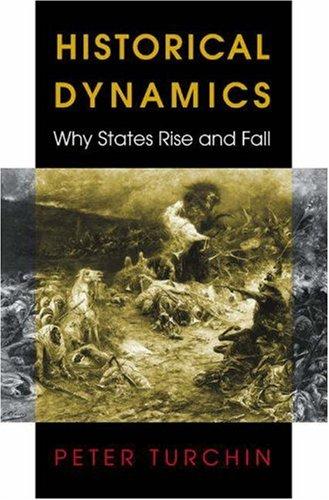
Historical Dynamics: Why States Rise and Fall (Princeton Studies in Complexity)

Peter Turchin

★★★★★
Read Logistics Logistics Economics ISBN 0691116695

Princeton University Press · 2003

Many historical processes are dynamic. Populations grow and decline. Empires expand and collapse. Religions spread and wither. Natural scientists have made great strides in understanding dynamical processes in the physical and biological worlds using a synthetic approach that combines mathematical modeling with statistical analyses. Taking up the problem of territorial dynamics--why some polities at certain times expand and at other times contract--this book shows that a similar research program can advance our understanding of dynamical processes in history. Peter Turchin develops hypotheses from a wide range of social, political, economic, and demographic geopolitics, factors affecting collective solidarity, dynamics of ethnic assimilation/religious conversion, and the interaction between population dynamics and sociopolitical stability. He then translates these into a spectrum of mathematical models, investigates the dynamics predicted by the models, and contrasts model predictions with empirical patterns. Turchin's highly instructive empirical tests demonstrate that certain models predict empirical patterns with a very high degree of accuracy. For instance, one model accounts for the recurrent waves of state breakdown in medieval and early modern Europe. And historical data confirm that ethno-nationalist solidarity produces an aggressively expansive state under certain conditions (such as in locations where imperial frontiers coincide with religious divides). The strength of Turchin's results suggests that the synthetic approach he advocates can significantly improve our understanding of historical dynamics.
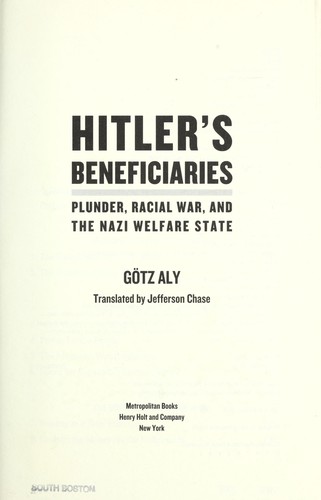
Hitler's Beneficiaries: Plunder, Racial War, and the Nazi Welfare State

Götz Aly

★★★★★
Read Advanced intel Military history Logistics WWII Logistics Economics ISBN 9780805079265

Metropolitan · 2007

A "provocative" account of great "intellectual significance," illuminating the economic workings of the Third Reich—and the reasons ordinary Germans supported the Nazi state (The New York Times Book Review) In this groundbreaking book, historian Götz Aly addresses one of modern history's greatest conundrums: How did Hitler win the allegiance of ordinary Germans? The answer is as shocking as it is persuasive: by engaging in a campaign of theft on an almost unimaginable scale—and by channeling the proceeds into generous social programs—Hitler literally "bought" his people's consent. Drawing on secret files and financial records, Aly shows that while Jews and citizens of occupied lands suffered crippling taxation, mass looting, enslavement, and destruction, most Germans enjoyed an improved standard of living. Buoyed by millions of packages soldiers sent from the front, Germans also benefited from the systematic plunder of Jewish possessions. Any qualms were swept away by waves of tax breaks and government handouts. Hitler's Beneficiaries has been hailed as "startling" by Richard Evans, and as "fascinating and important" by Christopher Browning. Above all, as Omer Bartov testifies, this remarkable book "irreversibly transforms our understanding of the Third Reich."

The American Civil War: A Military History

John Keegan

★★★★★
Read Strategy / theory Economics US Civil War ISBN 9780091794835

Hutchinson · 2009

In this magesterial history and national bestseller, John Keegan shares his original and perceptive insights into the psychology, ideology, demographics, and economics of the American Civil War. Illuminated by Keegan’s knowledge of military history he provides a fascinating look at how command and the slow evolution of its strategic logic influenced the course of the war. Above all, The American Civil War gives an intriguing account of how the scope of the conflict combined with American geography to present a uniquely complex and challenging battle space. Irresistibly written and incisive in its analysis, this is an indispensable account of America’s greatest conflict.

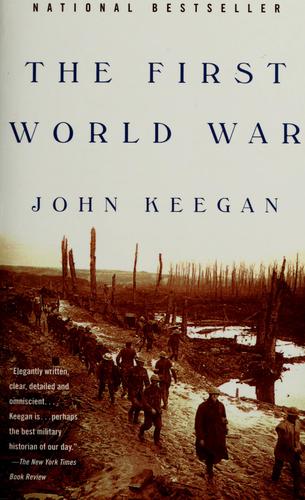
The First World War

John Keegan

★★★★★
Read Intel history WWII WWI Armor Russia / USSR Economics ISBN 9780375700453

Vintage · 2000

The First World War created the modern world. A conflict of unprecedented ferocity, it abruptly ended the relative peace and prosperity of the Victorian era, unleashing such demons of the twentieth century as mechanized warfare and mass death. It also helped to usher in the ideas that have shaped our times--modernism in the arts, new approaches to psychology and medicine, radical thoughts about economics and society--and in so doing shattered the faith in rationalism and liberalism that had prevailed in Europe since the Enlightenment. With The First World War, John Keegan, one of our most eminent military historians, fulfills a lifelong ambition to write the definitive account of the Great War for our generation. Probing the mystery of how a civilization at the height of its achievement could have propelled itself into such a ruinous conflict, Keegan takes us behind the scenes of the negotiations among Europe's crowned heads (all of them related to one another by blood) and ministers, and their doomed efforts to defuse the crisis. He reveals how, by an astonishing failure of diplomacy and communication, a bilateral dispute grew to engulf an entire continent. But the heart of Keegan's superb narrative is, of course, his analysis of the military conflict. With unequalled authority and insight, he recreates the nightmarish engagements whose names have become legend--Verdun, the Somme and Gallipoli among them--and sheds new light on the strategies and tactics employed, particularly the contributions of geography and technology. No less central to Keegan's account is the human aspect. He acquaints us with the thoughts of the intriguing personalities who oversaw the tragically unnecessary catastrophe--from heads of state like Russia's hapless tsar, Nicholas II, to renowned warmakers such as Haig, Hindenburg and Joffre. But Keegan reserves his most affecting personal sympathy for those whose individual efforts history has not recorded--"the anonymous millions, indistinguishably drab, undifferentially deprived of any scrap of the glories that by tradition made the life of the man-at-arms tolerable." By the end of the war, three great empires--the Austro-Hungarian, the Russian and the Ottoman--had collapsed. But as Keegan shows, the devastation ex-tended over the entirety of Europe, and still profoundly informs the politics and culture of the continent today. His brilliant, panoramic account of this vast and terrible conflict is destined to take its place among the classics of world history. With 24 pages of photographs, 2 endpaper maps, and 15 maps in text

The Myth of the Robber Barons: A New Look at the Rise of Big Business in America

Burton W. Folsom Jr.

★★★★★
Read Logistics Logistics Intel history Economics ISBN 0963020307

Young America's Foundation · 1991

The Myth of the Robber Barons describes the role of key entrepreneurs in the economic growth of the United States from 1850 to 1910. The entrepreneurs studied are Cornelius Vanderbilt, John D. Rockefeller, James J. Hill, Andrew Mellon, Charles Schwab, and the Scranton family. Most historians argue that these men, and others like them, were Robber Barons. The story, however, is more complicated. The author, Burton Folsom, divides the entrepreneurs into two groups market entrepreneurs and political entrepreneurs. The market entrepreneurs, such as Hill, Vanderbilt, and Rockefeller, succeeded by producing a quality product at a competitive price. The political entrepreneurs such as Edward Collins in steamships and in railroads the leaders of the Union Pacific Railroad were men who used the power of government to succeed. They tried to gain subsidies, or in some way use government to stop competitors. The market entrepreneurs helped lead to the rise of the U. S. as a major economic power. By 1910, the U. S. dominated the world in oil, steel, and railroads led by Rockefeller, Schwab (and Carnegie), and Hill. The political entrepreneurs, by contrast, were a drain on the taxpayers and a thorn in the side of the market entrepreneurs. Interestingly, the political entrepreneurs often failed without help from government they could not produce competitive products. The author describes this clash of the market entrepreneurs and the political entrepreneurs. In the Mellon chapter, the author describes how Andrew Mellon an entrepreneur in oil and aluminum became Secretary of Treasury under Coolidge. In office, Mellon was the first American to practice supply-side economics. He supported cuts on income tax rates for all groups. The rate cut on the wealthiest Americans, from 73 percent to 25 percent, freed up investment capital and led to American economic growth during the 1920s. Also, the amount of revenue into the federal treasury increased sharply after tax rates were cut. The Myth of the Robber Barons has separate chapters on Vanderbilt, Hill, Schwab, Mellon, and the Scrantons. The author also has a conclusion, in which he looks at the textbook bias on the subject of Robber Barons and the rise of the U. S. in the late 1800s. This chapter explores three leading college texts in U. S. history and shows how they misread American history and disparage market entrepreneurs instead of the political entrepreneurs. This book is in its fifth edition, and is widely adopted in college and high school classrooms across the U. S.

The Winter War: Russia's Invasion Of Finland, 1939-40

Robert Edwards

★★★★★
Read Advanced intel Basic intel Military history Intel history Logistics WWII Cold War Russia / USSR Logistics Economics ISBN 9781933648507

Pegasus Books · December 30, 2007

On November 30, 1939, the Soviet Union's Red Army invaded the young nation-state of Finland, in the full expectation of routing the small, ill-equipped Finnish army and annexing the former Russian territory by the end of the year. But Finland held out for 105 bitterly cold, fiercely combative days, until March 15, 1940, when a peace agreement ended the short, savage Winter War. At the stirring center of the story lie the resourcefulness and resolve of the Finnish people, who against all military odds—in want of ammunition, food, sleep, and troops—fought a blundering, ineptly commanded Red Army to a standstill. On March 15, they ceded to the Soviet 11 percent of their territory and 30 percent of their economic assets, but none of their national pride. The Russians meanwhile had markedly damaged their international standing and effectively ruined their military reputation-to such an extent, as this probing chapter in World War II history demonstrates, that Germany, with proud-blooded Finland as an ally, dared to launch its 1940 invasion of Russia. At the same time, though, the fiasco of the Winter War forced Stalin to acknowledge the shortcomings of the Red Army and to reform it: Germany would fall at Stalingrad in 1941. With authority, this skillfully narrated military history unfolds its story of the four-month Soviet-Finnish war and explores its consequences from London to Moscow, from Helsinki to Paris, to Washington, DC.

When Money Dies: The Nightmare of the Weimar Hyper-inflation

Adam Fergusson

★★★★★
Read Advanced intel Military history Logistics Logistics Economics ISBN 9781906964443

Old Street Publishing · Apr 23, 2010

When Money Dies is the classic history of what happens when a nation’s currency depreciates beyond recovery. In 1923, with its currency effectively worthless (the exchange rate in December of that year was one dollar to 4,200,000,000,000 marks), the German republic was all but reduced to a barter economy. Expensive cigars, artworks, and jewels were routinely exchanged for staples such as bread; a cinema ticket could be bought for a lump of coal; and a bottle of paraffin for a silk shirt. People watched helplessly as their life savings disappeared and their loved ones starved. Germany’s finances descended into chaos, with severe social unrest in its wake.Money may no longer be physically printed and distributed in the voluminous quantities of 1923. However, “quantitative easing,” that modern euphemism for surreptitious deficit financing in an electronic era, can no less become an assault on monetary discipline. Whatever the reason for a country’s deficit necessity or profligacy, unwillingness to tax or blindness to expenditure it is beguiling to suppose that if the day of reckoning is postponed economic recovery will come in time to prevent higher unemployment or deeper recession. What if it does not? Germany in 1923 provides a vivid, compelling, sobering moral tale.

When Titans Clashed: How the Red Army Stopped Hitler (Modern War Studies)

David M. Glantz

★★★★★
Read Military history WWII Cold War Russia / USSR Intel history Strategy / theory Economics ISBN 0700608990

University of Kansas · 1998

By the time Pearl Harbor had ripped apart America's peacetime pretensions, the German blitzkrieg had already blasted the Red Army back to the gates of Moscow. Yet, less than four years later, the Soviet hammer-and-sickle flew above the ruins of Berlin, stark symbol of a miraculous comeback that destroyed the German army and shattered Hitler's imperial designs. Told in swift stirring prose, When Titans Clashed provides the first full account of this epic struggle from the Soviet perspective. David Glantz, one of the world's foremost authorities on the Soviet military, and Jonathan House present a fundamentally new interpretation of what the Russians called the "Great Patriotic War." Based on unprecedented access to formerly classified Soviet sources, they counter the German perspective that has dominated previous accounts and radically revise our understanding of the Soviet experience during World War II. Placing the war within its wider political, economic, and social contexts, the authors recount how the determined Soviets overcame their initial disasters to defeat the most powerful army ever assembled. As they vividly show, this truly was war waged on a titanic scale, sweeping across a half-million square miles from Moscow to Berlin, featuring monumental offensives and counteroffensives, and ultimately costing both sides combined a staggering forty million casualties. Their work offers new revelations on Soviet strategy and tactics, Stalin's role as supreme commander of the Red Army, the emergence of innovative and courageous commanders in the crucible of combat, numerous previously concealed or neglected military operations, German miscalculations on the road to the Red capital, the effect of D-Day and the "second front" on the Soviet effort, and the war's devastating impact on the Soviet economy and civilian population. An essential volume for anyone interested in World War II or Soviet history, When Titans Clashed will change forever how we look at one of the greatest military confrontations in world history.

Destiny in the Desert: The Story Behind El Alamein - the Battle That Turned the Tide

Jonathan Dimbleby

★★★★
Read Logistics Intel history Military history Economics WWII Russia / USSR Logistics Strategy / theory Economics Orthodox / theology ISBN 9781846684449

Profile Books Ltd · 2012

This is a unique single-volume history of the road to El Alamein - 'the end of the beginning' - and the bloody battle that followed...It was the British victory at the Battle of El Alamein in November 1942 that inspired one of Churchill's most famous aphorisms: 'it is not the end nor is it the beginning of the end, but it is the end of the beginning'. And yet the true significance of this iconic episode remains unrecognised. In this thrilling historical account, Jonathan Dimbleby describes the political and strategic realities that lay behind the battle, charting the nail-biting months that led to the victory at El Alamein in November 1942. It is a story of high drama, played out both in the war capitals of London, Washington, Berlin, Rome and Moscow, and at the front, in the command posts and foxholes in the desert. "El Alamein" is about politicians and generals, diplomats, civil servants and soldiers. It is about forceful characters and the tensions and rivalries between them. Drawing on official records and the personal insights of those involved at every level, Dimbleby creates a vivid portrait of a struggle which for Churchill marked the turn of the tide - and which for the soldiers on the ground involved fighting and dying in a foreign land.

Economics in One Lesson

Henry Hazlitt

★★★★
Read Basic intel Logistics Economics Logistics Intel history Economics Orthodox / theology ISBN 9780870004278

Blackstone Audiobooks · 1946

A million copy seller, Henry Hazlitt’s Economics in One Lesson is a classic economic primer. But it is also much more, having become a fundamental influence on modern “libertarian” economics of the type espoused by Ron Paul and others. Considered among the leading economic thinkers of the “Austrian School,” which includes Carl Menger, Ludwig von Mises, Friedrich (F.A.) Hayek, and others, Henry Hazlitt (1894-1993), was a libertarian philosopher, an economist, and a journalist. He was the founding vice-president of the Foundation for Economic Education and an early editor of The Freeman magazine, an influential libertarian publication.  Hazlitt wrote Economics in One Lesson, his seminal work, in 1946. Concise and instructive, it is also deceptively prescient and far-reaching in its efforts to dissemble economic fallacies that are so prevalent they have almost become a new orthodoxy. Many current economic commentators across the political spectrum have credited Hazlitt with foreseeing the collapse of the global economy which occurred more than 50 years after the initial publication of Economics in One Lesson. Hazlitt’s focus on non-governmental solutions, strong — and strongly reasoned — anti-deficit position, and general emphasis on free markets, economic liberty of individuals, and the dangers of government intervention make Economics in One Lesson, every bit as relevant and valuable today as it has been since publication.

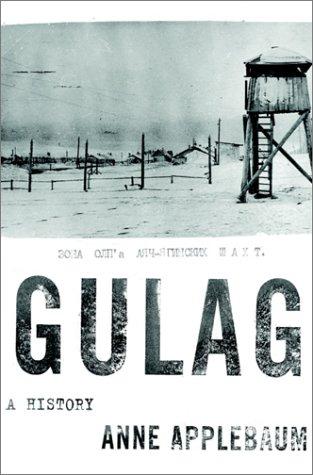
Gulag: A History

Anne Applebaum

★★★★
Read WWII Cold War Russia / USSR Biography Economics Revolution ISBN 0767900561

Doubleday · 2003

The Gulag—the vast array of Soviet concentration camps—was a system of repression and punishment whose rationalized evil and institutionalized inhumanity were rivaled only by the Holocaust. The Gulag entered the world's historical consciousness in 1972, with the publication of Alexander Solzhenitsyn's epic oral history of the Soviet camps, The Gulag Archipelago. Since the collapse of the Soviet Union, dozens of memoirs and new studies covering aspects of that system have been published in Russia and the West. Using these new resources as well as her own original historical research, Anne Applebaum has now undertaken, for the first time, a fully documented history of the Soviet camp system, from its origins in the Russian Revolution to its collapse in the era of glasnost. It is an epic feat of investigation and moral reckoning that places the Gulag where it belongs: at the center of our understanding of the troubled history of the twentieth century. Anne Applebaum first lays out the chronological history of the camps and the logic behind their creation, enlargement, and maintenance. The Gulag was first put in place in 1918 after the Russian Revolution. In 1929, Stalin personally decided to expand the camp system, both to use forced labor to accelerate Soviet industrialization and to exploit the natural resources of the country's barely habitable far northern regions. By the end of the 1930s, labor camps could be found in all twelve of the Soviet Union's time zones. The system continued to expand throughout the war years, reaching its height only in the early 1950s. From 1929 until the death of Stalin in 1953, some 18 million people passed through this massive system. Of these 18 million, it is estimated that 4.5 million never returned. But the Gulag was not just an economic institution. It also became, over time, a country within a country, almost a separate civilization, with its own laws, customs, literature, folklore, slang, and morality. Topic by topic, Anne Applebaum also examines how life was lived within this shadow country: how prisoners worked, how they ate, where they lived, how they died, how they survived. She examines their guards and their jailers, the horrors of transportation in empty cattle cars, the strange nature of Soviet arrests and trials, the impact of World War II, the relations between different national and religious groups, and the escapes, as well as the extraordinary rebellions that took place in the 1950s. She concludes by examining the disturbing question why the Gulag has remained relatively obscure, in the historical memory of both the former Soviet Union and the West. Gulag: A History will immediately be recognized as a landmark work of historical scholarship and an indelible contribution to the complex, ongoing, necessary quest for truth.

Hitler's War

David Irving

★★★★
Read WWII WWI Biography Economics ISBN 9780333357910

Macmillan · 1977

Beginning in 1933 with Hitler's economic and military rebuilding of Germany following World War I, and concluding in 1945 with the events surrounding his alleged Hitler's War is an insider's view of the events from the point of view of the man who held Europe in thrall for more than a decade. 16 pages of photographs.

How to Feed a Dictator: Saddam Hussein, Idi Amin, Enver Hoxha, Fidel Castro, and Pol Pot Through the Eyes of Their Cooks

Witold Szabłowski

★★★★
Read Military history Middle East Intel history Biography Economics ISBN 9780143129752

Penguin Publishing Group · 2020

Anthony Bourdain meets Kapuściński in this chilling look from within the kitchen at the appetites of five of the twentieth century’s most infamous dictators, by the acclaimed author of Dancing Bears. What was Pol Pot eating while two million Cambodians were dying of hunger? Did Idi Amin really eat human flesh? And why was Fidel Castro obsessed with one particular cow? Traveling across four continents, from the ruins of Iraq to the savannahs of Kenya, Witold Szabłowski tracked down the personal chefs of five dictators known for the oppression and massacre of their own citizens—Iraq’s Saddam Hussein, Uganda’s Idi Amin, Albania’s Enver Hoxha, Cuba’s Fidel Castro, and Cambodia’s Pol Pot—and listened to their stories over sweet-and-sour soup, goat-meat pilaf, bottles of rum, and games of gin rummy. Dishy, deliciously readable, and dead serious, How to Feed a Dictator provides a knife’s-edge view of life under tyranny.

Midnight in Chernobyl: The Untold Story of the World's Greatest Nuclear Disaster

Adam Higginbotham

★★★★
Read Cold War Nuclear Russia / USSR Biography Economics ISBN 9781501134616

2019

The story of Chernobyl is more complex, more human, and more terrifying than the Soviet myth. Adam Higginbotham has written a harrowing and compelling narrative which brings the 1986 disaster to life through the eyes of the men and women who witnessed it firsthand. Drawing on hundreds of hours of interviews conducted over the course of more than ten years, as well as letters, unpublished memoirs, and documents from recently-declassified archives, this book makes for a masterful non-fiction thriller. Chernobyl has become lodged in the collective nightmares of the world: shorthand for the spectral horrors of radiation poisoning, for a dangerous technology slipping its leash, for ecological fragility, and for what can happen when a dishonest and careless state endangers not only its own citizens, but all of humanity. It is a story that has long remained in dispute, clouded from the beginning in secrecy, propaganda, and misinformation. Midnight In Chernobyl is an indelible portrait of history's worst nuclear disaster, of human resilience and ingenuity and the lessons learned when mankind seeks to bend the natural world to his will - lessons which, in the face of climate change and other threats - remain not just vital but necessary. Now, Higginbotham brings us closer to the truth behind this colossal tragedy.

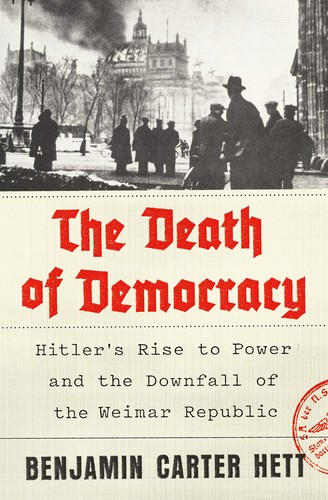
The Death of Democracy: Hitler's Rise to Power and the Downfall of the Weimar Republic

Benjamin Carter Hett

★★★★
Read Military history Economics WWII Guerrilla / COIN Strategy / theory Economics ISBN 9781250162502

Henry Holt and Co. · 2018

A riveting account of how the Nazi Party came to power and how the failures of the Weimar Republic and the shortsightedness of German politicians allowed it to happen Why did democracy fall apart so quickly and completely in Germany in the 1930s? How did a democratic government allow Adolf Hitler to seize power? In The Death of Democracy, Benjamin Carter Hett answers these questions, and the story he tells has disturbing resonances for our own time. To say that Hitler was elected is too simple. He would never have come to power if Germany’s leading politicians had not responded to a spate of populist insurgencies by trying to co-opt him, a strategy that backed them into a corner from which the only way out was to bring the Nazis in. Hett lays bare the misguided confidence of conservative politicians who believed that Hitler and his followers would willingly support them, not recognizing that their efforts to use the Nazis actually played into Hitler’s hands. They had willingly given him the tools to turn Germany into a vicious dictatorship. Benjamin Carter Hett is a leading scholar of twentieth-century Germany and a gifted storyteller whose portraits of these feckless politicians show how fragile democracy can be when those in power do not respect it. He offers a powerful lesson for today, when democracy once again finds itself embattled and the siren song of strongmen sounds ever louder.

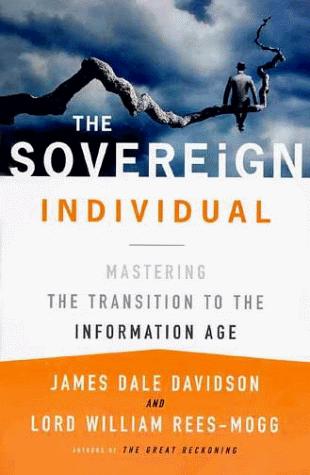
The Sovereign Individual: Mastering the Transition to the Information Age

James Dale Davidson

★★★★
Read Advanced intel Logistics Technical warfare Cold War Russia / USSR Logistics Economics US Civil War ISBN 9780684832722

Touchstone · 1999-08-26

Two renowned investment advisors and authors of the bestseller The Great Reckoning bring to light both currents of disaster and the potential for prosperity and renewal in the face of radical changes in human history as we move into the next century. The Sovereign Individual details strategies necessary for adapting financially to the next phase of Western civilization. Few observers of the late twentieth century have their fingers so presciently on the pulse of the global political and economic realignment ushering in the new millennium as do James Dale Davidson and Lord William Rees-Mogg. Their bold prediction of disaster on Wall Street in Blood in the Streets was borne out by Black Tuesday. In their ensuing bestseller, The Great Reckoning, published just weeks before the coup attempt against Gorbachev, they analyzed the pending collapse of the Soviet Union and foretold the civil war in Yugoslavia and other events that have proved to be among the most searing developments of the past few years. In The Sovereign Individual, Davidson and Rees-Mogg explore the greatest economic and political transition in centuries—the shift from an industrial to an information-based society. This transition, which they have termed "the fourth stage of human society," will liberate individuals as never before, irrevocably altering the power of government. This outstanding book will replace false hopes and fictions with new understanding and clarified values.

No cover · Amazon

The Vampire Economy: Doing Business Under Fascism

Günter Reimann

★★★★
Read Logistics Advanced intel WWII Logistics Economics

Here is a study of the actual workings of business under national socialism. Written in 1939, Reimann discusses the effects of heavy regulation, inflation, price controls, trade interference, national economic planning, and attacks on private property, and what consequences they had for human rights and economic development. This is a subject rarely discussed and for reasons that are discomforting,: as much as the left hated the social and cultural agenda of the Nazis, the economic agenda fit straight into a pattern of statism that had emerged in Europe and the United States, and in this area, the world has not be de-Nazified. This books makes for alarming reading, as one discovers the extent to which the Nazi economic agenda of totalitarian control--without finally abolishing private property--has become the norm. The author is by no means an Austrian but his study provides historical understanding and frightening look at the consequences of state economic management.

The Wages of Destruction: The Making and Breaking of the Nazi Economy

Adam Tooze

★★★★
Read Advanced intel Logistics WWII Russia / USSR Logistics Intel history Economics ISBN 9780670038268

Viking · 2006

The idea that Nazi Germany was an unstoppable juggernaut, backed by an efficient, highly industrialized economy, has been central to all accounts of World War II. But what if this was not the case? What if the war had its roots in Germany's weakness, not its strength? This is the radical argument in this pathbreaking book, the first account of the Nazi era for the twenty-first century and our globalized world. There was no aspect of Nazi power untouched by economics, yet Adam Tooze is the first to place economics alongside race and politics at the heart of the story of the Third Reich. And America, in Tooze's view, is the true pivot for Hitler's epic challenge to a shift in the world order. Hitler intuitively understood how Germany's relative poverty in the 1930s was the result not just of global depression, but also of Germany's limited resources. He predicted the dawning of a globalized world in which Europe would be crushed by America's overwhelming power, against which he saw only one last chance: a German super-state dominating Europe. Doing what Europeans had done for three centuries, he sought to carve out an imperial hinterland through one last land grab to the east, to give him the self-sufficiency to prevail in the coming superpower competition. With the odds stacked against him, he launched his underresourced armies on their unprecedented and ultimately futile rampage across Europe. Hitler knew by the summer of 1939 that his efforts to prepare for a long war with the West were doomed to failure. Ideology drove him forward. Hitler became convinced that Jewish elements in Washington, London, and Paris were circling round him, and from 1938, the international "Jewish question: was synonymous with America in his mind. Even in the summer of 1940, at the moment of Germany's greatest triumphs, Hitler was still haunted by the looming threat of Anglo-American air and sea power, orchestrated by, he believed, the world Jewish conspiracy. Tooze also casts a stark new light on Albert Speer's role in sustaining the Third Reich to its bloody end, after the catastrophe of the Soviet invasion. Speer, Tooze proposes, was no apolitical agent of technocratic efficiency but a Hitler loyalist who would stop at nothing to continue a hopeless battle of attrition, at the cost of tens of millions of lives. The Wages of Destruction is a chilling work of originality and tremendous scholarship that will fundamentally change the way in which we view Nazi Germany and the Second World War.

War In The Shadows: The Guerrilla in History

Robert B. Asprey

★★★★
Read Intel history Advanced intel Vietnam Cold War Guerrilla / COIN Russia / USSR Middle East Strategy / theory Economics Revolution ISBN 9780595225934

Backinprint.com · May 2002

Ranging from Alexander the Great's battles with Asiatic Scythians, through the Russian Revolution, and on up to the turmoil in the Middle East and the battle in Northern Ireland, War in the Shadows is a book of monumental sweep and singular perspective. It also contains a comprehensive and hard-hitting strategic evaluation of the Vietnam War-one of the most significant analyses of "the war that won't go away." War in the Shadows tells the story of the countries currently torn by armed insurgencies and clarifies the causes of each conflict. It provides the broad viewpoint necessary for understanding them in the historical terms of guerilla warfare. With the collapse of the Soviet Union, the end of the Cold War, and a highly unstable "new world order," this brand of rebellion has never been more powerful and potentially disruptive. As the author states in his Foreword, "For a number of reasons guerilla warfare has evolved into an ideal instrument for the realization of social-political-economic aspirations of underprivileged peoples. This is so patently true as to allow one to suggest that we may be witnessing a transition to a new era in warfare, an era as radically different as those of which followed the writings of Sun Tzu, Machiavelli, Clausewitz, and Mahan." War in the Shadows is crucial to understanding the complex challenges of our new and dangerous era.

Air Force Advising and Assistance: Developing Airpower in Client States (Modern Military History)

Donald Stoker

★★★☆☆
Read Advanced intel Intel history GWOT Naval Air power Guerrilla / COIN Strategy / theory Economics ISBN 9781912390601

Helion and Company · Sep 20, 2018

The increased focus on counterinsurgency warfare and US nation building efforts after the attacks of 11 September 2001 reignited interest in military advising within military and other government organizations, private think tanks, and defense related contractors. Most studies on the subject, based on the chronological scope and numerical preponderance of ground advising missions, has quite naturally focused on these past efforts. Less attention has been given to air or naval advisory missions. This work seeks in part to help redress this current imbalance by examining a number of historical case studies dealing with air advisory efforts. By examining a number of historical case studies, this volume analyzes the challenges and opportunities inherent in aerial advisory efforts and offers insights into the methods by which such missions succeed or fail. Air advisory missions date almost to the first days of powered flight. Air advisory efforts have a number of unique elements based on the fundamental role of advanced technology and the extensive resource requirements associated with aviation operations. For example, air advisory efforts are profoundly influenced by the types of aircraft involved and the types of mission flown. Likewise, the issues of maintenance support and the infrastructure needed for these missions plays a key role in determining capabilities available to the host nation. In the case of infrastructure, airfields, fuelling depots, maintenance and repair facilities, and radar and communications equipment offer a few of the most obvious requirements to support flight operations. The early history of advisory efforts reveal issues that remain relevant today, including questions related to the nature of aerial technology to be shared, the type of training to be provided, and the potential economic benefits that might accrue to the donor nation as a result of the sale of aviation technology to the host country. In many respects, air advisory efforts raise a number of profound strategic questions for the donor nation. Among others, these questions relate to the type of technology to be shared, the nature of training to be given, the role of foreign advisors in operations, the issue of infrastructure development and auxiliary training programs, the preparation of foreign advisors for their duties, and perhaps most significantly the development of the type of capabilities required to address the host nation’s security environment. Via a series of historical case studies, this volume explores these questions and others.

Freakonomics: A Rogue Economist Explores the Hidden Side of Everything

Steven D. Levitt

★★★☆☆
Read Economics ISBN 9780061234002

William Morrow · 2007

Which is more dangerous, a gun or a swimming pool? What do schoolteachers and sumo wrestlers have in common? Why do drug dealers still live with their moms? How much do parents really matter? What kind of impact did Roe v. Wade have on violent crime? Freakonomics will literally redefine the way we view the modern world. These may not sound like typical questions for an economist to ask. But Steven D. Levitt is not a typical economist. He is a much heralded scholar who studies the stuff and riddles of everyday life -- from cheating and crime to sports and child rearing -- and whose conclusions regularly turn the conventional wisdom on its head. He usually begins with a mountain of data and a simple, unasked question. Some of these questions concern life-and-death issues; others have an admittedly freakish quality. Thus the new field of study contained in this book: freakonomics. Through forceful storytelling and wry insight, Levitt and co-author Stephen J. Dubner show that economics is, at root, the study of incentives -- how people get what they want, or need, especially when other people want or need the same thing. In Freakonomics, they set out to explore the hidden side of ... well, everything. The inner workings of a crack gang. The truth about real-estate agents. The myths of campaign finance. The telltale marks of a cheating schoolteacher. The secrets of the Ku Klux Klan. What unites all these stories is a belief that the modern world, despite a surfeit of obfuscation, complication, and downright deceit, is not impenetrable, is not unknowable, and -- if the right questions are asked -- is even more intriguing than we think. All it takes is a new way of looking. Steven Levitt, through devilishly clever and clear-eyed thinking, shows how to see through all the clutter. Freakonomics establishes this unconventional premise: If morality represents how we would like the world to work, then economics represents how it actually does work. It is true that readers of this book will be armed with enough riddles and stories to last a thousand cocktail parties. But Freakonomics can provide more than that. It will literally redefine the way we view the modern world. (front flap)

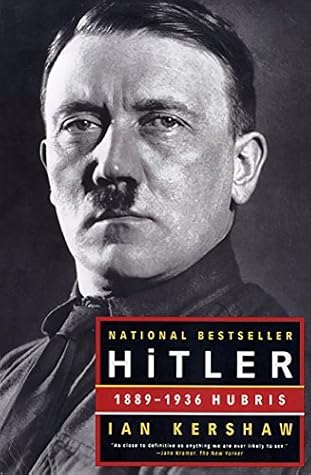
Hitler: 1889-1936 Hubris

Ian Kershaw

★★★☆☆
Read Biographies WWII WWI Biography Economics ISBN 0393320359

W.W. Norton · 2000

From his illegitimate birth in a small Austrian village to his fiery death in a bunker under the Reich chancellery in Berlin, Adolf Hitler left a murky trail, strewn with contradictory tales & overgrown with self-created myths. One truth prevails: the sheer scale of the evils that he unleashed on the world has made him a demonic figure without equal in this century. Kershaw's Hitler brings us closer than ever before to the character of the bizarre misfit in his 30-year ascent from a Viennese shelter for the indigent to uncontested rule over the German nation that had tried & rejected democracy in the crippling aftermath of WWI. With extraordinary vividness, Kershaw recreates the settings that made Hitler's rise possible: the virulent anti-Semitism of prewar Vienna, the crucible of a war with immense casualties, the toxic nationalism that gripped Bavaria in the 20s, the undermining of the Weimar Republic by extremists of the Right & the Left, the hysteria that accompanied Hitler's seizure of power in 1933 & then mounted in brutal attacks by his storm troopers on Jews & others condemned as enemies of the Aryan race. In an account drawing on many previously untapped sources, Hitler metamorphoses from an obscure fantasist, a drummer sounding an insistent beat of hatred in Munich beer halls, to the instigator of an infamous failed putsch &, ultimately, to the leadership of a ragtag alliance of right-wing parties fused into a movement that enthralled the German people. This volume, 1st of two, ends with the promulgation of the infamous Nuremberg laws that pushed German Jews to the outer fringes of society, & with the march of the German army into the Rhineland, Hitler's initial move toward the abyss of war.

No cover · Amazon

Human Hacking: Win Friends, Influence People, and Leave Them Better Off for Having Met You

Christopher Hadnagy

★★★☆☆
Read Cyber Economics

A global security expert draws on psychological insights to help you master the art of social engineering—human hacking. Make friends, influence people, and leave them feeling better for having met you by being more empathetic, generous, and kind. Eroding social conventions, technology, and rapid economic change are making human beings more stressed and socially awkward and isolated than ever. We live in our own bubbles, reluctant to connect, and feeling increasingly powerless, insecure, and apprehensive when communicating with others. A pioneer in the field of social engineering and a master hacker, Christopher Hadnagy specializes in understanding how malicious attackers exploit principles of human communication to access information and resources through manipulation and deceit. Now, he shows you how to use social engineering as a force for good—to help you regain your confidence and control. Human Hacking provides tools that will help you establish rapport with strangers, use body language and verbal cues to your advantage, steer conversations and influence other’s decisions, and protect yourself from manipulators. Ultimately, you’ll become far more self-aware about how you’re presenting yourself—and able to use it to improve your life.  Hadnagy includes lessons and interactive “missions”—exercises spread throughout the book to help you learn the skills, practice them, and master them. With Human Hacking, you’ll soon be winning friends, influencing people, and achieving your goals.

Nazi Economics: Ideology, Theory, and Policy

Avraham Barkai

★★★☆☆
Read Advanced intel Logistics WWII Middle East Logistics Economics ISBN 0300044666

Yale University Press · 1990

This respected Israeli scholar argues that fundamental ideological and political goals of Nazi leaders made them receptive to revolutionary economic theories such as those of J. M. Keynes. He examines how the economic system of the Third Reich was based on an anti-liberal philosophy that proved extraordinarily effective in bringing about the 'German Economic Miracle' by 1937.