S2 Search · Reading list

S2 Actual reading list

Books from S2 Actual on Goodreads, organized by his shelves and topic buckets (intel lists, military history, logistics, etc.). Metadata filled via Open Library.

Not official S2 Underground. Independent fan index — not affiliated with or endorsed by S2. Official hub: linktr.ee/S2_underground. S2 materials are CC BY-NC-SA 4.0.

S2 topic buckets (Goodreads)

Subjects & genres

48 books · Read · subject Guerrilla / COIN · page 1 of 2

No cover · Amazon

Besieged: The Epic Battle For Cholm

Jason D. Mark

★★★★★
Read Advanced intel Military history Logistics WWII Naval Air power Guerrilla / COIN Russia / USSR Logistics

Kampfgruppe Scherer’s outstanding feat of arms was one of Germany’s most famous military achievements during the Second World War. With only a few thousand men from all branches of the service, including mountain troopers, elderly reservists, police officers, navy drivers, SS partisan hunters and supply troops, Generalmajor Theodor Scherer was ordered to hold Cholm in the face of a superior enemy force. That Scherer and his men prevailed is now an historical fact but analysis of daily radio traffic and combat reports reveals that the pocket’s survival was precarious; at times, even senior commanders doubted if it could be saved. On several occasions the Soviet onslaught looked poised to inflict the death blow but somehow the exhausted men of Cholm grimly clung to a few resistance nests upon which a new line was anchored. General Scherer, a popular leader and inspiration to all his soldiers, despaired many times and was forced to continually plead for more men, more supplies and more aerial support. Urgent demands by other sectors meant Kampfgruppe Scherer was drip-fed just enough supplies and reinforcements to stay alive until, eventually, a relief force forged a permanent link and freed the exhausted survivors. After a catastrophic winter of setbacks and resounding defeats for the Wehrmacht, the General and his men were lauded as heroes and recognised with an arm shield that marked them as “Cholmkämpfer,” men of exceptional courage who had prevailed despite overwhelming odds. Primary sources have been utilised for the first time to present this battle in a detailed day-by-day format, from the forlorn days of January and February to liberation in early May.

No cover · Amazon

Dragon Days: Time for "Unconventional" Tactics

H. John Poole

★★★★★
Read Advanced intel Vietnam Korea Guerrilla / COIN Middle East Strategy / theory

This book shows how to control a contested region with squad-sized outposts . North Vietnam and Iran have done it. Now, North Korea may try to consolidate the South with such a strategy. Scores of tiny Western outposts could do this too. After a short threat assessment, Dragon Days describes what a single U.S. rifle squad must do to safely accomplish such a mission in Asia. It will need the following Unconventional Warfare (UW) (1) some police procedure; (2) obscurely defending; (3) finding an enemy weakness; (4) making a secret approach; (5) disguising the attack; (6) precluding a counterstroke; (7) rural E&E; (8) enhancing rural terrain (9) urban E&E; and (10) enhancing urban terrain . Because of Asia's bottom-up culture, the little picture is where such an ability originates. This heavily illustrated book contains more small-unit perspective than any U.S. govt. publication. In fact, it may still constitute America's only UW tactical-technique manual .

Expeditionary Eagles: Outmaneuvering the Taliban

H. John Poole

★★★★★
Read Advanced intel GWOT Guerrilla / COIN Strategy / theory ISBN 9780981865928

Posterity Press · 2010

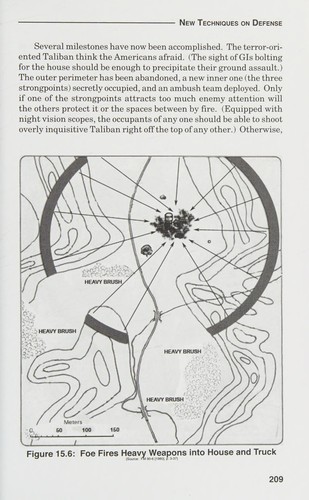
The Afghan War is still salvagable. For America, it has been about denying sanctuary to al-Qaeda. For local factions and governments, a traditional fund raiser--heroin--is more important. Only with less smuggling of drugs out and ordnance in, can the insurgency be limited. Both have been broken down into more easily concealable "pieces." All traffic along the 14 entrance highways must be better inspected to curtail their movement. Herein lies the most detailed study in existence of Pakistan's drug and militant madrasa networks. Also discussed is how a lone U.S. squad could--without a single artillery round or drone missile--rely on deception to defend a roadside outpost against hundreds of attacking narco-insurgents.

No cover · Amazon

Fast Tanks and Heavy Bombers: Innovation in the U.S. Army, 1917-1945

David E. Johnson

★★★★★
Read Basic intel Military history Intel history Logistics WWII Air power Armor Guerrilla / COIN Logistics Strategy / theory

The U.S. Army entered World War II unprepared. In addition, lacking Germany's blitzkrieg approach of coordinated armor and air power, the army was organized to fight two wars: one on the ground and one in the air. Previous commentators have blamed Congressional funding and public apathy for the army's unprepared state. David E. Johnson believes instead that the principal causes were internal: army culture and bureaucracy, and their combined impact on the development of weapons and doctrine. Johnson examines the U.S. Army's innovations for both armor and aviation between the world wars, arguing that the tank became a captive of the conservative infantry and cavalry branches, while the airplane's development was channeled by air power insurgents bent on creating an independent air force. He maintains that as a consequence, the tank's potential was hindered by the traditional arms, while air power advocates focused mainly on proving the decisiveness of strategic bombing, neglecting the mission of tactical support for ground troops. Minimal interaction between ground and air officers resulted in insufficient cooperation between armored forces and air forces. Fast Tanks and Heavy Bombers makes a major contribution to a new understanding of both the creation of the modern U.S. Army and the Army's performance in World War II. The book also provides important insights for future military innovation.

Hybrid Warfare: Fighting Complex Opponents from the Ancient World to the Present

Williamson Murray

★★★★★
Read Military history Intel history Logistics Technical warfare GWOT Guerrilla / COIN Logistics Strategy / theory ISBN 9781107026087

Cambridge University Press · 2012

Hybrid warfare has been an integral part of the historical landscape since the ancient world, but only recently have analysts incorrectly categorized these conflicts as unique. Great powers throughout history have confronted opponents who used a combination of regular and irregular forces to negate the advantage of the great powers' superior conventional military strength. As this study shows, hybrid wars are labor-intensive and long-term affairs; they are difficult struggles that defy the domestic logic of opinion polls and election cycles. Hybrid wars are also the most likely conflicts of the twenty-first century, as competitors use hybrid forces to wear down America's military capabilities in extended campaigns of exhaustion. Nine historical examples of hybrid warfare, from ancient Rome to the modern world, provide readers with context by clarifying the various aspects of conflicts and examining how great powers have dealt with them in the past.

Militant Tricks: Battlefield Ruses of the Islamic Insurgent

H. John Poole

★★★★★
Read Advanced intel GWOT Guerrilla / COIN China Middle East Strategy / theory ISBN 9780963869586

Posterity Press · October 17, 2005

THIS BOOK WAS ON THE U.S. ARMY'S MOST PRESTIGIOUS READING LIST. Since 9/11, our deployed troops have learned many things. Though the war in Afghanistan has just ended, many of their hard-won lessons have yet to be assimilated by the Stateside bureaucracy. To help, "Militant Tricks" has recounted America's progress in Iraq and Afghanistan from the standpoint of East Asian BATTLEFIELD DECEPTION. Both countries were part of the Mongol Empire for over 200 years and thus prone to every sort of ancient Chinese illusion. "Militant Tricks" also contains the TACTICAL TECHNIQUES WITH WHICH TO COUNTER AN ISLAMIC EXTREMIST'S URBAN OFFENSIVE. While some of these nontraditional techniques were risked during the Baghdad Surge, they may soon be forgotten.

Tactics of the Crescent Moon: Militant Muslim Combat Methods

H. John Poole

★★★★★
Read Basic intel Intel history GWOT Guerrilla / COIN Middle East ISBN 9780963869579

Posterity Press · November 2004

This book focuses on how Iran and its various proxies fight. It is on the most prestigious pre-deployment reading lists for both the U.S. Army and the U.S. Marine Corps, because it fully details the Islamists' yet-to-be-defeated 4GW method. That method is best countered by "truly light" infantry tactics, but America has had only "line" infantry since 1943. Its members travel mostly by truck and fight mostly with supporting arms. That's because the Pentagon is still practicing a "higher-tech" version of 2GW (killing as many enemy as possible). How to operate the latest equipment takes up so much of the young infantryman's day that he never learns how to sneak up on an expert defender. He and his buddies don't become any less visible by donning advanced electronics, so their traditional small-unit maneuvers remain as predictable as before. All Posterity Press books should be viewed as instruments of long-overdue change.

Tequila Junction: 4th-Generation Counterinsurgency

H. John Poole

★★★★★
Read Advanced intel GWOT Special ops Guerrilla / COIN ISBN 9780963869517

Posterity Press · 2008

Don't recognize this drug-funded Maoist army ? Its operatives have been busy in at least nine Latin American countries. Bringing an end to America's white-heroin deluge may take temporarily reinforcing -- with a lone U.S. infantry squad -- a few police outposts in Colombia, Panama, and Mexico. After briefly noting the extent of criminal, Communist, and Islamist subversion throughout the region, this book shows the Unconventional Warfare (UW) techniques that 14 isolated GIs might need to vie with many times their number of drug runners and revolutionaries. Among the "how-to" chapters (1) "Best 4GW Defense Is Locally Tailored;" (2) "Deep Interdiction;" (3) "Buffer Zones"; and (4) "Working a Heavily Populated Area." well illustrated, full of tiny element maneuvers, and quite exciting to read. One even shows how to blanket an area with secretly occupied fire team zones. Such an advanced UW concept would also work in other parts of the world. According to Australian Army Journal, "Poole's methods in Tequila Junction are an example of a decentralised approach to counterinsurgency that may provide a tactical level solution ... [to] keep the insurgents off balance in Uruzgan [Afghanistan]." As a final bonus , this book's appendix shows a fully tested way for any U.S. infantry or special operations company to develop its own state-of-the-art techniques for any intensity of combat.

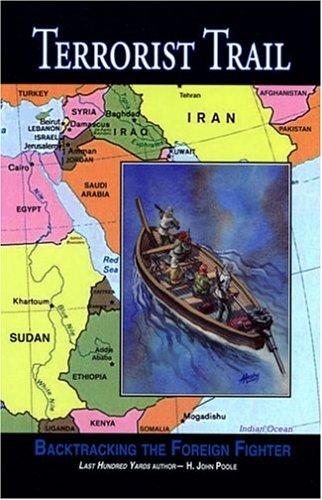
Terrorist Trail: Backtracking the Foreign Fighter

H. John Poole

★★★★★
Read Basic intel GWOT Guerrilla / COIN Middle East Strategy / theory ISBN 9780963869593

Posterity Press (NC); Illustrate · September 20, 2006

This book is about covertly penetrating the enemy heartland along the ground. At the height of the Iraq War, it was selling to Marines in the Euphrates Valley at a rate of 200 per month. That's because it helped them to seize the initiative. First, it describes the West's most effective counter-guerrilla force. This was not the British in Malaysia, but Rhodesia's Selous Scouts. Their ability to operate safely as tiny teams deep in enemy territory is the model to which all U.S. special operators should aspire. Never fond of apartheid, they regularly converted former foes into loyal members. Then, it shows how to follow enemy footprints in urban terrain. Finally, it provides a spellbinding history of "terrorism" in Africa--the most recent arena for Islamist and Communist expansion.

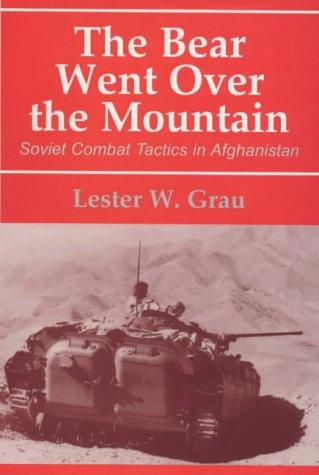
The Bear Went Over the Mountain: Soviet Combat Tactics in Afghanistan

Lester W. Grau

★★★★★
Read Basic intel Cold War GWOT Guerrilla / COIN Russia / USSR ISBN 0714648574

Frank Cass · 1998

This collection of vignettes was written by Soviet junior officers describing their experiences fighting the Mujahideen guerillas. It is not a history of the Soviet-Afghan war, but snapshots of combat as seen by young platoon leaders, company commanders, battalion commanders and military advisers.

The Black Book of Communism: Crimes, Terror, Repression

Stéphane Courtois

★★★★★
Read Military history Advanced intel Vietnam Korea Cold War GWOT Guerrilla / COIN China Russia / USSR Orthodox / theology ISBN 0674076087

Harvard University Press · 1999

Already famous throughout Europe, this international bestseller plumbs recently opened archives in the former Soviet bloc to reveal the actual, practical accomplishments of Communism around the terror, torture, famine, mass deportations, and massacres. Astonishing in the sheer detail it amasses, the book is the first comprehensive attempt to catalogue and analyze the crimes of Communism over seventy years. "Revolutions, like trees, must be judged by their fruit," Ignazio Silone wrote, and this is the standard the authors apply to the Communist experience―in the China of "the Great Helmsman," Kim Il Sung's Korea, Vietnam under "Uncle Ho" and Cuba under Castro, Ethiopia under Mengistu, Angola under Neto, and Afghanistan under Najibullah. The authors, all distinguished scholars based in Europe, document Communist crimes against humanity, but also crimes against national and universal culture, from Stalin's destruction of hundreds of churches in Moscow to Ceausescu's leveling of the historic heart of Bucharest to the widescale devastation visited on Chinese culture by Mao's Red Guards. As the death toll mounts―as many as 25 million in the former Soviet Union, 65 million in China, 1.7 million in Cambodia, and on and on―the authors systematically show how and why, wherever the millenarian ideology of Communism was established, it quickly led to crime, terror, and repression. An extraordinary accounting, this book amply documents the unparalleled position and significance of Communism in the hierarchy of violence that is the history of the twentieth century.

The Secret War: Spies, Codes and Guerrillas 1939-1945

Max Hastings

★★★★★
Read Basic intel Intel history WWII Espionage Guerrilla / COIN Russia / USSR ISBN 9780007503742

William Collins · Sep 10, 2015

Examining the espionage and intelligence stories in World War II, on a global basis, bringing together the British, American, German, Russian and Japanese histories. There were two Second World Wars: one fought on the battlefields, and another conducted by men and women few of whom ever fired a weapon in anger, but whose efforts vastly influenced the conflict. ‘The Secret War 1939-45’ examines that other war waged by British, American, German, Russian and Japanese intelligence-gathering personnel. Moving chronologically through the conflict, Max Hastings charts the successes and failures of allied and axis forces, espionage and counterespionage. Observing how the evolution of electronic communications dramatically increased the possibilities and significance of these secret battles, this is the story of intelligence beyond Bletchley to the FBI, Russia and the spies of axis dictatorships. For the first time since his best-selling ‘All Hell Let Loose’, Max Hastings returns to the Second World War, this time to chronicle its second, untold story.

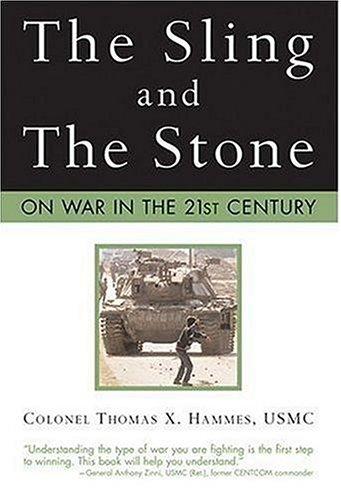
The Sling and the Stone: On War in the 21st Century

Thomas X. Hammes

★★★★★
Read Basic intel Advanced intel Military history Intel history Vietnam Cold War GWOT Guerrilla / COIN Russia / USSR Middle East Strategy / theory ISBN 9780760324073

Zenith Press · February 17, 2006

4GW (Fourth Generation Warfare) is the only kind of war America has ever lost. And we have done so three times - in Vietnam, Lebanon, and Somalia. This form of warfare has also defeated the French in Vietnam and Algeria, and the USSR in Afghanistan.As the only Goliath left in the world, we should be worried that the world's Davids have found a sling and stone that work." - Chapter 1, The Sling and the Stone: On War in the 21st Century. The War in Iraq. The War on Terror. These types of "asymmetrical" warfare are the conflicts of the 21st century - and show how difficult it is for the world's remaining superpower to battle insurgents and terrorists who will fight unconventionally in the face of superior military power. This change in military conflict may seem sudden.

Vietnam: An Epic Tragedy, 1945-1975

Max Hastings

★★★★★
Read Intel history Military history Vietnam Special ops Guerrilla / COIN Biography ISBN 9780062405661

Harper · 2018

An absorbing and definitive modern history of the Vietnam War from the acclaimed New York Times bestselling author of The Secret War. Vietnam became the Western world’s most divisive modern conflict, precipitating a battlefield humiliation for France in 1954, then a vastly greater one for the United States in 1975. Max Hastings has spent the past three years interviewing scores of participants on both sides, as well as researching a multitude of American and Vietnamese documents and memoirs, to create an epic narrative of an epic struggle. He portrays the set pieces of Dienbienphu, the 1968 Tet offensive, the air blitz of North Vietnam, and also much less familiar miniatures such as the bloodbath at Daido, where a US Marine battalion was almost wiped out, together with extraordinary recollections of Ho Chi Minh’s warriors. Here are the vivid realities of strife amid jungle and paddies that killed two million people. Many writers treat the war as a US tragedy, yet Hastings sees it as overwhelmingly that of the Vietnamese people, of whom forty died for every American. US blunders and atrocities were matched by those committed by their enemies. While all the world has seen the image of a screaming, naked girl seared by napalm, it forgets countless eviscerations, beheadings, and murders carried out by the communists. The people of both former Vietnams paid a bitter price for the Northerners’ victory in privation and oppression. Here is testimony from Vietcong guerrillas, Southern paratroopers, Saigon bargirls, and Hanoi students alongside that of infantrymen from South Dakota, Marines from North Carolina, and Huey pilots from Arkansas. No past volume has blended a political and military narrative of the entire conflict with heart-stopping personal experiences, in the fashion that Max Hastings’ readers know so well. The author suggests that neither side deserved to win this struggle with so many lessons for the twenty-first century about the misuse of military might to confront intractable political and cultural challenges. He marshals testimony from warlords and peasants, statesmen and soldiers, to create an extraordinary record.

No cover · Amazon

Weaving the Tangled Web: Military Deception in Large-Scale Combat Operations (Large-Scale Combat Operations Series Book 1)

Christopher M. Rein

★★★★★
Read Basic intel Military history Intel history WWII Korea Cold War GWOT Guerrilla / COIN China Russia / USSR Middle East Intel history Strategy / theory

This book is from Army University Press and is Volume 1 in it's Large-Scale Combat Operations Series. It has footnotes, maps, and pictures, and was originally published in 2018. “Since the Soviet Union’s fall in 1989, the specter of large-scale ground combat against a peer adversary was remote. During the years following, the US Army found itself increasingly called upon to lead multinational operations in the lower to middle tiers of the range of military operations and conflict continuum. The events of 11 September 2001 led to more than 15 years of intense focus on counterterrorism, counterinsurgency, and stability operations in Iraq and Afghanistan. An entire generation of Army leaders and Soldiers were culturally imprinted by this experience. We emerged as an Army more capable in limited contingency operations than at any time in our nation’s history, but the geopolitical landscape continues to shift and the risk of great power conflict is no longer a remote possibility. “While our Army focused on limited contingency operations in the Middle East and Southwest Asia, other regional and peer adversaries scrutinized US military processes and methods and adapted their own accordingly. As technology has proliferated and become accessible in even the most remote corners of the world, the US military’s competitive advantage is being challenged across all of the warfighting domains. In the last decade, we have witnessed an emergent China, a revanchist and aggressive Russia, a menacing North Korea, and a cavalier Iranian regime. Each of these adversaries seeks to change the world order in their favor and contest US strategic interests abroad. The chance for war against a peer or regional near-peer adversary has increased exponentially, and we must rapidly shift our focus to successfully compete in all domains and across the full range of military operations." Includes: Introduction: Multi-Domain Deception (Christopher M. Rein, General Editor); Chapter 1: The Belfort Ruse the American Deception plan for the battle of st. Mihiel, 1918 (Mark E. Grotelueschen); Chapter 2: From Beersheba To Megiddo British Deception Operations During The Palestine Campaign, 1917-1918; (Major Brian J. Drohan); Chapter 3: Operation Bertram British Deception At El Alamein (Gary W. Linhart); Chapter 4: Operations Barclay, Cascade, And Mincemeat Allied Deception In The Mediterranean, 1943 (Gregory S. Hospodor); Chapter 5: Operation Kreml German Strategic Deception On The Eastern Front In 1942 (Alan P. Donohue); Chapter 6: Red Star Resurgent Soviet Deception Operations At Stalingrad, 1942-1943 (First Lieutenant Kyle B. Vautrinot); Chapter 7: Operation Bagration Maskirovka At Its Height, Summer 1944 (Curtis S. King); Chapter 8: Deceive, Divert, And Delay Operation Fortitude In Support Of D-Day (Scott C. Farquhar); Chapter 9: Chinese Deception And The 1950 Intervention In The Korean War (Joseph G.D. Babb); Chapter 10: From Maneuvers To War The Egyptian Deception Plan On The Eve Of The Yom-Kippur War (Tal Tovy); Chapter 11: Target San Carlos British Deception During The Repossession Of The Falkland Islands (Steven Paget); Chapter 12: Deception In The Desert Deceiving Iraq In Operation Desert Storm (Donald P. Wright); Conclusion: The Future Of Military Deception Operations (Conrad C. Crane)

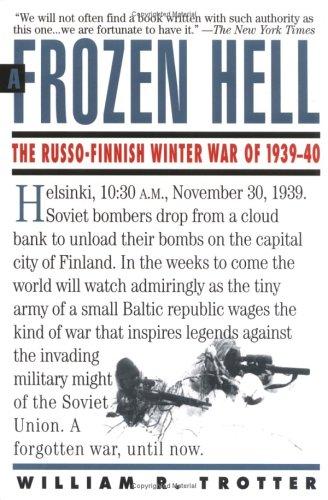
A Frozen Hell: The Russo-Finnish Winter War of 1939-1940

William R. Trotter

★★★★
Read Advanced intel Military history Technical warfare Cold War Guerrilla / COIN Russia / USSR ISBN 9781565122499

Algonquin Books of Chapel Hill, a division of Workman Publishing · January 2000

In 1939, tiny Finland waged war - the kind of war that spawns legends - against the mighty Soviet Union, and yet their epic struggle has been largely ignored. Guerrillas on skis, heroic single-handed attacks on tanks, unfathomable endurance, and the charismatic leadership of one of this century's true military geniuses - these are the elements of both the Finnish victory and a gripping tale of war.

Afghanistan: A Cultural and Political History (Princeton Studies in Muslim Politics)

Thomas Barfield

★★★★
Read Advanced intel Military history Intel history GWOT Guerrilla / COIN Russia / USSR US Civil War ISBN 9780691145686

Princeton University Press · 2010

Afghanistan traces the historic struggles and the changing nature of political authority in this volatile region of the world, from the Mughal Empire in the sixteenth century to the Taliban resurgence today. Thomas Barfield introduces readers to the bewildering diversity of tribal and ethnic groups in Afghanistan, explaining what unites them as Afghans despite the regional, cultural, and political differences that divide them. He shows how governing these peoples was relatively easy when power was concentrated in a small dynastic elite, but how this delicate political order broke down in the nineteenth and twentieth centuries when Afghanistan's rulers mobilized rural militias to expel first the British and later the Soviets. Armed insurgency proved remarkably successful against the foreign occupiers, but it also undermined the Afghan government's authority and rendered the country ever more difficult to govern as time passed. Barfield vividly describes how Afghanistan's armed factions plunged the country into a civil war, giving rise to clerical rule by the Taliban and Afghanistan's isolation from the world. He examines why the American invasion in the wake of September 11 toppled the Taliban so quickly, and how this easy victory lulled the United States into falsely believing that a viable state could be built just as easily. Afghanistan is essential reading for anyone who wants to understand how a land conquered and ruled by foreign dynasties for more than a thousand years became the graveyard of empires for the British and Soviets, and what the United States must do to avoid a similar fate.

Counterinsurgency Warfare: Theory and Practice (PSI Classics of the Counterinsurgency Era)

David Galula

★★★★
Read Basic intel Vietnam GWOT Guerrilla / COIN Middle East Strategy / theory ISBN 9780275993030

Praeger Security International Paperback · August 30, 2006

This volume in the Praeger Security International (PSI) series Classics of the Counterinsurgency Era defines the laws of insurgency and outlines the strategy and tactics to combat such threats. Drawn from the observations of a French officer, David Galula, who witnessed guerrilla warfare on three continents, the book remains relevant today as American policymakers, military analysts, and members of the public look to the counterinsurgency era of the 1960s for lessons to apply to the current situation in Iraq and Afghanistan. With a new foreword by John A. Nagl, author of Counterinsurgency Lessons from Malaya and Vietnam (Praeger, 2002).

No cover · Amazon

Harvest of Despair: Life and Death in Ukraine under Nazi Rule

Karel C. Berkhoff

★★★★
Read Advanced intel Military history Logistics WWII Guerrilla / COIN Russia / USSR Logistics Revolution

"If I find a Ukrainian who is worthy of sitting at the same table with me, I must have him shot," declared Nazi commissar Erich Koch. To the Nazi leaders, the Ukrainians were Untermenschen—subhumans. But the rich land was deemed prime territory for Lebensraum expansion. Once the Germans rid the country of Jews, Roma, and Bolsheviks, the Ukrainians would be used to harvest the land for the master race. Karel Berkhoff provides a searing portrait of life in the Third Reich's largest colony. Under the Nazis, a blend of German nationalism, anti-Semitism, and racist notions about the Slavs produced a reign of terror and genocide. But it is impossible to understand fully Ukraine's response to this assault without addressing the impact of decades of repressive Soviet rule. Berkhoff shows how a pervasive Soviet mentality worked against solidarity, which helps explain why the vast majority of the population did not resist the Germans. He also challenges standard views of wartime eastern Europe by treating in a more nuanced way issues of collaboration and local anti-Semitism. Berkhoff offers a multifaceted discussion that includes the brutal nature of the Nazi administration; the genocide of the Jews and Roma; the deliberate starving of Kiev; mass deportations within and beyond Ukraine; the role of ethnic Germans; religion and national culture; partisans and the German response; and the desperate struggle to stay alive. Harvest of Despair is a gripping depiction of ordinary people trying to survive extraordinary events.

Phantom Soldier: The Enemy's Answer to U.S. Firepower

H. John Poole

★★★★
Read Advanced intel Military history WWII GWOT Air power Guerrilla / COIN Strategy / theory ISBN 9780963869555

Posterity Press · August 9, 2001

"Phantom Soldier" is now on the U.S. Army's most prestigious pre-deployment reading list for a reason. It won't please those who have come to believe that wars are won and casualties limited through technology, or that the victor's version of one is always correct. But, all U.S. security personnel should read it. Possibly the West's best treatise on Oriental warfare, it sheds new light on what Asian infantry can do: (1) alternate between guerrilla, mobile, and positional warfare; (2) use "ordinary forces" to engage and "extraordinary forces [infiltrators]" to defeat; and then (3) retreat to save lives. What occurred in history doesn't change, but one's perception of it does--as he comes to better understand his former foe. Here's what really happened at Guadalcanal, Iwo Jima, Chosin Reservoir, and Hue City. Those who believe this book's cover art to be fantasy have only to google the term "dac cong." Through how the NVA held their own without resupply, tanks, artillery, or air power, U.S. grunts could better survive the more lethal enemy weaponry of the 21st Century.

The Death of Democracy: Hitler's Rise to Power and the Downfall of the Weimar Republic

Benjamin Carter Hett

★★★★
Read Military history Economics WWII Guerrilla / COIN Strategy / theory Economics ISBN 9781250162502

Henry Holt and Co. · 2018

A riveting account of how the Nazi Party came to power and how the failures of the Weimar Republic and the shortsightedness of German politicians allowed it to happen Why did democracy fall apart so quickly and completely in Germany in the 1930s? How did a democratic government allow Adolf Hitler to seize power? In The Death of Democracy, Benjamin Carter Hett answers these questions, and the story he tells has disturbing resonances for our own time. To say that Hitler was elected is too simple. He would never have come to power if Germany’s leading politicians had not responded to a spate of populist insurgencies by trying to co-opt him, a strategy that backed them into a corner from which the only way out was to bring the Nazis in. Hett lays bare the misguided confidence of conservative politicians who believed that Hitler and his followers would willingly support them, not recognizing that their efforts to use the Nazis actually played into Hitler’s hands. They had willingly given him the tools to turn Germany into a vicious dictatorship. Benjamin Carter Hett is a leading scholar of twentieth-century Germany and a gifted storyteller whose portraits of these feckless politicians show how fragile democracy can be when those in power do not respect it. He offers a powerful lesson for today, when democracy once again finds itself embattled and the siren song of strongmen sounds ever louder.

War In The Shadows: The Guerrilla in History

Robert B. Asprey

★★★★
Read Intel history Advanced intel Vietnam Cold War Guerrilla / COIN Russia / USSR Middle East Strategy / theory Economics Revolution ISBN 9780595225934

Backinprint.com · May 2002

Ranging from Alexander the Great's battles with Asiatic Scythians, through the Russian Revolution, and on up to the turmoil in the Middle East and the battle in Northern Ireland, War in the Shadows is a book of monumental sweep and singular perspective. It also contains a comprehensive and hard-hitting strategic evaluation of the Vietnam War-one of the most significant analyses of "the war that won't go away." War in the Shadows tells the story of the countries currently torn by armed insurgencies and clarifies the causes of each conflict. It provides the broad viewpoint necessary for understanding them in the historical terms of guerilla warfare. With the collapse of the Soviet Union, the end of the Cold War, and a highly unstable "new world order," this brand of rebellion has never been more powerful and potentially disruptive. As the author states in his Foreword, "For a number of reasons guerilla warfare has evolved into an ideal instrument for the realization of social-political-economic aspirations of underprivileged peoples. This is so patently true as to allow one to suggest that we may be witnessing a transition to a new era in warfare, an era as radically different as those of which followed the writings of Sun Tzu, Machiavelli, Clausewitz, and Mahan." War in the Shadows is crucial to understanding the complex challenges of our new and dangerous era.

We Were One: Shoulder to Shoulder with the Marines Who Took Fallujah

Patrick K. O'Donnell

★★★★
Read Military history WWII GWOT Air power Guerrilla / COIN Middle East Biography ISBN 9780306814693

Da Capo Press · October 30, 2006

The platoon included four pairs of best friends. Each of the four would lose a best friend forever.Five months after being deployed to Iraq, Lima Company’s 1st Platoon found itself in Fallujah, embroiled in some of the most intense house-to-house, hand-to-hand combat since World War II. Civilians were used as human shields or as bait to lure soldiers into buildings rigged with explosives; suicide bombers approached from every corner hoping to die and take Americans with them; radical insurgents, high on adrenaline, fought to the death. The Marines of the 1st Platoon (part of 3rd Battalion, 1st Marine Regiment) were among the first to fight in Fallujah, and they bore the brunt of this epic battle. When it was over, the platoon had suffered thirty-five casualties, including four dead.This is their story.Award-winning author and historian Patrick O’Donnell stood shoulder-to-shoulder with this modern band of brothers as they marched and fought through the streets of Fallujah, and he stayed with them as the casualties mounted. O’Donnell captures not only the sights, sounds, and smells of the gritty street combat, but also the human drama of young men in a close-knit platoon fighting for their lives-and the lives of their buddies. We Were One chronicles the 1st Platoon’s story, from its formation at Camp Pendleton in California to its near destruction in the smoldering ruins of Fallujah.We Were One is an unforgettable portrait of the new “Greatest Generation.”With 16 pages of extraordinary photographs from the front lines of the Battle for Fallujah.

Air Force Advising and Assistance: Developing Airpower in Client States (Modern Military History)

Donald Stoker

★★★☆☆
Read Advanced intel Intel history GWOT Naval Air power Guerrilla / COIN Strategy / theory Economics ISBN 9781912390601

Helion and Company · Sep 20, 2018

The increased focus on counterinsurgency warfare and US nation building efforts after the attacks of 11 September 2001 reignited interest in military advising within military and other government organizations, private think tanks, and defense related contractors. Most studies on the subject, based on the chronological scope and numerical preponderance of ground advising missions, has quite naturally focused on these past efforts. Less attention has been given to air or naval advisory missions. This work seeks in part to help redress this current imbalance by examining a number of historical case studies dealing with air advisory efforts. By examining a number of historical case studies, this volume analyzes the challenges and opportunities inherent in aerial advisory efforts and offers insights into the methods by which such missions succeed or fail. Air advisory missions date almost to the first days of powered flight. Air advisory efforts have a number of unique elements based on the fundamental role of advanced technology and the extensive resource requirements associated with aviation operations. For example, air advisory efforts are profoundly influenced by the types of aircraft involved and the types of mission flown. Likewise, the issues of maintenance support and the infrastructure needed for these missions plays a key role in determining capabilities available to the host nation. In the case of infrastructure, airfields, fuelling depots, maintenance and repair facilities, and radar and communications equipment offer a few of the most obvious requirements to support flight operations. The early history of advisory efforts reveal issues that remain relevant today, including questions related to the nature of aerial technology to be shared, the type of training to be provided, and the potential economic benefits that might accrue to the donor nation as a result of the sale of aviation technology to the host country. In many respects, air advisory efforts raise a number of profound strategic questions for the donor nation. Among others, these questions relate to the type of technology to be shared, the nature of training to be given, the role of foreign advisors in operations, the issue of infrastructure development and auxiliary training programs, the preparation of foreign advisors for their duties, and perhaps most significantly the development of the type of capabilities required to address the host nation’s security environment. Via a series of historical case studies, this volume explores these questions and others.