S2 Search · Reading list

S2 Actual reading list

Books from S2 Actual on Goodreads, organized by his shelves and topic buckets (intel lists, military history, logistics, etc.). Metadata filled via Open Library.

Not official S2 Underground. Independent fan index — not affiliated with or endorsed by S2. Official hub: linktr.ee/S2_underground. S2 materials are CC BY-NC-SA 4.0.

S2 topic buckets (Goodreads)

Subjects & genres

25 books · Read · subject Naval · page 1 of 2

No cover · Amazon

Besieged: The Epic Battle For Cholm

Jason D. Mark

★★★★★
Read Advanced intel Military history Logistics WWII Naval Air power Guerrilla / COIN Russia / USSR Logistics

Kampfgruppe Scherer’s outstanding feat of arms was one of Germany’s most famous military achievements during the Second World War. With only a few thousand men from all branches of the service, including mountain troopers, elderly reservists, police officers, navy drivers, SS partisan hunters and supply troops, Generalmajor Theodor Scherer was ordered to hold Cholm in the face of a superior enemy force. That Scherer and his men prevailed is now an historical fact but analysis of daily radio traffic and combat reports reveals that the pocket’s survival was precarious; at times, even senior commanders doubted if it could be saved. On several occasions the Soviet onslaught looked poised to inflict the death blow but somehow the exhausted men of Cholm grimly clung to a few resistance nests upon which a new line was anchored. General Scherer, a popular leader and inspiration to all his soldiers, despaired many times and was forced to continually plead for more men, more supplies and more aerial support. Urgent demands by other sectors meant Kampfgruppe Scherer was drip-fed just enough supplies and reinforcements to stay alive until, eventually, a relief force forged a permanent link and freed the exhausted survivors. After a catastrophic winter of setbacks and resounding defeats for the Wehrmacht, the General and his men were lauded as heroes and recognised with an arm shield that marked them as “Cholmkämpfer,” men of exceptional courage who had prevailed despite overwhelming odds. Primary sources have been utilised for the first time to present this battle in a detailed day-by-day format, from the forlorn days of January and February to liberation in early May.
Das Boot

Lothar-Günther Buchheim

★★★★★
Read Military history Naval ISBN 9780006166467

Fontana · 1976

Alternate cover edition of ISBN 9780304352319 The thrilling wartime novel that inspired Wolfgang Petersen's Academy Award-nominated, blockbuster film! Written by an actual survivor of Germany's U-boat fleet, Das Boot is one of the most exciting stories of naval warfare ever published, a tale filled with almost unbearable tension and suspense. In autumn 1941, a German U-boat commander and his crew set out on yet another hazardous patrol in the Battle of the Atlantic. Over the coming weeks they brave the ocean's stormy waters and seek out British supply ships to destroy. But their targets travel in well-guarded convoys. When contact finally occurs, the hunter quickly becomes the hunted, and a cat-and-mouse game begins as the U-boat hides deep beneath the surface of the sea. Soon, claustrophobia becomes an enemy almost as frightening as the depth charges exploding around them.

Enigma: The Battle for the Code

Hugh Sebag-Montefiore

★★★★★
Read Basic intel Cryptography Military history Intel history WWII Espionage Naval Air power Intel history Orthodox / theology ISBN 9780471490357

Wiley · February 12, 2004

Winston Churchill called the cracking of the German Enigma Code "the secret weapon that won the war." Now, for the first time, noted British journalist Hugh-Sebag-Montefiore reveals the complete story of the breaking of the code by the Allies--the breaking that played a crucial role in the outcome of World War II. This fascinating account relates the never-before-told, hair-raising stories of the heroic British and American sailors, spies, and secret agents who faced death in order to capture vital codebooks from sinking ships and snatch them from under the noses of Nazi officials. Sebag-Montefiore also relates new details about the genesis of the code, little-known facts about how the Poles first cracked the Luftwaffe's version of the code (and then passed it along to the British), and the feverish activities at Bletchley Park. Based in part on documents recently unearthed from American and British archives--including previously confidential government files--and in part on unforgettable, firsthand accounts of surviving witnesses, Enigma unearths the stunning truth about the brilliant piece of decryption that changed history.

Intelligence in War: Knowledge of the Enemy from Napoleon to Al-Qaeda

John Keegan

★★★★★
Read Basic intel Intel history WWII Espionage GWOT Naval Air power Intel history Biography ISBN 0375400532

Knopf · 2003

In fiction, the spy is a glamorous figure whose secrets make or break peace, but, historically, has intelligence really been a vital step to military victories? In this breakthrough study, the preeminent war historian John Keegan goes to the heart of a series of important conflicts to develop a powerful argument about military intelligence. In his characteristically wry and perceptive prose, Keegan offers us nothing short of a new history of war through the prism of intelligence. He brings to life the split-second decisions that went into waging war before the benefit of aerial surveillance and electronic communications. The English admiral Horatio Nelson was hot on the heels of Napoleon’s fleet in the Mediterranean and never knew it, while Stonewall Jackson was able to compensate for the Confederacy’s disadvantage in firearms and manpower with detailed maps of the Appalachians. In the past century, espionage and decryption have changed the face of the Japanese surprise attack at the Battle of the Midway was thwarted by an early warning. Timely information, however, is only the beginning of the surprising and disturbing aspects of decisions that are made in war, where brute force is often more critical. Intelligence in War is a thought-provoking work that ranks among John Keegan’s finest achievements.

Iron Coffins: A Personal Account of the German U-boat Battles of World War II

Herbert A. Werner

★★★★★
Read Military history WWII Naval Biography Strategy / theory ISBN 9780306811609

Da Capo Press · June 2002

The Battle of the Atlantic was one of the most savage and strategically significant campaigns of World War II: 28,000 out of 39,000 men in the German U-boat force disappeared beneath the waves. Herbert A. Werner, one of the few surviving German U-boat commanders, served on five submarines from 1941 to 1945. From the Atlantic to the Mediterranean, from the English Channel to the North Sea, he takes the reader with him through the triumphant years of 1941 and 1942, when German U-boats nearly strangled England, to the apocalyptic final years of destruction, disillusionment, and defeat.

Operation Mincemeat: How a Dead Man and a Bizarre Plan Fooled the Nazis and Assured an Allied Victory

Ben Macintyre

★★★★★
Read Basic intel Intel history WWII Espionage Naval Biography Orthodox / theology ISBN 9780747598688

Bloomsbury · 2010

In 1943, from a windowless London basement office, two intelligence officers conceived a plan that was both simple & complicated—Operation Mincemeat. Purpose? To deceive the Nazis into thinking the Allies were planning to attack Europe by way of Greece or Sardinia, rather than Sicily, as the Nazis had assumed & the Allies ultimately chose. Charles Cholmondeley of MI5 and the British naval intelligence officer Ewen Montagu were very different. Cholmondeley was a dreamer seeking adventure. Montagu was an aristocratic, detail-oriented barrister. A perfect team, they created an ingenious plan: equip a corpse with secret (but false) papers concerning the invasion, then drop it off the coast of Spain where German spies would hopefully take the bait. The idea was approved by British intelligence officials, including Ian Fleming (007's creator). Winston Churchill believed it might ring true to the Axis & help bring victory. Filled with spies, double agents, rogues, heroes & a corpse, the story of Operation Mincemeat reads like an international thriller. Unveiling never-before-released material, Macintyre goes into the minds of intelligence officers, their moles & spies, & the German Abwehr agents who suffered the “twin frailties of wishfulness & yesmanship.” He weaves together the eccentric personalities of Cholmondeley & Montagu & their improbable feats into an adventure that saved thousands & paved the way for the conquest of Sicily.

Relentless Strike: The Secret History of Joint Special Operations Command

Sean Naylor

★★★★★
Read Basic intel Advanced intel Military history Intel history Technical warfare GWOT Special ops Naval Air power Nuclear Middle East ISBN 9781250014542

St. Martin's Press · 2015

The New York Times Bestseller and Winner of the 2015 Army Historical Foundation Distinguished Writing Award for Unit History Since the attacks of September 11, one organization has been at the forefront of America's military response. Its efforts turned the tide against al-Qaida in Iraq, killed Bin Laden and Zarqawi, rescued Captain Phillips and captured Saddam Hussein. Its commander can direct cruise missile strikes from nuclear submarines and conduct special operations raids anywhere in the world. Relentless Strike tells the inside story of Joint Special Operations Command, the secret military organization that during the past decade has revolutionized counterterrorism, seamlessly fusing intelligence and operational skills to conduct missions that hit the headlines, and those that have remained in the shadows-until now. Because JSOC includes the military's most storied special operations units-Delta Force, SEAL Team 6, the 75th Ranger Regiment-as well as America's most secret aviation and intelligence units, this is their story, too. Relentless Strike reveals tension-drenched meetings in war rooms from the Pentagon to Iraq and special operations battles from the cabin of an MH-60 Black Hawk to the driver's seat of Delta Force's Pinzgauer vehicles as they approach their targets. Through exclusive interviews, reporter Sean Naylor uses his unique access to reveal how an organization designed in the 1980s for a very limited mission set transformed itself after 9/11 to become the military's premier weapon in the war against terrorism and how it continues to evolve today.

Silent Victory: The U.S. Submarine War Against Japan

Clay Blair Jr.

★★★★★
Read Military history Intel history WWII Espionage Naval Strategy / theory ISBN 155750217X

Naval Institute Press · 2001

The long-awaited publication of Silent Victory fills a major gap in the annals of World War II. Here for the first time is the definitive history of the submarine war against Japan--the only full-scale submarine war the United States ever fought--which has for the most part been shrouded in secrecy for three decades. Only recently have the codebreakers who played such a pivotal role in the submarine war been willing to talk about their work. And only recently have the private papers, diaries, and official reports of the submarine admirals and skippers been made available to historians. In preparing to write this book, Clay Blair, Jr. combed hundreds of thousands of pages of recently declassified documents and personal letters. In individual interviews he listened to scores of skippers, staff officers, and codebreakers speaking freely. He researched in depth the development of submarine and torpedo from prewar days down to the present time. The result is a revealing and immensely exciting book that sets the submarine war within the framework of history and the overall war in the Pacific. Silent Victory takes you into the submarine war at all levels--the highest strategy sessions in Washington, the terrifying moments in a submarine trapped on the bottom for hours as depth charges explode around it, the zany efforts of a torpedo crew coaxing an emaciated chicken to lay an egg. It tells of the jealous infighting of admirals vying for power . . . of "overcautious" skippers, trained in peacetime and ill suited for war, and the mutinies they provoked . . . of the shocking torpedo scandal and the toll it took . . . of the later breed of younger skippers whose daring was so effective against Japanese shipping that the war, as Blair argues, could have ended months earlier, saving thousands of lives. The complete saga that led to victory is here supplemented by ● 37 specially drawn maps showing submarine activity in the context of every important naval engagement in the Pacific ● 32 pages of photographs ● 12 appendixes, including a calendar of all submarine war patrols ● an index of over 2,000 entries. A work of great scholarship and scope, Silent Victory is a timeless contribution to the history of World War II.

No cover · Amazon

The Diary of a U-boat Commander

R.N. Etienne

★★★★★
Read Military history Naval

The M.S. of this amazing diary of a German U-Boat Commander has fallen into our hands under somewhat unusual and mysterious circumstances, the name of the writer being withheld for reasons which will be readily apparent to all who read his astounding experiences. It is, however, a story so thrilling and sensational that we have no hesitation in offering it as it stands to the public, kept so long in ignorance by the necessary evil of a rigid censorship. A particularly human and intriguing touch is given to the book by the Author's very frank account of his mad infatuation for a beautiful girl of his own country who was inextricably involved in his incredible exploits and adventures on the high seas.

The Fujita Plan: Japanese Attacks on the United States and Australia during the Second World War

Mark Felton

★★★★★
Read Intel history WWII Espionage Naval Air power ISBN 1844154807

PEN & SWORD · Nov 14, 2006

After the staggering success of the Pearl Harbor surprise attack, the Japanese plotted to maintain the initiative and spread fear and panic among the civil population of the United States and Australia. With his usual skilled research the author has uncovered numerous plans. Some like the midget submarine attack on Sydney Harbour and the daring Seaplane air raids on Oregon were put into effect. Others never reached that stage due to either impracticality, bad luck or counter-espionage. The Fujita Plan throws fascinating new light on a little known aspect of the Second World War.

No cover · Amazon

Barren SEAD: USAF Defense Suppression Doctrine, 1953-1972

James L. Young Jr.

★★★★
Read Basic intel Military history Intel history Technical warfare Vietnam Cold War Special ops Naval Air power Cyber Biography Strategy / theory

Since 1972, the United States Air Force has argued that its operations against North Vietnam were unsuccessful primarily through a combination of civilian interference and poor strategic choices. Often citing the “success” of Operation Linebacker II as an example of what might have been had its leaders been given free rein, for almost fifty years the Air Force has maintained that its proper employment is the key to winning America’s wars. In Barren SEAD, award winning historian James L. Young Jr. propagates a different Instead of being a sign of what the Air Force was capable of, Linebacker II was a bitter failure that starkly outlined the USAF’s limitations. Furthermore, the meddling of the Johnson and Nixon Administrations played a minor role in this outcome. The USAF's defeat was not brought about by civilian meddling, but resulted from Air Force leaders’ refusal to develop a Suppression of Enemy Air Defenses (SEAD) doctrine from 1953-1972. Relying primarily on Air Force archival documents, memoirs, and contemporary doctrinal publications, Dr. Young illustrates just how dangerous the Air Force’s inability to nurture its SEAD capability was during this period of the Cold War. James L. Young Jr. holds a doctorate in U.S. History from Kansas State University and is a graduate of the United States Military Academy. Barren SEAD is his first non-fiction book. Previously he has won the United States Naval Institute's 2016 Cyberwarfare Essay Contest, runner up in the 2011 James Adams Cold War Essay Contest, and has had an essay selected by the U.S. Naval Heritage Command for its professional reading list. Dr. Young's other professional articles can be found in Armor Magazine, The Journal of Military History, and Proceedings. For those who prefer fiction, Dr. Young also writes alternate history (Usurper's War series / Phases of Mars anthologies) and military science fiction (Vergassy Universe).

No cover · Amazon

Pacific Express: The Critical Role of Military Logistics in World War II (Amphibious Operations in the South Pacific in WWII, Vol. 3)

William L. McGee

★★★★
Read Logistics WWII Korea Naval Logistics

Under one cover, an edited collection of the best works by noted military historians on the importance of military logistics in World War II. *** PACIFIC EXPRESS IS ON THE MARINE CORPS COMMANDANT'S PROFESSIONAL READING LIST FOR LOGISTICS FOR ALL OFFICER AND ENLISTED MARINES, WHETHER ACTIVE DUTY OR RESERVE. *** In PACIFIC EXPRESS, award-winning World War II military historian William L. McGee acts as editor gathering together the best writings on military logistics in WWII. Consider this: In World War II, 16.1 million men and women served in the U.S. Armed Forces. For every individual who served in combat, ten individuals served in a support role. McGee profiles many of the major components of the “Pacific express”: * U.S. Navy Seabees and U.S. Marine Corps Engineers - who built the Advance Bases. * U.S. Navy crews - who manned the amphibious force and Fleet’s floating mobile Service Squadrons throughout the vast reaches of the Pacific. * U.S. Merchant Marine and U.S. Naval Armed Guard - who manned and defended the thousands of War Shipping Administration cargo ships, transports, and tankers to “Deliver the goods!” * U.S. Army and civilian (civil service) Transportation Corps personnel - who operated most of the Army’s large and small vessels, but were seldom covered by the consumer-oriented media during WWII. * U.S. Coast Guardsmen - who manned hundreds of U.S. Army and Navy long-haul vessels and thousands of battle-loaded amphibious landing ships and craft. IN THE AUTHOR'S WORDS “I’ve dedicated PACIFIC EXPRESS to the men and women – military and civilian – who served in logistical support roles for the front line combat personnel in WWII. The story of the vital logistics services supporting the U.S. Armed Forces operating in the Pacific is told - proof positive that warfare is not all blazing combat.” –William L. McGee 560 pp, 111 b&w photos, 7 maps, 21 figures/tables/charts, appendix, notes, bibliography, index, Paperback 6" x 9" OTHER TITLES IN THE SERIES Vol. I, THE AMPHIBIANS ARE COMING! Emergence of the 'Gator Navy and its Revolutionary Landing Craft Vol. II, THE SOLOMONS CAMPAIGNS, 1942-1943: From Guadalcanal to Bougainville, Pacific War Turning Point WHAT READERS ARE SAYING … ■ A very polished and professional volume covering a major and relatively unheralded part of World War II … I’m sure the author will receive widespread acclaim for providing the quality and quantity of naval history in PACIFIC EXPRESS. –David H. Grover, CDR USNR (Ret), and author of "U.S. Army Ships and Watercraft of World War II" ■ Bill McGee’s account of amphibious operations in the Pacific and of the supply effort needed to support all operations there is meticulously researched and told with the skill of a born storyteller. PACIFIC EXPRESS and the other volumes in the series will make a proud addition to anyone’s library. -Gordon Smith, Chairman, Amphibious Forces Memorial Museum ■ The editors have woven historical facts with firsthand accounts to create a behind-the-scenes look at military logistics in World War II. —C.A. Lloyd, Chairman, USN Armed Guard Veterans Association WWII ■ Besides providing statistics, Bill McGee provides a personal touch with interviews and references to persons who were actually there. -Jim Higman, Merchant Marine Engineer (Ret) and editor of "California Central Coast U.S. Navy Armed Guard & Merchant Marine Vets WWII" ■ Bill McGee hits another home run with PACIFIC EXPRESS. My time served in the South Pacific in WWII springs to life as I hear the bow doors open and the ramp fall on Pacific soil … Reading this book brings back memories and tears to this eighty-plus year old LSM sailor. -Royce N. McNeill, USS LSM-LSMR Association ■ With PACIFIC EXPRESS, Bill McGee secures his title of “Godfather of amphibious operations history.” This Volume III in his series anchors Volumes I and II as essential reading and reference for military history. –Joe Flynn, California Director and Member National Board, USS LCI National Association ■ Although about WWII, much of what is written in PACIFIC EXPRESS applied when I served on the USS HELENA (CA-75) during the Korean War and afterward. Bill McGee does a through job of explaining military logistics in ways we can understand. -Dave Brouchoud, USS Helena (CA-75), Jan 1952–May 1955 ■ Just finished reading Bill McGee’s third volume in his Amphibious Operations series and it certainly passes inspection. –Ron Swanson, Editor, Flotilla, LCT Flotillas of World War II

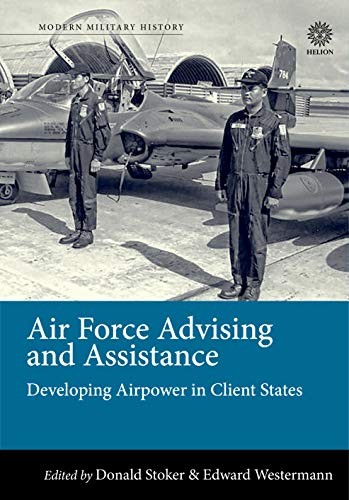
Air Force Advising and Assistance: Developing Airpower in Client States (Modern Military History)

Donald Stoker

★★★☆☆
Read Advanced intel Intel history GWOT Naval Air power Guerrilla / COIN Strategy / theory Economics ISBN 9781912390601

Helion and Company · Sep 20, 2018

The increased focus on counterinsurgency warfare and US nation building efforts after the attacks of 11 September 2001 reignited interest in military advising within military and other government organizations, private think tanks, and defense related contractors. Most studies on the subject, based on the chronological scope and numerical preponderance of ground advising missions, has quite naturally focused on these past efforts. Less attention has been given to air or naval advisory missions. This work seeks in part to help redress this current imbalance by examining a number of historical case studies dealing with air advisory efforts. By examining a number of historical case studies, this volume analyzes the challenges and opportunities inherent in aerial advisory efforts and offers insights into the methods by which such missions succeed or fail. Air advisory missions date almost to the first days of powered flight. Air advisory efforts have a number of unique elements based on the fundamental role of advanced technology and the extensive resource requirements associated with aviation operations. For example, air advisory efforts are profoundly influenced by the types of aircraft involved and the types of mission flown. Likewise, the issues of maintenance support and the infrastructure needed for these missions plays a key role in determining capabilities available to the host nation. In the case of infrastructure, airfields, fuelling depots, maintenance and repair facilities, and radar and communications equipment offer a few of the most obvious requirements to support flight operations. The early history of advisory efforts reveal issues that remain relevant today, including questions related to the nature of aerial technology to be shared, the type of training to be provided, and the potential economic benefits that might accrue to the donor nation as a result of the sale of aviation technology to the host country. In many respects, air advisory efforts raise a number of profound strategic questions for the donor nation. Among others, these questions relate to the type of technology to be shared, the nature of training to be given, the role of foreign advisors in operations, the issue of infrastructure development and auxiliary training programs, the preparation of foreign advisors for their duties, and perhaps most significantly the development of the type of capabilities required to address the host nation’s security environment. Via a series of historical case studies, this volume explores these questions and others.

No cover · Amazon

Extreme Ownership: How U.S. Navy SEALs Lead and Win

Jocko Willink

★★★☆☆
Read Basic intel Military history Special ops Naval Middle East Intel history

The #1 New York Times bestseller Sent to the most violent battlefield in Iraq, Jocko Willink and Leif Babin’s SEAL task unit faced a seemingly impossible help U.S. forces secure Ramadi, a city deemed “all but lost.” In gripping firsthand accounts of heroism, tragic loss, and hard-won victories in SEAL Team Three’s Task Unit Bruiser, they learned that leadership―at every level―is the most important factor in whether a team succeeds or fails.Willink and Babin returned home from deployment and instituted SEAL leadership training that helped forge the next generation of SEAL leaders. After departing the SEAL Teams, they launched Echelon Front, a company that teaches these same leadership principles to businesses and organizations. From promising startups to Fortune 500 companies, Babin and Willink have helped scores of clients across a broad range of industries build their own high-performance teams and dominate their battlefields. Now, detailing the mind-set and principles that enable SEAL units to accomplish the most difficult missions in combat, Extreme Ownership shows how to apply them to any team, family or organization. Each chapter focuses on a specific topic such as Cover and Move, Decentralized Command, and Leading Up the Chain, explaining what they are, why they are important, and how to implement them in any leadership environment. A compelling narrative with powerful instruction and direct application, Extreme Ownership revolutionizes business management and challenges leaders everywhere to fulfill their ultimate lead and win.

No cover · Amazon

Behind the battle: Intelligence in the war with Germany, 1939-45

Ralph Bennett

unrated
Read Advanced intel Intel history WWII Espionage Naval Air power Intel history

By the end of 1942, Ultra had become the richest and most reliable of the many different sources of intelligence, however, the relation between their individual contributions requires analysis. Ralph Bennett's study aims to present a succinct survey and analysis of the military intelligence available to Britain and her allies during World War II. When war began, Britain was as ill-prepared in intelligence as in armaments. Civilian scientists had discovered the principle of radar in the mid-1930s, but everything else had to be learned from scratch in the heat of emergency. In 1939, all three armed services lacked staff trained to appraise and distribute intelligence. Because it had so often been unreliable in the past, field commanders were reluctant to accept it and had to learn new ways. First signs of improvement came in mid-1941, when Ultra targeted naval vessels and bomber aircraft onto so many of Rommel's supply ships that the Afrika Korps almost withered on the vine. From then on intelligence played an increasingly indispensable part in final victory. Ultra won the Battle of the Atlantic, driving the U-boats back to coastal waters by June 1943. A lower grade code gave Montgomery the vital first news of the whereabouts of the German tanks as he planned the breakthrough at Alamein. Only "Bomber" Harris refused to give intelligence the credit it deserved, for reasons investigated in "Behind the Battle".

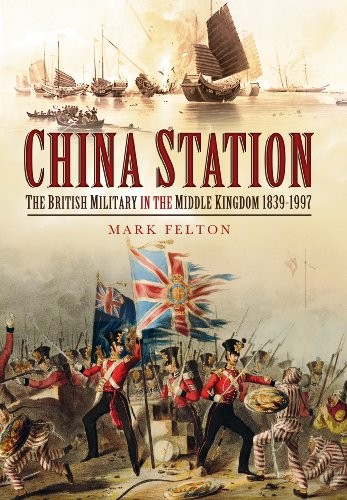
China Station: The British Military in the Middle Kingdom 1839 – 1997

Mark Felton

unrated
Read Military history Naval China Economics US Civil War ISBN 9781781590690

Pen and Sword Military · Oct 19, 2013

The author, who lives in Shanghai, sets out to demonstrate that the British military has been at the forefront of many of the great changes that have swept China over the last two centuries. The author, who lives in Shanghai, sets out to demonstrate that the British military has been at the forefront of many of the great changes that have swept China over the last two centuries. He devotes chapters to the various wars, military adventures and rebellions that regularly punctuated Sino/British relationships since the 1st Opium War 1839-1842. This classic example of Imperial intervention saw the establishment of Hong Kong and Shanghai as key trading centers. The Second Opium War and the Taiping and Boxer Rebellions saw the advancement of British influence despite determined but unsuccessful efforts by the Chinese to loosen the grip of Western domination. The Royal Navy's might ensured that, by gunboat diplomacy, trading rights and new posts were established and great fortunes made. But in the 1940s the British grossly underestimated Japanese military might and intentions with disastrous results. After the Second World War the British returned to find that the Americans had supplanted them. The Communists victory in the Civil War sealed British and Western fates and, while Hong Kong remained under British control until 1997, the end of British rule was almost inevitable. But the handover was a masterly piece of pragmatic capitalism and the former Colony remains an economic powerhouse with strong British influence.

No cover · Amazon

Eating for Victory: Healthy Home Front Cooking on War Rations

Jill Norman

unrated
Read Logistics Economics Naval Logistics Economics

Food rationing was introduced in England in January 1940 after supply ships were attacked by German U-boats. The first food items to be rationed were butter, sugar, bacon, and ham, though restrictions were also eventually placed on meat, fish, jam, biscuits, cheese, eggs, and milk. In response, the Ministry of Food produced a series of "Eating for Victory" pamphlets that advised the general public on how to cope with these shortages. Designed to lift spirits in a time of shortage, these jolly leaflets contained a variety of recipes and cooking advice ranging from how to make steamed and boiled puddings and hints on how to reconstitute dried eggs. For all the hardship that rationing brought, the food restrictions resulted in many people eating more healthily than ever before. A nostalgic look back at one of the most difficult and yet healthiest times in history, this quaint collection is also a relevant guide to good eating today.

Invisible Armies: An Epic History of Guerrilla Warfare from Ancient Times to the Present

Max Boot

unrated
Read Basic intel Intel history Military history Vietnam GWOT Naval Guerrilla / COIN Middle East Strategy / theory ISBN 9780871404244

Liveright Pub. Corporation · 2012

As fitting for the twenty-first century as von Clausewitz’s On War was in its own time, Invisible Armies is a complete global history of guerrilla uprisings through the ages. Beginning with the first insurgencies in the ancient world―when Alexander the Great discovered that fleet nomads were harder to defeat than massive conventional armies―Max Boot, best-selling author and military advisor in Iraq and Afghanistan, masterfully guides us from the Jewish rebellion against the Roman Empire up through the horrors of the French-Indochina War and the shadowy, post-9/11 battlefields of today. Relying on a diverse cast of unforgettable characters―not only Mao and Che but also the legendary Italian nationalist Giuseppe Garibaldi, the archaeologist-turned–military commander T. E. Lawrence, and the “Quiet American” Edward Lansdale, among others―Boot explodes everything we thought we knew about unconventional combat. The result is both an enthralling read and our most important work on nontraditional warfare. 70 illustrations; 8 maps

Japan Prepares for Total War: The Search for Economic Security, 1919-1941

Michael A. Barnhart

unrated
Read Logistics Military history WWII Naval Logistics Economics ISBN 0801419158

Cornell University Press · 1991

The roots of Japan's aggressive, expansionist foreign policy have often been traced to its concern over acute economic vulnerability. Historian Michael Barnhart tests this assumption by examining the events leading up to World War II in the context of Japan's quest for economic security. Drawing on a wide array of Japanese and American sources, this is the first English-language book on the war's origins to be based on research in archives on both sides of the Pacific. Barnhart focuses on the critical years from 1938 to 1941 as he investigates the development of Japan's drive for national economic self-sufficiency and independence and the way in which this drive shaped its internal and external policies. He also explores American economic pressure on Tokyo and assesses its impact on Japan's foreign policy and domestic economy. He concludes that Japan's internal political dynamics, especially the bitter rivalry between its army and navy, played a far greater role in propelling the nation into war with the United States than did its economic condition or even pressure from Washington. Japan Prepares for Total War sheds new light on prewar Japan and confirms the opinions of those in Washington who advocated economic pressure against Japan. At a time of growing interest in U.S.-Japanese economic relations, this book will be stimulating and provocative reading for scholars and students of international relations and American and Asian history.

Japanese Intelligence in World War II (General Military)

Ken Kotani

unrated
Read Advanced intel Intel history WWII Espionage Naval China Russia / USSR Intel history ISBN 9781846034251

Osprey · 2009

In the eyes of history, Japanese intelligence in World War II has fared very poorly. However, these historians have most often concentrated on the later years of the war, when Japan was fighting a multi-front war against numerous opponents. In this groundbreaking new study, Japanese scholar Ken Kotani re-examines the Japanese Intelligence department, beginning with the early phase of the war. He points out that without the intelligence gathered by the Japanese Army and Navy they would have been unable to achieve their long string of victories against the forces of Russia, China, and Great Britain. Notable in these early campaigns were the successful strikes against both Singapore and Pearl Harbor. Yet as these victories expanded the sphere of Japanese control, they also made it harder for the intelligence services to gather accurate information about their growing list of adversaries. At the battle of Midway in 1942, Japanese intelligence suffered its worst mishap when the Americans broke their code and tricked the Japanese into revealing the target of their attack. It was a mistake from which they would never recover. As the military might of Japan was forced to retreat and her forces deteriorated, so too did her intelligence services.

Lone Survivor: The Eyewitness Account of Operation Redwing and the Lost Heroes of SEAL Team 10

Marcus Luttrell

unrated
Read GWOT Special ops Naval Intel history Biography ISBN 9780316067591

Little, Brown · 2007

On a clear night in late June 2005, four U.S. Navy SEALs left their base in northern Afghanistan for the mountainous Pakistani border. Their mission was to capture or kill a notorious al Qaeda leader known to be ensconced in a Taliban stronghold surrounded by a small but heavily armed force. Less then twenty-four hours later, only one of those Navy SEALs remained alive. This is the story of fire team leader Marcus Luttrell, the sole survivor of Operation Redwing, and the desperate battle in the mountains that led, ultimately, to the largest loss of life in Navy SEAL history. But it is also, more than anything, the story of his teammates, who fought ferociously beside him until he was the last one left-blasted unconscious by a rocket grenade, blown over a cliff, but still armed and still breathing. Over the next four days, badly injured and presumed dead, Luttrell fought off six al Qaeda assassins who were sent to finish him, then crawled for seven miles through the mountains before he was taken in by a Pashtun tribe, who risked everything to protect him from the encircling Taliban killers. A six-foot-five-inch Texan, Leading Petty Officer Luttrell takes us, blow-by-blow, through the brutal training of America's warrior elite and the relentless rites of passage required by the Navy SEALs. He transports us to a monstrous battle fought in the desolate peaks of Afghanistan, where the beleaguered American team plummeted headlong a thousand feet down a mountain as they fought back through flying shale and rocks. In this rich , moving chronicle of courage, honor, and patriotism, Marcus Luttrell delivers one of the most powerful narratives ever written about modern warfare-and a tribute to his teammates, who made the ultimate sacrifice for their country.

One Hundred Years of Sea Power: The U. S. Navy, 1890-1990

George W. Baer

unrated
Read Military history Logistics Naval Logistics Strategy / theory ISBN 9780804727945

Stanford University Press · July 1, 1996

A navy is a state's main instrument of maritime force. What it should do, what doctrine it holds, what ships it deploys, and how it fights are determined by practical political and military choices in relation to national needs. Choices are made according to the state's goals, perceived threat, maritime opportunity, technological capabilities, practical experience, and, not the least, the way the sea service defines itself and its way of war. This book is a history of the modern U.S. Navy. It explains how the Navy, in the century after 1890, was formed and reformed in the interaction of purpose, experience, and doctrine.

No cover · Amazon

The Admirals' Advantage: U.S. Navy Operational Intelligence in World War II and the Cold War

Christopher A. Ford

unrated
Read Advanced intel WWII Cold War Naval

Operational intelligence, knowledge of the enemy’s location and actions, is crucial to effective military operations. The Admirals’ Advantage offers a revealing look at naval operational intelligence based on the findings of a classified Operational Intelligence (OPINTEL) Lessons-Learned Project and a 1998 Symposium at the Navy and Marine Corps Intelligence Training Center. Participants included senior intelligence and operational leaders who explored the evolution and significance of OPINTEL since World War II. Past and current practices were examined with inputs from fleet and shore commands and insights from interviews and correspondence with senior flag officers and intelligence professionals.

No cover · Amazon

The Rise of Theodore Roosevelt (Theodore Roosevelt, #1)

Edmund Morris

unrated
Read Biographies Cold War GWOT Naval Guerrilla / COIN Intel history Biography

Selected by The Modern Library as one of the 100 best nonfiction books of all time This classic biography is the story of seven men—a naturalist, a writer, a lover, a hunter, a ranchman, a soldier, and a politician—who merged at age forty-two to become the youngest President in history. The Rise of Theodore Roosevelt begins at the apex of his international prestige. That was on New Year’s Day, 1907, when TR, who had just won the Nobel Peace Prize, threw open the doors of the White House to the American people and shook 8,150 hands. One visitor remarked afterward, “You go to the White House, you shake hands with Roosevelt and hear him talk—and then you go home to wring the personality out of your clothes.” The rest of this book tells the story of TR’s irresistible rise to power. During the years 1858–1901, Theodore Roosevelt transformed himself from a frail, asthmatic boy into a full-blooded man. Fresh out of Harvard, he simultaneously published a distinguished work of naval history and became the fist-swinging leader of a Republican insurgency in the New York State Assembly. He chased thieves across the Badlands of North Dakota with a copy of Anna Karenina in one hand and a Winchester rifle in the other. Married to his childhood sweetheart in 1886, he became the country squire of Sagamore Hill on Long Island, a flamboyant civil service reformer in Washington, D.C., and a night-stalking police commissioner in New York City. As assistant secretary of the navy, he almost single-handedly brought about the Spanish-American War. After leading “Roosevelt’s Rough Riders” in the famous charge up San Juan Hill, Cuba, he returned home a military hero, and was rewarded with the governorship of New York. In what he called his “spare hours” he fathered six children and wrote fourteen books. By 1901, the man Senator Mark Hanna called “that damned cowboy” was vice president. Seven months later, an assassin’s bullet gave TR the national leadership he had always craved. His is a story so prodigal in its variety, so surprising in its turns of fate, that previous biographers have treated it as a series of haphazard episodes. This book, the only full study of TR’s pre-presidential years, shows that he was an inevitable chief executive. “It was as if he were subconsciously aware that he was a man of many selves,” the author writes, “and set about developing each one in turn, knowing that one day he would be President of all the people.”