ADP 3-90, page 22
Offense and Defense
Army Doctrine Publication: Offense and Defense
July 2019 public edition (supersedes Aug 2018); key terrain cited in S2 KOCOA
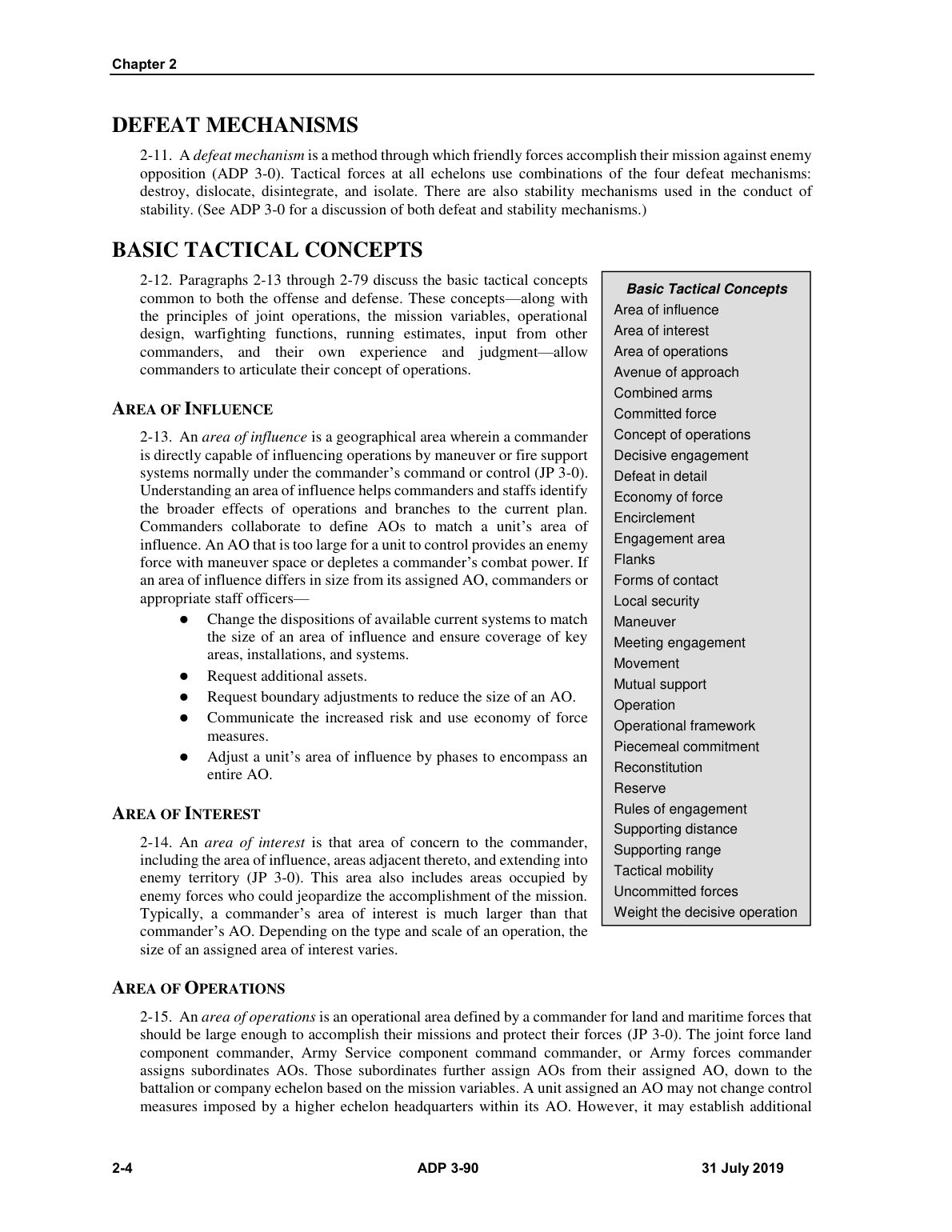
Searchable page text (OCR / PDF)
Chapter 2
2-4
ADP 3-90
31 July 2019
DEFEAT MECHANISMS
2-11. A defeat mechanism is a method through which friendly forces accomplish their mission against enemy
opposition (ADP 3-0). Tactical forces at all echelons use combinations of the four defeat mechanisms:
destroy, dislocate, disintegrate, and isolate. There are also stability mechanisms used in the conduct of
stability. (See ADP 3-0 for a discussion of both defeat and stability mechanisms.)
BASIC TACTICAL CONCEPTS
2-12. Paragraphs 2-13 through 2-79 discuss the basic tactical concepts
common to both the offense and defense. These concepts—along with
the principles of joint operations, the mission variables, operational
design, warfighting functions, running estimates, input from other
commanders, and their own experience and judgment—allow
commanders to articulate their concept of operations.
AREA OF INFLUENCE
2-13. An area of influence is a geographical area wherein a commander
is directly capable of influencing operations by maneuver or fire support
systems normally under the commander’s command or control (JP 3-0).
Understanding an area of influence helps commanders and staffs identify
the broader effects of operations and branches to the current plan.
Commanders collaborate to define AOs to match a unit’s area of
influence. An AO that is too large for a unit to control provides an enemy
force with maneuver space or depletes a commander’s combat power. If
an area of influence differs in size from its assigned AO, commanders or
appropriate staff officers—
Change the dispositions of available current systems to match
the size of an area of influence and ensure coverage of key
areas, installations, and systems.
Request additional assets.
Request boundary adjustments to reduce the size of an AO.
Communicate the increased risk and use economy of force
measures.
Adjust a unit’s area of influence by phases to encompass an
entire AO.
AREA OF INTEREST
2-14. An area of interest is that area of concern to the commander,
including the area of influence, areas adjacent thereto, and extending into
enemy territory (JP 3-0). This area also includes areas occupied by
enemy forces who could jeopardize the accomplishment of the mission.
Typically, a commander’s area of interest is much larger than that
commander’s AO. Depending on the type and scale of an operation, the
size of an assigned area of interest varies.
AREA OF OPERATIONS
2-15. An area of operations is an operational area defined by a commander for land and maritime forces that
should be large enough to accomplish their missions and protect their forces (JP 3-0). The joint force land
component commander, Army Service component command commander, or Army forces commander
assigns subordinates AOs. Those subordinates further assign AOs from their assigned AO, down to the
battalion or company echelon based on the mission variables. A unit assigned an AO may not change control
measures imposed by a higher echelon headquarters within its AO. However, it may establish additional
Basic Tactical Concepts
Area of influence
Area of interest
Area of operations
Avenue of approach
Combined arms
Committed force
Concept of operations
Decisive engagement
Defeat in detail
Economy of force
Encirclement
Engagement area
Flanks
Forms of contact
Local security
Maneuver
Meeting engagement
Movement
Mutual support
Operation
Operational framework
Piecemeal commitment
Reconstitution
Reserve
Rules of engagement
Supporting distance
Supporting range
Tactical mobility
Uncommitted forces
Weight the decisive operation