ADP 3-90, page 66
Offense and Defense
Army Doctrine Publication: Offense and Defense
July 2019 public edition (supersedes Aug 2018); key terrain cited in S2 KOCOA
Searchable page text (OCR / PDF)
Chapter 4
4-6
ADP 3-90
31 July 2019
on most of these FSCMs. See FM 3-52 for discussions on airspace coordination areas.) Commanders can
also designate final protective fire (FPF). Final protective fire is an immediately available, prearranged
barrier of fire designed to impede enemy movement across defensive lines or areas (JP 3-09.3).
FORWARD EDGE OF THE BATTLE AREA
4-31. The forward edge of the battle area is the foremost limits of a series of areas in which ground combat
units are deployed to coordinate fire support, the positioning of forces, or the maneuver of units, excluding
areas in which covering or screening forces are operating (JP 3-09.3). The Army uses a FEBA only during
the defense. The FEBA is not a boundary, but it conveys the commander’s intent. The FEBA shows the senior
commander’s planned limit for the effects of direct fires. It marks the foremost limits of the areas in which
most ground combat units deploy, excluding the areas in which security forces are operating. MBA forces
can temporarily move forward of the FEBA to expedite the retrograde operations of security forces.
Commanders designate a FEBA to coordinate fire support and to help in the maneuver of subordinate forces.
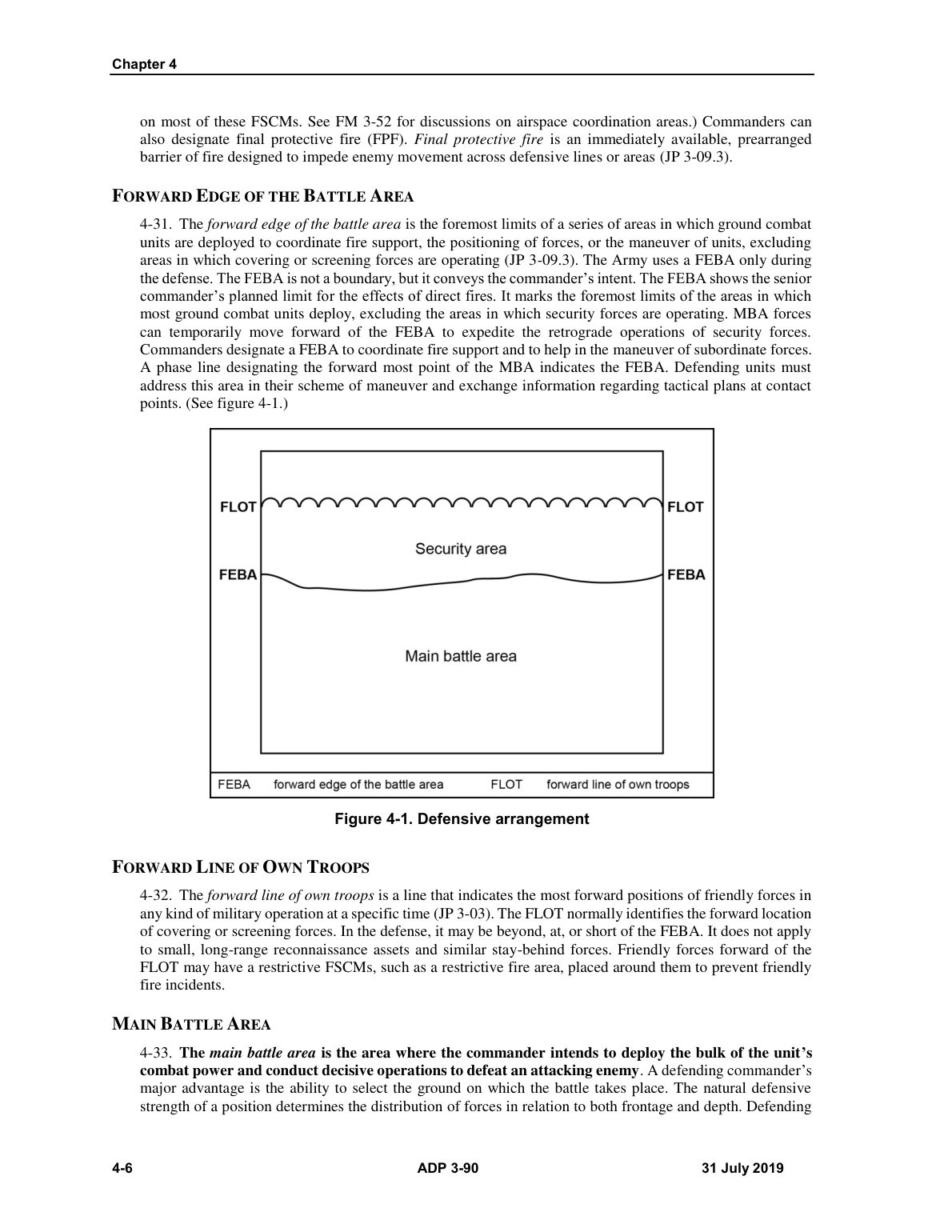
A phase line designating the forward most point of the MBA indicates the FEBA. Defending units must
address this area in their scheme of maneuver and exchange information regarding tactical plans at contact
points. (See figure 4-1.)
Figure 4-1. Defensive arrangement
FORWARD LINE OF OWN TROOPS
4-32. The forward line of own troops is a line that indicates the most forward positions of friendly forces in
any kind of military operation at a specific time (JP 3-03). The FLOT normally identifies the forward location
of covering or screening forces. In the defense, it may be beyond, at, or short of the FEBA. It does not apply
to small, long-range reconnaissance assets and similar stay-behind forces. Friendly forces forward of the
FLOT may have a restrictive FSCMs, such as a restrictive fire area, placed around them to prevent friendly
fire incidents.
MAIN BATTLE AREA
4-33. The main battle area is the area where the commander intends to deploy the bulk of the unit’s
combat power and conduct decisive operations to defeat an attacking enemy. A defending commander’s
major advantage is the ability to select the ground on which the battle takes place. The natural defensive
strength of a position determines the distribution of forces in relation to both frontage and depth. Defending