AFDD 2-1.9, page 15
Targeting
Air Force Doctrine Document: Targeting
DTIC ADA454614 public copy
Searchable page text (OCR / PDF)
5
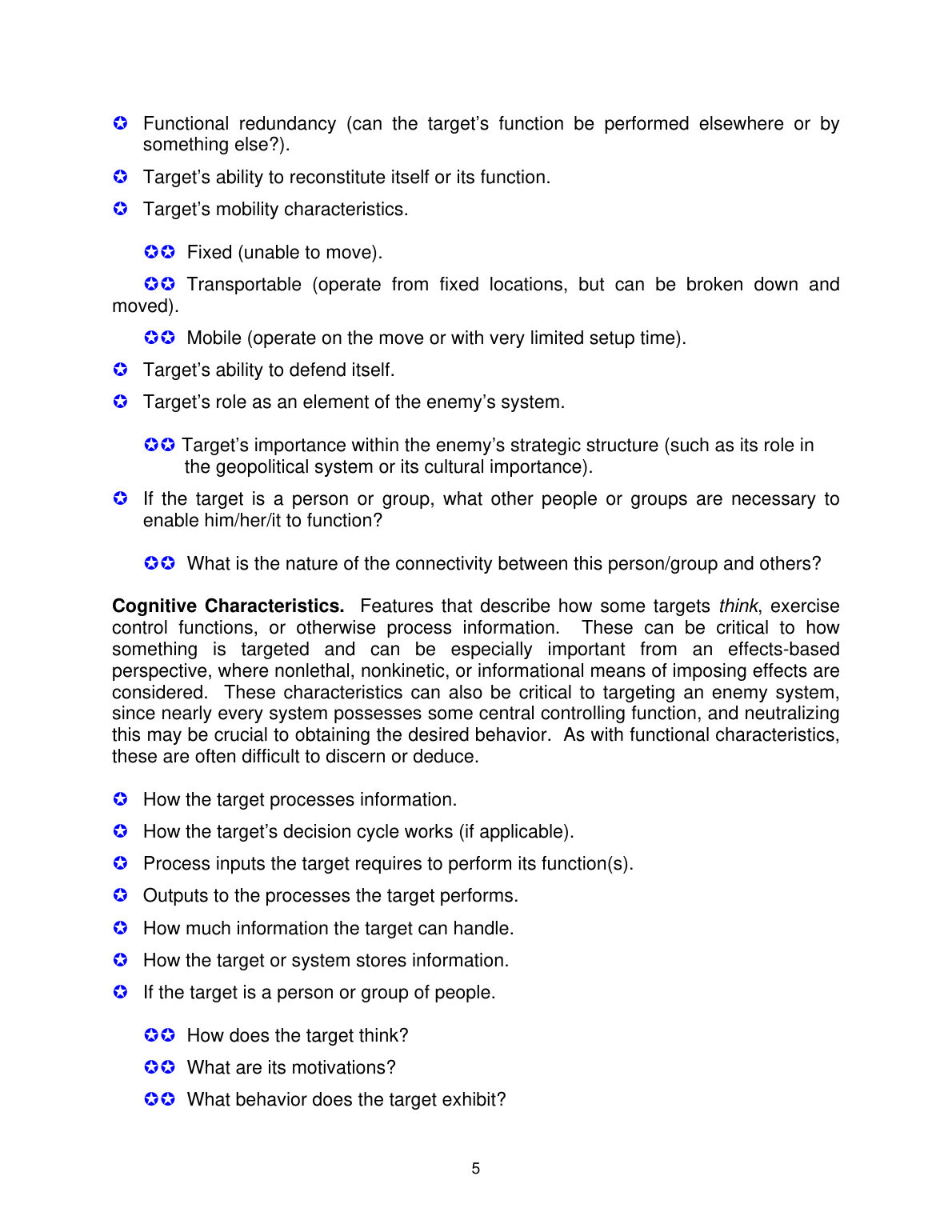
Functional redundancy (can the target’s function be performed elsewhere or by
something else?).
Target’s ability to reconstitute itself or its function.
Target’s mobility characteristics.
Fixed (unable to move).
Transportable (operate from fixed locations, but can be broken down and
moved).
Mobile (operate on the move or with very limited setup time).
Target’s ability to defend itself.
Target’s role as an element of the enemy’s system.
Target’s importance within the enemy’s strategic structure (such as its role in
the geopolitical system or its cultural importance).
If the target is a person or group, what other people or groups are necessary to
enable him/her/it to function?
What is the nature of the connectivity between this person/group and others?
Cognitive Characteristics. Features that describe how some targets think, exercise
control functions, or otherwise process information. These can be critical to how
something is targeted and can be especially important from an effects-based
perspective, where nonlethal, nonkinetic, or informational means of imposing effects are
considered. These characteristics can also be critical to targeting an enemy system,
since nearly every system possesses some central controlling function, and neutralizing
this may be crucial to obtaining the desired behavior. As with functional characteristics,
these are often difficult to discern or deduce.
How the target processes information.
How the target’s decision cycle works (if applicable).
Process inputs the target requires to perform its function(s).
Outputs to the processes the target performs.
How much information the target can handle.
How the target or system stores information.
If the target is a person or group of people.
How does the target think?
What are its motivations?
What behavior does the target exhibit?