AFDD 2-1.9, page 17
Targeting
Air Force Doctrine Document: Targeting
DTIC ADA454614 public copy
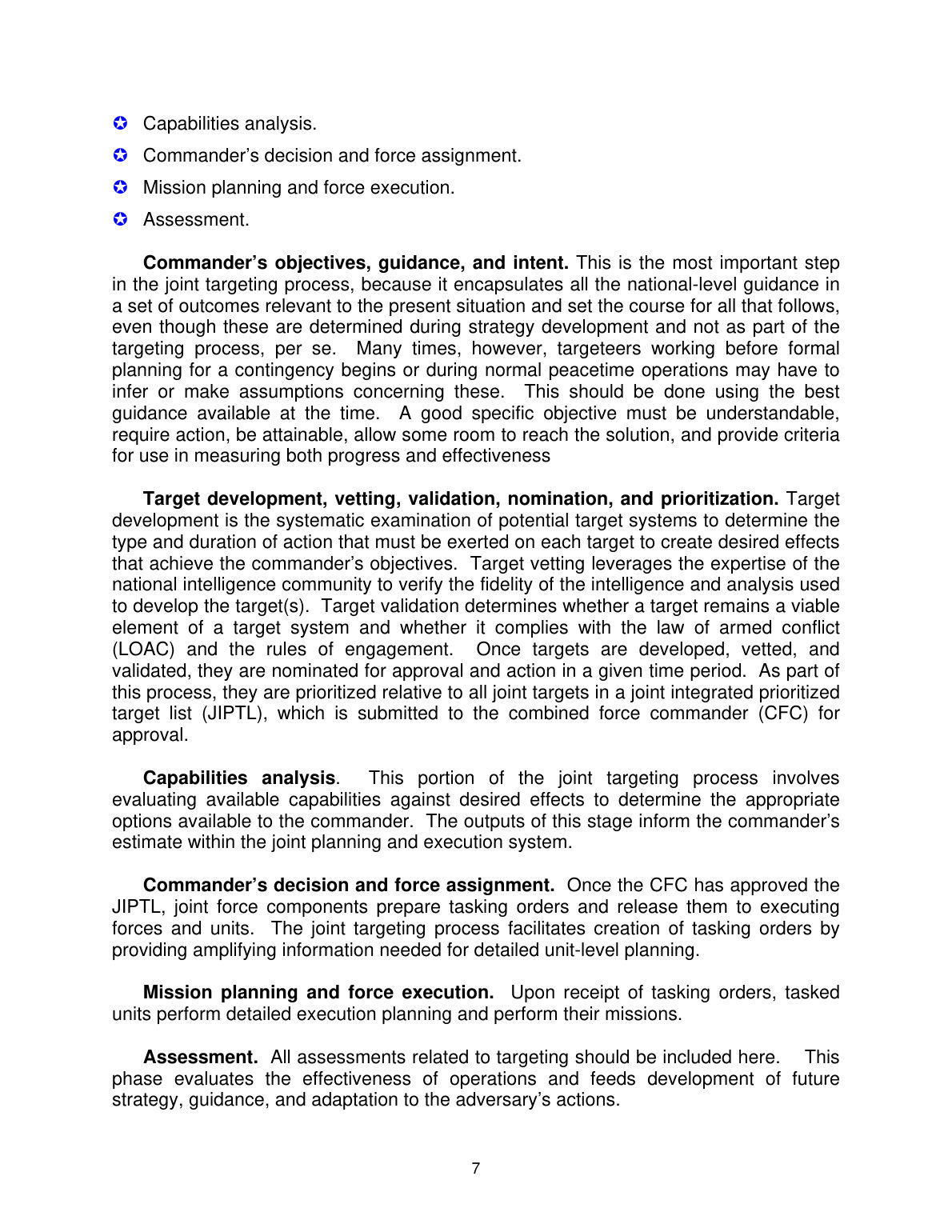
Searchable page text (OCR / PDF)
7
Capabilities analysis.
Commander’s decision and force assignment.
Mission planning and force execution.
Assessment.
Commander’s objectives, guidance, and intent. This is the most important step
in the joint targeting process, because it encapsulates all the national-level guidance in
a set of outcomes relevant to the present situation and set the course for all that follows,
even though these are determined during strategy development and not as part of the
targeting process, per se. Many times, however, targeteers working before formal
planning for a contingency begins or during normal peacetime operations may have to
infer or make assumptions concerning these. This should be done using the best
guidance available at the time. A good specific objective must be understandable,
require action, be attainable, allow some room to reach the solution, and provide criteria
for use in measuring both progress and effectiveness
Target development, vetting, validation, nomination, and prioritization. Target
development is the systematic examination of potential target systems to determine the
type and duration of action that must be exerted on each target to create desired effects
that achieve the commander’s objectives. Target vetting leverages the expertise of the
national intelligence community to verify the fidelity of the intelligence and analysis used
to develop the target(s). Target validation determines whether a target remains a viable
element of a target system and whether it complies with the law of armed conflict
(LOAC) and the rules of engagement. Once targets are developed, vetted, and
validated, they are nominated for approval and action in a given time period. As part of
this process, they are prioritized relative to all joint targets in a joint integrated prioritized
target list (JIPTL), which is submitted to the combined force commander (CFC) for
approval.
Capabilities analysis. This portion of the joint targeting process involves
evaluating available capabilities against desired effects to determine the appropriate
options available to the commander. The outputs of this stage inform the commander’s
estimate within the joint planning and execution system.
Commander’s decision and force assignment. Once the CFC has approved the
JIPTL, joint force components prepare tasking orders and release them to executing
forces and units. The joint targeting process facilitates creation of tasking orders by
providing amplifying information needed for detailed unit-level planning.
Mission planning and force execution. Upon receipt of tasking orders, tasked
units perform detailed execution planning and perform their missions.
Assessment. All assessments related to targeting should be included here. This
phase evaluates the effectiveness of operations and feeds development of future
strategy, guidance, and adaptation to the adversary’s actions.