AFDD 2-1.9, page 22
Targeting
Air Force Doctrine Document: Targeting
DTIC ADA454614 public copy
Searchable page text (OCR / PDF)
12
Targeting is inherently estimative and anticipatory. Matching actions and
effects to targets requires estimating and anticipating future outcomes. In some
cases the outcome is straightforward, such as anticipating that disabling a fire control
radar will put a surface-to-air missile battery out of action. In most cases, however,
estimation is more complicated. Many factors contribute to successful targeting. IPB
should yield insight on the enemy and his intentions. Target system analysis yields
understanding of how components of the enemy system interact and how the system
functions as a whole. ISR assets gather needed data and help improve the accuracy
and extent of estimation. Such analyses enable planners to select targets and methods
of affecting them that increase the probability of desired outcomes and make the most
efficient use of limited air and space resources. This does not imply perfect knowledge
or anticipation; uncertainty and friction still apply.
Targeting is systematic. In supporting the commander’s objectives, the
targeting process seeks to achieve effects in a systematic manner. Targeting, like
the other processes that it complements, is a rational, iterative process that
methodically analyzes, prioritizes, and assigns forces against adversary targets to
achieve the effects needed to meet campaign objectives. If the desired effects are not
achieved, targets are “recycled” through the tasking process, or different targets are
selected.
The principles set forth above establish a broad framework on which the targeting
discipline should build. To put them in proper context, however, one must understand
what targets are and how they are prosecuted, as well as what targeting responsibilities
the commander of air and space forces has. The sections below describe targets, the
two basic types of targeting, and commanders’ responsibilities, all of which are explored
further in the following chapters.
EFFECTS-BASED APPROACH TO OPERATIONS
To understand how targeting forms one pillar of a flexible system that can
accommodate many different strategies and achieve a wide variety of objectives
through a wide variety of means, it is first necessary to understand the effects-based
approach and how targeting fits within it.
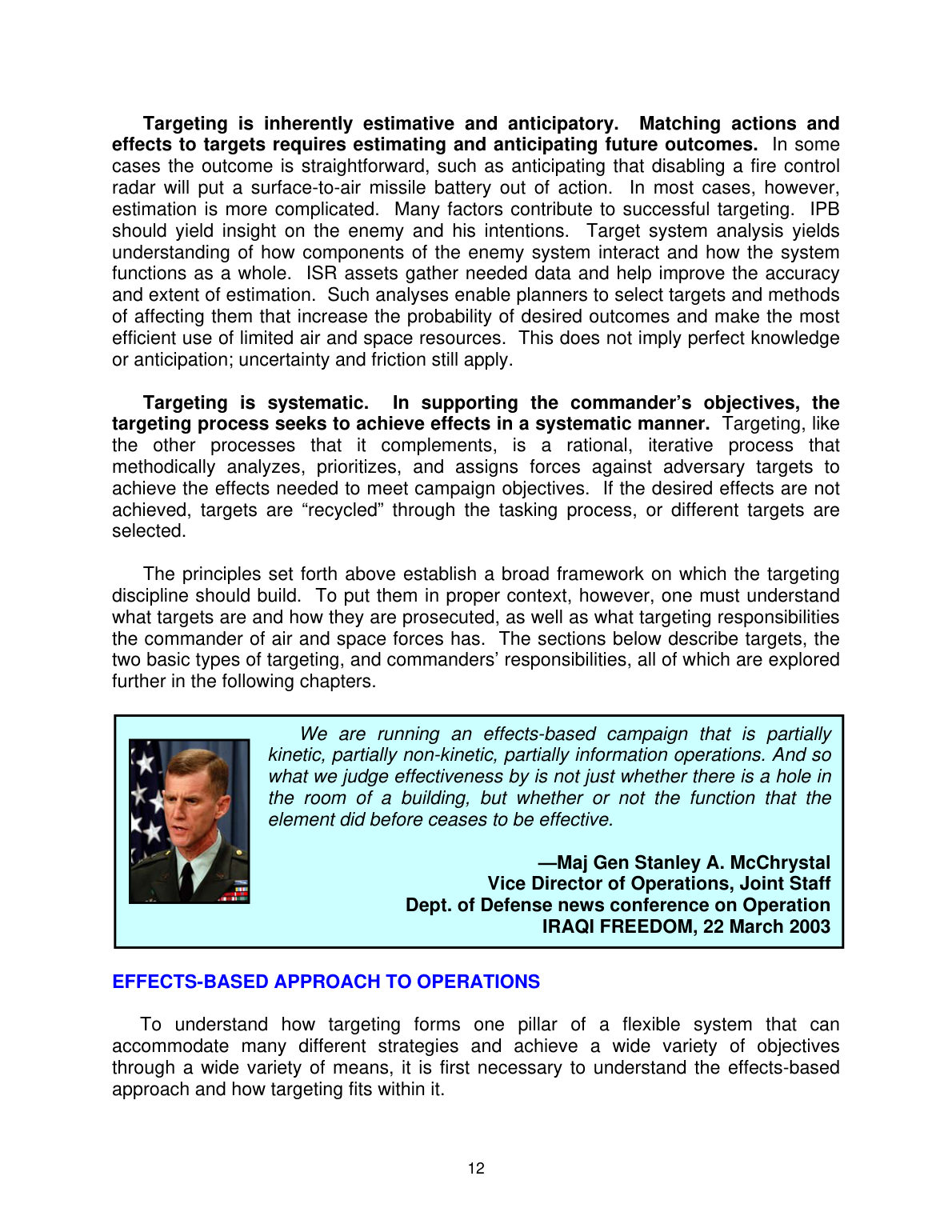
We are running an effects-based campaign that is partially
kinetic, partially non-kinetic, partially information operations. And so
what we judge effectiveness by is not just whether there is a hole in
the room of a building, but whether or not the function that the
element did before ceases to be effective.
—Maj Gen Stanley A. McChrystal
Vice Director of Operations, Joint Staff
Dept. of Defense news conference on Operation
IRAQI FREEDOM, 22 March 2003