AFDD 2-1.9, page 28
Targeting
Air Force Doctrine Document: Targeting
DTIC ADA454614 public copy
Searchable page text (OCR / PDF)
18
locations. However, deliberate targeting can be used against mobile targets, especially
when the target is in a defensive posture and may be in positions for long periods of
time. On-call missions can be used against fixed, transportable, and mobile targets.
For instance, a fixed building may be watched, but does not become a target until some
critical person, group, or equipment arrives, at which time the on-call mission is
scheduled on the tasking order if intelligence arrives in sufficient time. Other potential
targets that are detected or become significant during the current execution period
(once all formal products of the planning and tasking processes are issued), including
the CFC’s TSTs, are dealt with using dynamic targeting (see Chapter Three).
The effects-based principles set forth in AFDD 2 should guide all planning efforts,
including deliberate targeting. The spectacular success US forces have enjoyed in
major combat operations since Operation DESERT STORM was made possible in large
part by their ability to exploit the full range of effects beyond simple destruction and
attrition. This is an advantage that the effects-based approach confers. An effects-
based approach is even more critical for success in stability operations such as
counterinsurgency and peace enforcement, because they rely more on “non-kinetic”
means and less on types of effects for which cause and effect are well understood, like
attrition. To exploit the full range of possible effects in a given situation, planners must
understand what effects are, how they relate to actions and objectives, and how various
types of effects can be exploited to yield desired outcomes.
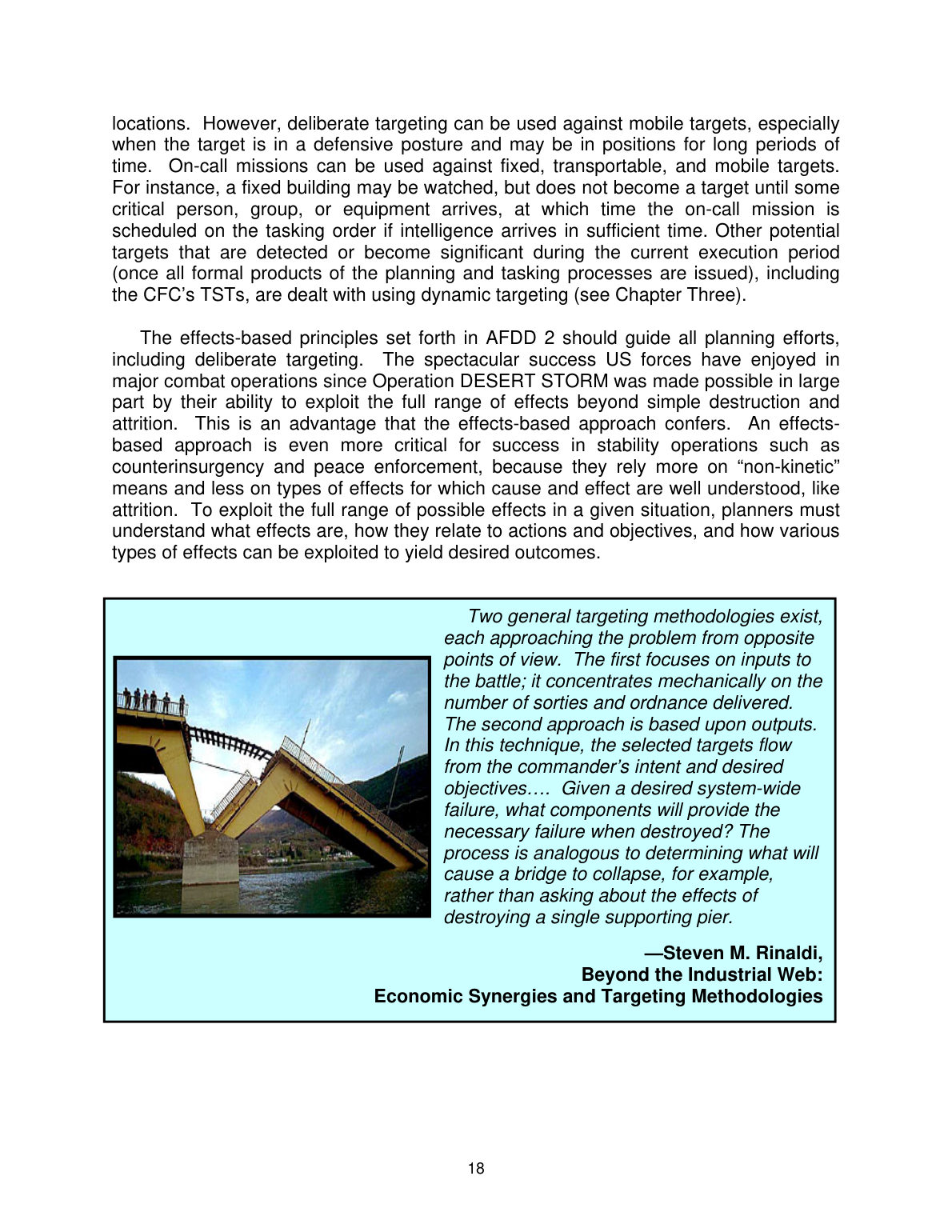
Two general targeting methodologies exist,
each approaching the problem from opposite
points of view. The first focuses on inputs to
the battle; it concentrates mechanically on the
number of sorties and ordnance delivered.
The second approach is based upon outputs.
In this technique, the selected targets flow
from the commander’s intent and desired
objectives…. Given a desired system-wide
failure, what components will provide the
necessary failure when destroyed? The
process is analogous to determining what will
cause a bridge to collapse, for example,
rather than asking about the effects of
destroying a single supporting pier.
—Steven M. Rinaldi,
Beyond the Industrial Web:
Economic Synergies and Targeting Methodologies