AFDD 2-1.9, page 80
Targeting
Air Force Doctrine Document: Targeting
DTIC ADA454614 public copy
Searchable page text (OCR / PDF)
70
intelligence to combatant commanders, consists of several physically separated
squadrons and does not fall under any geographic combatant command. As such, it is
called upon to support US Air Forces Europe (USAFE), Central Air Forces (CENTAF),
Pacific Air Forces (PACAF), and other targeting efforts, often at the same time. Unless
clear guidance or memoranda of agreement are put in place, a COMAFFOR may see
part of his expected federated targeting infrastructure assigned to other tasks. Effective
delineation of duties is critical if this federated targeting system is to work in both peace
and war. Such federated support is necessary for all aspects of ongoing targeting
readiness, and is important to keep in mind while addressing specific targeting duties.
Targeting duties are typically the responsibility of the targeteers in air intelligence
squadrons (AIS) and information operations teams (IOT). These units provide the core
personnel for an air intelligence group (AIG) or air and space operations group (AOG),
depending on the theater. Commanders of these units must ensure that their personnel
are conducting all necessary targeting planning activities for their areas of responsibility
during peacetime.
TARGET DEVELOPMENT
Much of peacetime targeting readiness is geared toward target development.
Targeteers work closely with AIS intelligence analysts to develop target intelligence and
target system models. However, they may have to coordinate with many types of
intelligence analysts (general military intelligence, imagery, signals intelligence
[SIGINT], human intelligence [HUMINT], etc.), outside of the CAOC. See Appendix B
for specifics. Even if there are no official federation procedures in place, CAOC
targeteers should still work with these organizations to utilize their expertise.
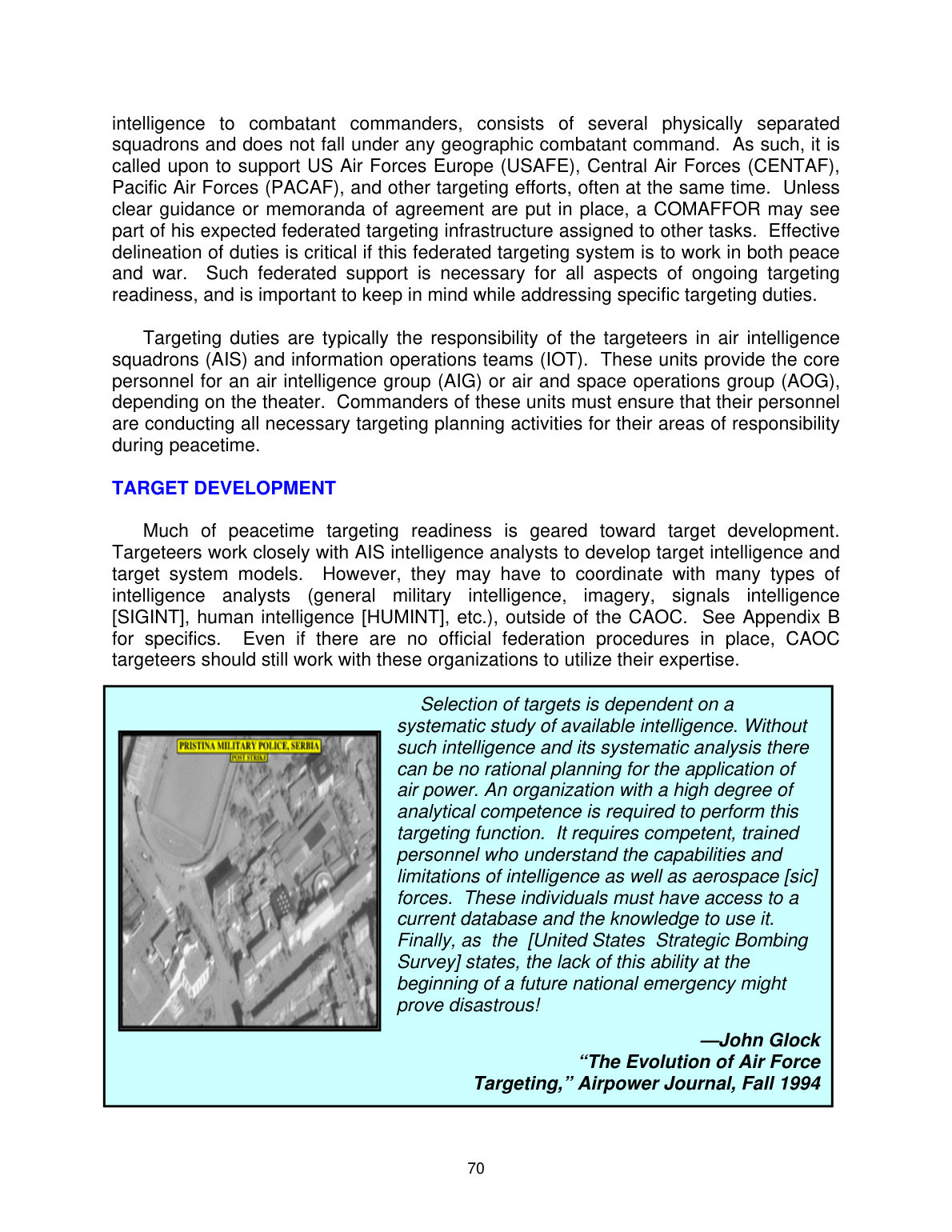
Selection of targets is dependent on a
systematic study of available intelligence. Without
such intelligence and its systematic analysis there
can be no rational planning for the application of
air power. An organization with a high degree of
analytical competence is required to perform this
targeting function. It requires competent, trained
personnel who understand the capabilities and
limitations of intelligence as well as aerospace [sic]
forces. These individuals must have access to a
current database and the knowledge to use it.
Finally, as the [United States Strategic Bombing
Survey] states, the lack of this ability at the
beginning of a future national emergency might
prove disastrous!
—John Glock
“The Evolution of Air Force
Targeting,” Airpower Journal, Fall 1994