ATP 2-33.4, page 7
Intelligence Analysis
Army Techniques Publication: Intelligence Analysis
2014 public edition (Archive.org)
Searchable page text (OCR / PDF)
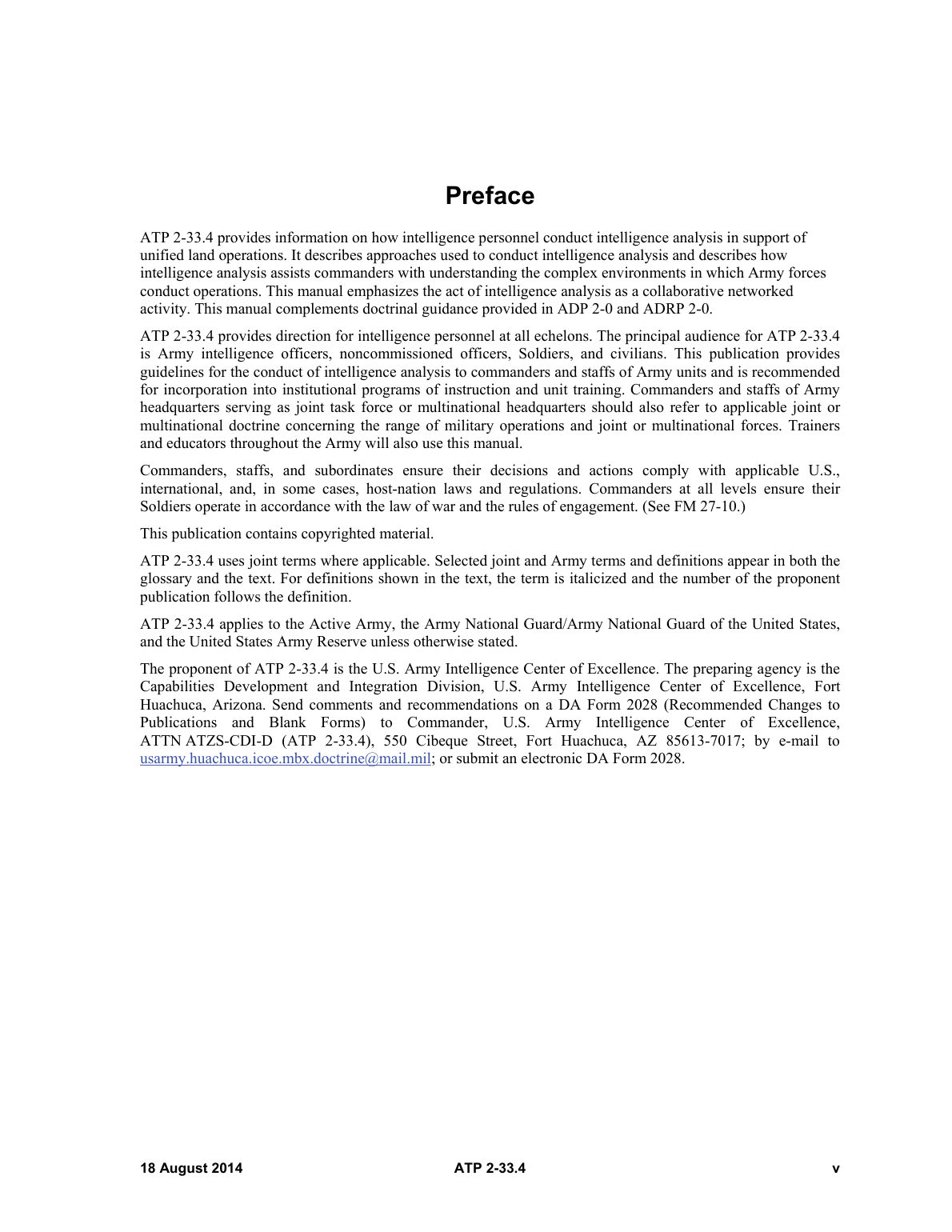
Preface
ATP 2-33.4 provides information on how intelligence personnel conduct intelligence analysis in support of
unified land operations. It describes approaches used to conduct intelligence analysis and describes how
intelligence analysis assists commanders with understanding the complex environments in which Army forces
conduct operations. This manual emphasizes the act of intelligence analysis as a collaborative networked
activity. This manual complements doctrinal guidance provided in ADP 2-0 and ADRP 2-0.
ATP 2-33.4 provides direction for intelligence personnel at all echelons. The principal audience for ATP 2-33.4
is Army intelligence officers, noncommissioned officers, Soldiers, and civilians. This publication provides
guidelines for the conduct of intelligence analysis to commanders and staffs of Army units and is recommended
for incorporation into institutional programs of instruction and unit training. Commanders and staffs of Army
headquarters serving as joint task force or multinational headquarters should also refer to applicable joint or
multinational doctrine concerning the range of military operations and joint or multinational forces. Trainers
and educators throughout the Army will also use this manual.
Commanders, staffs, and subordinates ensure their decisions and actions comply with applicable U.S.,
international, and, in some cases, host-nation laws and regulations. Commanders at all levels ensure their
Soldiers operate in accordance with the law of war and the rules of engagement. (See FM 27-10.)
This publication contains copyrighted material.
ATP 2-33.4 uses joint terms where applicable. Selected joint and Army terms and definitions appear in both the
glossary and the text. For definitions shown in the text, the term is italicized and the number of the proponent
publication follows the definition.
ATP 2-33.4 applies to the Active Army, the Army National Guard/Army National Guard of the United States,
and the United States Army Reserve unless otherwise stated.
The proponent of ATP 2-33.4 is the U.S. Army Intelligence Center of Excellence. The preparing agency is the
Capabilities Development and Integration Division, U.S. Army Intelligence Center of Excellence, Fort
Huachuca, Arizona. Send comments and recommendations on a DA Form 2028 (Recommended Changes to
Publications and Blank Forms) to Commander, U.S. Army Intelligence Center of Excellence,
ATTN ATZS-CDI-D (ATP 2-33.4), 550 Cibeque Street, Fort Huachuca, AZ 85613-7017; by e-mail to
usarmy.huachuca.icoe.mbx.doctrine@mail.mil; or submit an electronic DA Form 2028.
18 August 2014 ATP 2-33.4 v
18 August 2014
ATP 2-33.4
v
Preface
ATP 2-33.4 provides information on how intelligence personnel conduct intelligence analysis in support of
unified land operations. It describes approaches used to conduct intelligence analysis and describes how
intelligence analysis assists commanders with understanding the complex environments in which Army forces
conduct operations. This manual emphasizes the act of intelligence analysis as a collaborative networked
activity. This manual complements doctrinal guidance provided in ADP 2-0 and ADRP 2-0.
ATP 2-33.4 provides direction for intelligence personnel at all echelons. The principal audience for ATP 2-33.4
is Army intelligence officers, noncommissioned officers, Soldiers, and civilians. This publication provides
guidelines for the conduct of intelligence analysis to commanders and staffs of Army units and is recommended
for incorporation into institutional programs of instruction and unit training. Commanders and staffs of Army
headquarters serving as joint task force or multinational headquarters should also refer to applicable joint or
multinational doctrine concerning the range of military operations and joint or multinational forces. Trainers
and educators throughout the Army will also use this manual.
Commanders, staffs, and subordinates ensure their decisions and actions comply with applicable U.S.,
international, and, in some cases, host-nation laws and regulations. Commanders at all levels ensure their
Soldiers operate in accordance with the law of war and the rules of engagement. (See FM 27-10.)
This publication contains copyrighted material.
ATP 2-33.4 uses joint terms where applicable. Selected joint and Army terms and definitions appear in both the
glossary and the text. For definitions shown in the text, the term is italicized and the number of the proponent
publication follows the definition.
ATP 2-33.4 applies to the Active Army, the Army National Guard/Army National Guard of the United States,
and the United States Army Reserve unless otherwise stated.
The proponent of ATP 2-33.4 is the U.S. Army Intelligence Center of Excellence. The preparing agency is the
Capabilities Development and Integration Division, U.S. Army Intelligence Center of Excellence, Fort
Huachuca, Arizona. Send comments and recommendations on a DA Form 2028 (Recommended Changes to
Publications and Blank Forms) to Commander, U.S. Army Intelligence Center of Excellence,
ATTN ATZS-CDI-D (ATP 2-33.4), 550 Cibeque Street, Fort Huachuca, AZ 85613-7017; by e-mail to
usarmy.huachuca.icoe.mbx.doctrine@mail.mil; or submit an electronic DA Form 2028.