ATP 2-33.4, page 82
Intelligence Analysis
Army Techniques Publication: Intelligence Analysis
2014 public edition (Archive.org)
Searchable page text (OCR / PDF)
Chapter 5
5-28
ATP 2-33.4
18 August 2014
Facts
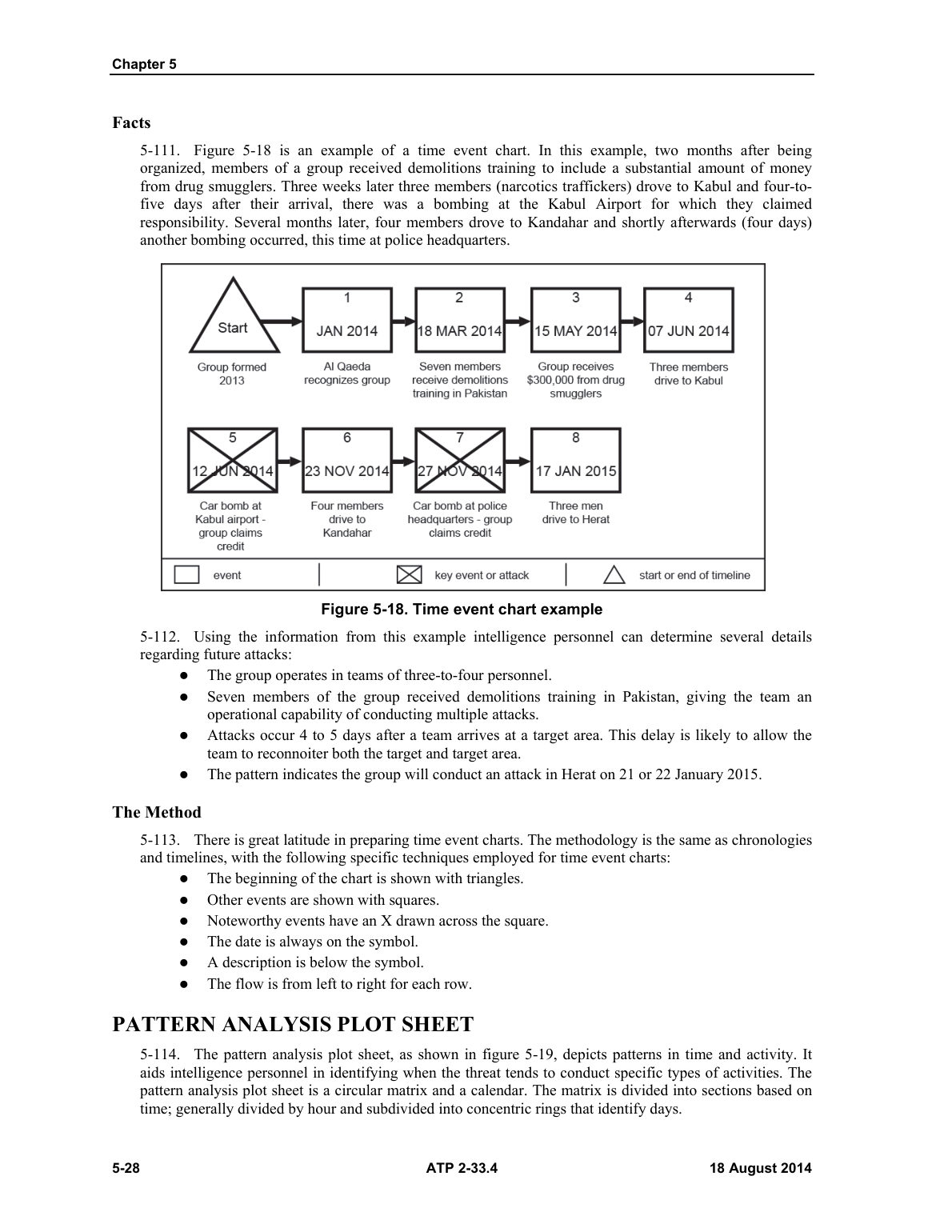
5-111. Figure 5-18 is an example of a time event chart. In this example, two months after being
organized, members of a group received demolitions training to include a substantial amount of money
from drug smugglers. Three weeks later three members (narcotics traffickers) drove to Kabul and four-to-
five days after their arrival, there was a bombing at the Kabul Airport for which they claimed
responsibility. Several months later, four members drove to Kandahar and shortly afterwards (four days)
another bombing occurred, this time at police headquarters.
Figure 5-18. Time event chart example
5-112. Using the information from this example intelligence personnel can determine several details
regarding future attacks:
The group operates in teams of three-to-four personnel.
Seven members of the group received demolitions training in Pakistan, giving the team an
operational capability of conducting multiple attacks.
Attacks occur 4 to 5 days after a team arrives at a target area. This delay is likely to allow the
team to reconnoiter both the target and target area.
The pattern indicates the group will conduct an attack in Herat on 21 or 22 January 2015.
The Method
5-113. There is great latitude in preparing time event charts. The methodology is the same as chronologies
and timelines, with the following specific techniques employed for time event charts:
The beginning of the chart is shown with triangles.
Other events are shown with squares.
Noteworthy events have an X drawn across the square.
The date is always on the symbol.
A description is below the symbol.
The flow is from left to right for each row.
PATTERN ANALYSIS PLOT SHEET
5-114. The pattern analysis plot sheet, as shown in figure 5-19, depicts patterns in time and activity. It
aids intelligence personnel in identifying when the threat tends to conduct specific types of activities. The
pattern analysis plot sheet is a circular matrix and a calendar. The matrix is divided into sections based on
time; generally divided by hour and subdivided into concentric rings that identify days.