GhostNet 1.5, page 11
GhostNet Guide
S2 Underground field guide: GhostNet Guide
Version 1.5 — Stopgap Comms Solutions (CC BY-NC-SA 4.0)
Searchable page text (OCR / PDF)
11
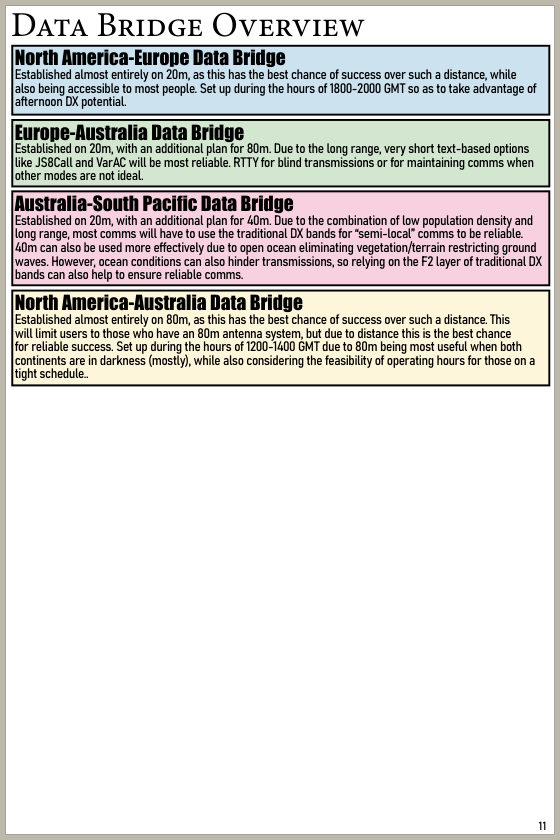
North America-Europe Data Bridge
Established almost entirely on 20m, as this has the best chance of success over such a distance, while
also being accessible to most people. Set up during the hours of 1800-2000 GMT so as to take advantage of
afternoon DX potential.
Data Bridge Overview
North America-Australia Data Bridge
Established almost entirely on 80m, as this has the best chance of success over such a distance. This
will limit users to those who have an 80m antenna system, but due to distance this is the best chance
for reliable success. Set up during the hours of 1200-1400 GMT due to 80m being most useful when both
continents are in darkness (mostly), while also considering the feasibility of operating hours for those on a
tight schedule..
Europe-Australia Data Bridge
Established on 20m, with an additional plan for 80m. Due to the long range, very short text-based options
like JS8Call and VarAC will be most reliable. RTTY for blind transmissions or for maintaining comms when
other modes are not ideal.
Australia-South Pacific Data Bridge
Established on 20m, with an additional plan for 40m. Due to the combination of low population density and
long range, most comms will have to use the traditional DX bands for “semi-local” comms to be reliable.
40m can also be used more effectively due to open ocean eliminating vegetation/terrain restricting ground
waves. However, ocean conditions can also hinder transmissions, so relying on the F2 layer of traditional DX
bands can also help to ensure reliable comms.