GhostNet 1.5, page 17
GhostNet Guide
S2 Underground field guide: GhostNet Guide
Version 1.5 — Stopgap Comms Solutions (CC BY-NC-SA 4.0)
Searchable page text (OCR / PDF)
17
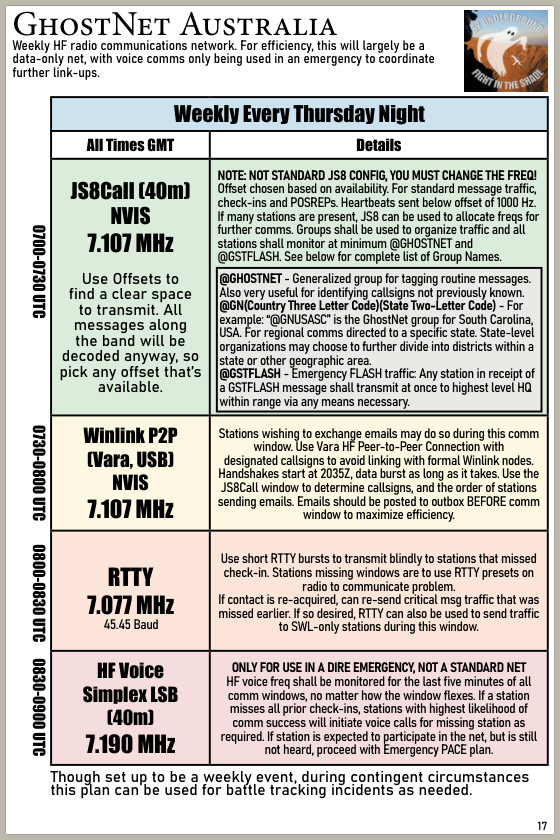
GhostNet Australia
0700-0730 UTC
0730-0800 UTC
0800-0830 UTC
0830-0900 UTC
Though set up to be a weekly event, during contingent circumstances
this plan can be used for battle tracking incidents as needed.
Weekly Every Thursday Night
All Times GMT
Details
JS8Call (40m)
NVIS
7.107 MHz
Use Offsets to
find a clear space
to transmit. All
messages along
the band will be
decoded anyway, so
pick any offset that’s
available.
NOTE: NOT STANDARD JS8 CONFIG, YOU MUST CHANGE THE FREQ!
Offset chosen based on availability. For standard message traffic,
check-ins and POSREPs. Heartbeats sent below offset of 1000 Hz.
If many stations are present, JS8 can be used to allocate freqs for
further comms. Groups shall be used to organize traffic and all
stations shall monitor at minimum @GHOSTNET and
@GSTFLASH. See below for complete list of Group Names.
Winlink P2P
(Vara, USB)
NVIS
7.107 MHz
Stations wishing to exchange emails may do so during this comm
window. Use Vara HF Peer-to-Peer Connection with
designated callsigns to avoid linking with formal Winlink nodes.
Handshakes start at 2035Z, data burst as long as it takes. Use the
JS8Call window to determine callsigns, and the order of stations
sending emails. Emails should be posted to outbox BEFORE comm
window to maximize efficiency.
RTTY
7.077 MHz
Use short RTTY bursts to transmit blindly to stations that missed
check-in. Stations missing windows are to use RTTY presets on
radio to communicate problem.
If contact is re-acquired, can re-send critical msg traffic that was
missed earlier. If so desired, RTTY can also be used to send traffic
to SWL-only stations during this window.
HF Voice
Simplex LSB
(40m)
7.190 MHz
ONLY FOR USE IN A DIRE EMERGENCY, NOT A STANDARD NET
HF voice freq shall be monitored for the last five minutes of all
comm windows, no matter how the window flexes. If a station
misses all prior check-ins, stations with highest likelihood of
comm success will initiate voice calls for missing station as
required. If station is expected to participate in the net, but is still
not heard, proceed with Emergency PACE plan.
@GHOSTNET - Generalized group for tagging routine messages.
Also very useful for identifying callsigns not previously known.
@GN(Country Three Letter Code)(State Two-Letter Code) - For
example: “@GNUSASC” is the GhostNet group for South Carolina,
USA. For regional comms directed to a specific state. State-level
organizations may choose to further divide into districts within a
state or other geographic area.
@GSTFLASH - Emergency FLASH traffic: Any station in receipt of
a GSTFLASH message shall transmit at once to highest level HQ
within range via any means necessary.
Weekly HF radio communications network. For efficiency, this will largely be a
data-only net, with voice comms only being used in an emergency to coordinate
further link-ups.
45.45 Baud