GhostNet 1.5, page 40
GhostNet Guide
S2 Underground field guide: GhostNet Guide
Version 1.5 — Stopgap Comms Solutions (CC BY-NC-SA 4.0)
Searchable page text (OCR / PDF)
40
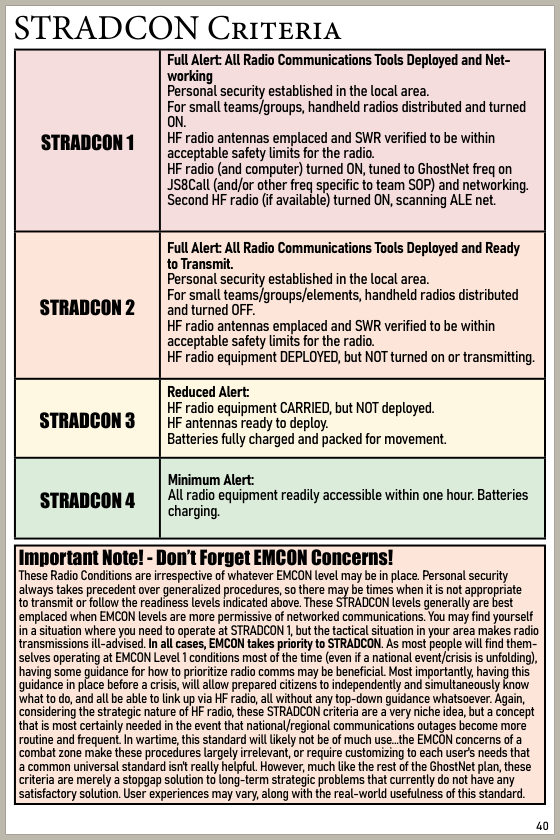
STRADCON Criteria
STRADCON 1
Full Alert: All Radio Communications Tools Deployed and Net-
working
Personal security established in the local area.
For small teams/groups, handheld radios distributed and turned
ON.
HF radio antennas emplaced and SWR verified to be within
acceptable safety limits for the radio.
HF radio (and computer) turned ON, tuned to GhostNet freq on
JS8Call (and/or other freq specific to team SOP) and networking.
Second HF radio (if available) turned ON, scanning ALE net.
STRADCON 2
Full Alert: All Radio Communications Tools Deployed and Ready
to Transmit.
Personal security established in the local area.
For small teams/groups/elements, handheld radios distributed
and turned OFF.
HF radio antennas emplaced and SWR verified to be within
acceptable safety limits for the radio.
HF radio equipment DEPLOYED, but NOT turned on or transmitting.
STRADCON 3
Reduced Alert:
HF radio equipment CARRIED, but NOT deployed.
HF antennas ready to deploy.
Batteries fully charged and packed for movement.
STRADCON 4
Minimum Alert:
All radio equipment readily accessible within one hour. Batteries
charging.
Important Note! - Don’t Forget EMCON Concerns!
These Radio Conditions are irrespective of whatever EMCON level may be in place. Personal security
always takes precedent over generalized procedures, so there may be times when it is not appropriate
to transmit or follow the readiness levels indicated above. These STRADCON levels generally are best
emplaced when EMCON levels are more permissive of networked communications. You may find yourself
in a situation where you need to operate at STRADCON 1, but the tactical situation in your area makes radio
transmissions ill-advised. In all cases, EMCON takes priority to STRADCON. As most people will find them-
selves operating at EMCON Level 1 conditions most of the time (even if a national event/crisis is unfolding),
having some guidance for how to prioritize radio comms may be beneficial. Most importantly, having this
guidance in place before a crisis, will allow prepared citizens to independently and simultaneously know
what to do, and all be able to link up via HF radio, all without any top-down guidance whatsoever. Again,
considering the strategic nature of HF radio, these STRADCON criteria are a very niche idea, but a concept
that is most certainly needed in the event that national/regional communications outages become more
routine and frequent. In wartime, this standard will likely not be of much use...the EMCON concerns of a
combat zone make these procedures largely irrelevant, or require customizing to each user's needs that
a common universal standard isn't really helpful. However, much like the rest of the GhostNet plan, these
criteria are merely a stopgap solution to long-term strategic problems that currently do not have any
satisfactory solution. User experiences may vary, along with the real-world usefulness of this standard.