GhostNet 1.5, page 9
GhostNet Guide
S2 Underground field guide: GhostNet Guide
Version 1.5 — Stopgap Comms Solutions (CC BY-NC-SA 4.0)
Searchable page text (OCR / PDF)
9
Architecture of Privacy
Operational Security (OPSEC) is of great concern to those wishing to establish communications networks
in non-permissive environments. However, if maximum OPSEC procedures were to be followed 24/7, no
one would ever communicate at all. Therefore a careful balance must be struck, allowing for some com-
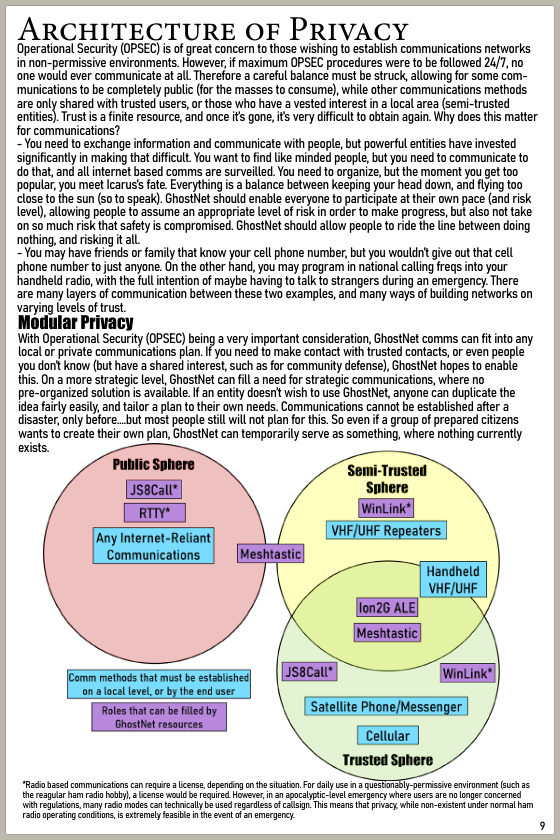
munications to be completely public (for the masses to consume), while other communications methods
are only shared with trusted users, or those who have a vested interest in a local area (semi-trusted
entities). Trust is a finite resource, and once it’s gone, it’s very difficult to obtain again. Why does this matter
for communications?
- You need to exchange information and communicate with people, but powerful entities have invested
significantly in making that difficult. You want to find like minded people, but you need to communicate to
do that, and all internet based comms are surveilled. You need to organize, but the moment you get too
popular, you meet Icarus’s fate. Everything is a balance between keeping your head down, and flying too
close to the sun (so to speak). GhostNet should enable everyone to participate at their own pace (and risk
level), allowing people to assume an appropriate level of risk in order to make progress, but also not take
on so much risk that safety is compromised. GhostNet should allow people to ride the line between doing
nothing, and risking it all.
- You may have friends or family that know your cell phone number, but you wouldn’t give out that cell
phone number to just anyone. On the other hand, you may program in national calling freqs into your
handheld radio, with the full intention of maybe having to talk to strangers during an emergency. There
are many layers of communication between these two examples, and many ways of building networks on
varying levels of trust.
Modular Privacy
With Operational Security (OPSEC) being a very important consideration, GhostNet comms can fit into any
local or private communications plan. If you need to make contact with trusted contacts, or even people
you don’t know (but have a shared interest, such as for community defense), GhostNet hopes to enable
this. On a more strategic level, GhostNet can fill a need for strategic communications, where no
pre-organized solution is available. If an entity doesn’t wish to use GhostNet, anyone can duplicate the
idea fairly easily, and tailor a plan to their own needs. Communications cannot be established after a
disaster, only before....but most people still will not plan for this. So even if a group of prepared citizens
wants to create their own plan, GhostNet can temporarily serve as something, where nothing currently
exists.
*Radio based communications can require a license, depending on the situation. For daily use in a questionably-permissive environment (such as
the reagular ham radio hobby), a license would be required. However, in an apocalyptic-level emergency where users are no longer concerned
with regulations, many radio modes can technically be used regardless of callsign. This means that privacy, while non-existent under normal ham
radio operating conditions, is extremely feasible in the event of an emergency.