JP 3-60, page 87
Joint Targeting
Joint Publication: Joint Targeting
31 January 2013 public edition
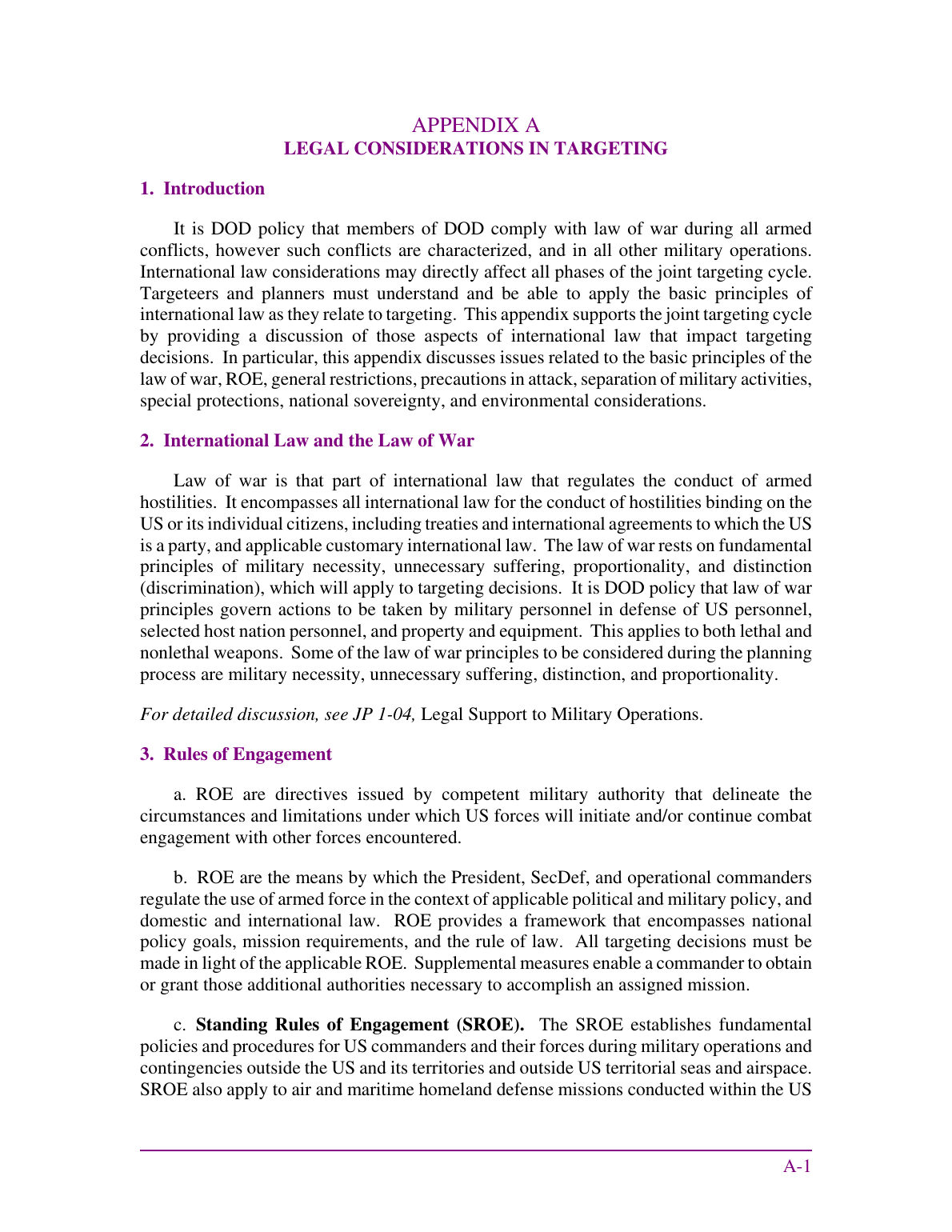
Searchable page text (OCR / PDF)
A-1
APPENDIX A
LEGAL CONSIDERATIONS IN TARGETING
1. Introduction
It is DOD policy that members of DOD comply with law of war during all armed
conflicts, however such conflicts are characterized, and in all other military operations.
International law considerations may directly affect all phases of the joint targeting cycle.
Targeteers and planners must understand and be able to apply the basic principles of
international law as they relate to targeting. This appendix supports the joint targeting cycle
by providing a discussion of those aspects of international law that impact targeting
decisions. In particular, this appendix discusses issues related to the basic principles of the
law of war, ROE, general restrictions, precautions in attack, separation of military activities,
special protections, national sovereignty, and environmental considerations.
2. International Law and the Law of War
Law of war is that part of international law that regulates the conduct of armed
hostilities. It encompasses all international law for the conduct of hostilities binding on the
US or its individual citizens, including treaties and international agreements to which the US
is a party, and applicable customary international law. The law of war rests on fundamental
principles of military necessity, unnecessary suffering, proportionality, and distinction
(discrimination), which will apply to targeting decisions. It is DOD policy that law of war
principles govern actions to be taken by military personnel in defense of US personnel,
selected host nation personnel, and property and equipment. This applies to both lethal and
nonlethal weapons. Some of the law of war principles to be considered during the planning
process are military necessity, unnecessary suffering, distinction, and proportionality.
For detailed discussion, see JP 1-04, Legal Support to Military Operations.
3. Rules of Engagement
a. ROE are directives issued by competent military authority that delineate the
circumstances and limitations under which US forces will initiate and/or continue combat
engagement with other forces encountered.
b. ROE are the means by which the President, SecDef, and operational commanders
regulate the use of armed force in the context of applicable political and military policy, and
domestic and international law. ROE provides a framework that encompasses national
policy goals, mission requirements, and the rule of law. All targeting decisions must be
made in light of the applicable ROE. Supplemental measures enable a commander to obtain
or grant those additional authorities necessary to accomplish an assigned mission.
c. Standing Rules of Engagement (SROE). The SROE establishes fundamental
policies and procedures for US commanders and their forces during military operations and
contingencies outside the US and its territories and outside US territorial seas and airspace.
SROE also apply to air and maritime homeland defense missions conducted within the US