MCRP 12-10B.1, page 221
Military Operations on Urbanized Terrain (MOUT)
Marine Corps Reference Publication: Military Operations on Urbanized Terrain (MOUT)
Public distribution statement A; S2 KOCOA cited as MCRP 12-10 b.1
Searchable page text (OCR / PDF)
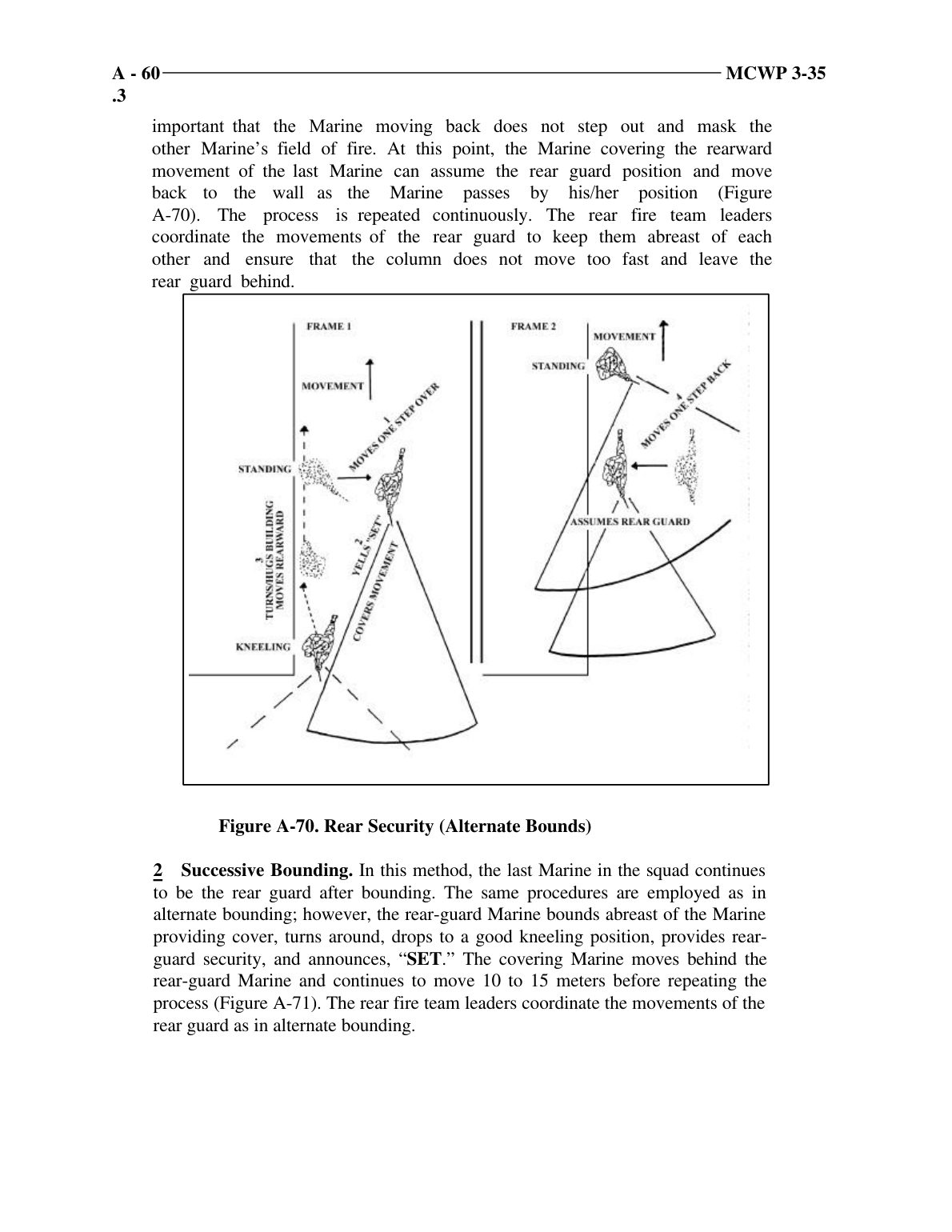
important that the Marine moving back does not step out and mask the
other Marine’s field of fire. At this point, the Marine covering the rearward
movement of the last Marine can assume the rear guard position and move
back to the wall as the
Marine
passes
by
his/her
position
(Figure
A-70). The process is repeated continuously. The rear fire team leaders
coordinate the movements of the rear guard to keep them abreast of each
other and ensure that the column does not move too fast and leave the
rear guard behind.
Figure A-70. Rear Security (Alternate Bounds)
2 Successive Bounding. In this method, the last Marine in the squad continues
to be the rear guard after bounding. The same procedures are employed as in
alternate bounding; however, the rear-guard Marine bounds abreast of the Marine
providing cover, turns around, drops to a good kneeling position, provides rear-
guard security, and announces, “SET.” The covering Marine moves behind the
rear-guard Marine and continues to move 10 to 15 meters before repeating the
process (Figure A-71). The rear fire team leaders coordinate the movements of the
rear guard as in alternate bounding.
A - 60
MCWP 3-35
.3