MCRP 12-10B.1, page 53
Military Operations on Urbanized Terrain (MOUT)
Marine Corps Reference Publication: Military Operations on Urbanized Terrain (MOUT)
Public distribution statement A; S2 KOCOA cited as MCRP 12-10 b.1
Searchable page text (OCR / PDF)
Cratering roads and performing other countermobility measures
•
Clearing rubble and obstacles
Requirements for engineer support in MOUT normally exceed capabilities. To
compensate, all Marines should receive basic demolition training prior to conducting urban
operations.
d. Fires. The attack of a built-up area may require extensive air and artillery preparation
prior to the ground attack. Supporting fires suppress the defender’s fire, restricts his/
her movement, and possibly destroys his/her position. Consideration should be given to the
rubbling effect produced by aerial and artillery bombardment. The assault should closely
follow air and artillery fire to exploit its immediate effect on the defender. Maneuver units
move near the final coordination line while the enemy is engaged by supporting fires. As the
attacking force assaults, supporting fires lift and/or shift to block enemy withdrawal or to
prevent the enemy from reinforcing their position. (See Chapter 4 for detailed discussion
on air and artillery support during urban warfare.) Fire can be categorized into indirect and
direct fires.
(1) Indirect Fire
(a) Artillery. Indirect artillery fire is planned to isolate objectives, to prevent
reinforcement and resupply, to neutralize known and suspected CPs and OPs, and to
suppress enemy defenders. Urbanized terrain requires that most indirect artillery fire
use a high-angle trajectory.
(b) Mortars. Mortars are the most responsive indirect-fire weapon for the urban
environment. They can be employed to hit targets of opportunity at the close ranges
that are typical of combat in built-up areas.
MCWP 3-35.3
2-22
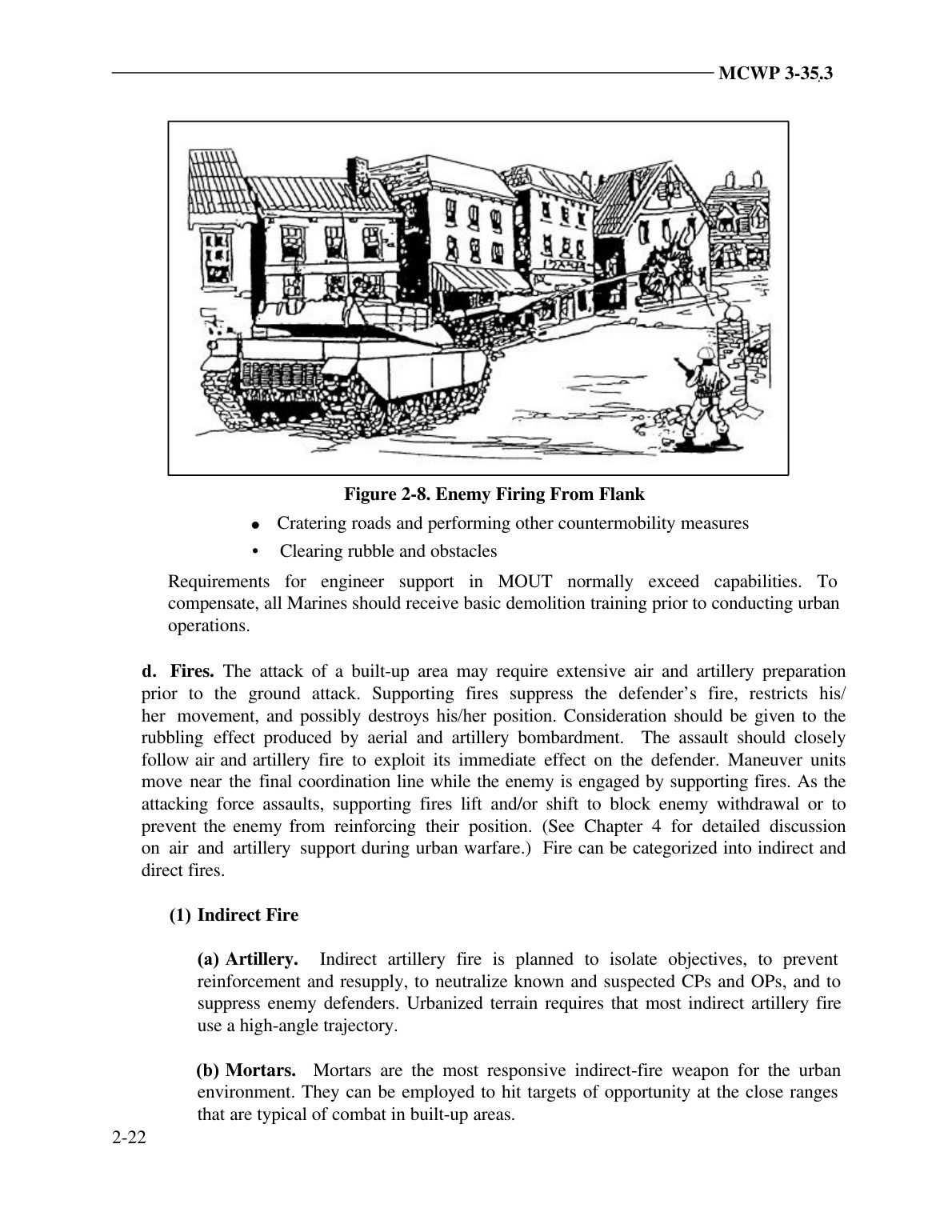
Figure 2-8. Enemy Firing From Flank