MCRP 12-10B.1, page 75
Military Operations on Urbanized Terrain (MOUT)
Marine Corps Reference Publication: Military Operations on Urbanized Terrain (MOUT)
Public distribution statement A; S2 KOCOA cited as MCRP 12-10 b.1
Searchable page text (OCR / PDF)
(a)
K: Key Terrain. Primary examples of key terrain in the urban environment are
ports, airfields, power grids, communication nodes, bridges, government building
complexes, or parks. We identify key terrain so that we can better select our defensive
positions and also better determine the enemy’s objectives.
1
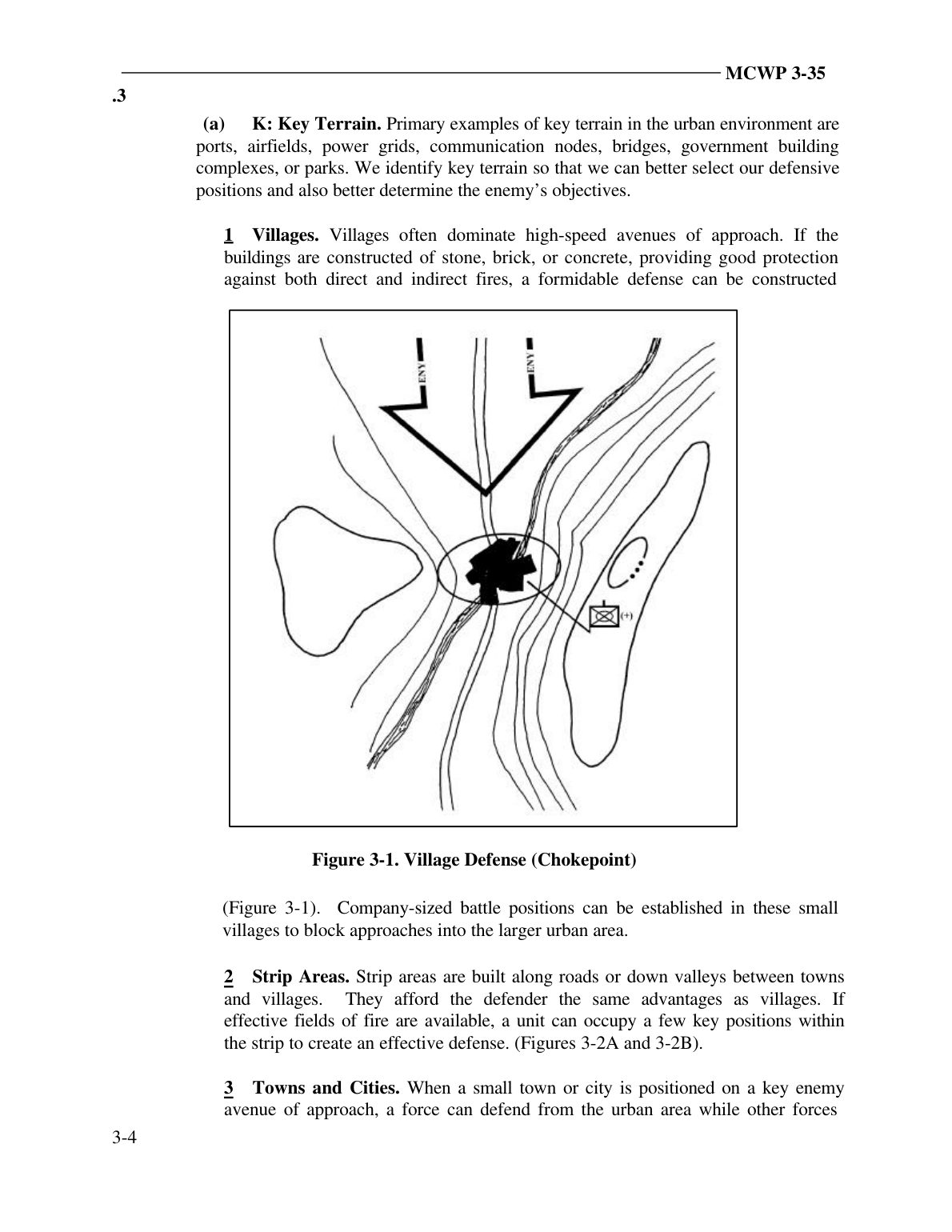
Villages. Villages often dominate high-speed avenues of approach. If the
buildings are constructed of stone, brick, or concrete, providing good protection
against both direct and indirect fires, a formidable defense can be constructed
(Figure 3-1). Company-sized battle positions can be established in these small
villages to block approaches into the larger urban area.
Figure 3-1. Village Defense (Chokepoint)
2 Strip Areas. Strip areas are built along roads or down valleys between towns
and villages. They afford the defender the same advantages as villages. If
effective fields of fire are available, a unit can occupy a few key positions within
the strip to create an effective defense. (Figures 3-2A and 3-2B).
3 Towns and Cities. When a small town or city is positioned on a key enemy
avenue of approach, a force can defend from the urban area while other forces
MCWP 3-35
.3
3-4