ADP 3-90, page 31
Offense and Defense
Army Doctrine Publication: Offense and Defense
July 2019 public edition (supersedes Aug 2018); key terrain cited in S2 KOCOA
Searchable page text (OCR / PDF)
Common Tactical Concepts and Echelons
31 July 2019
ADP 3-90
2-13
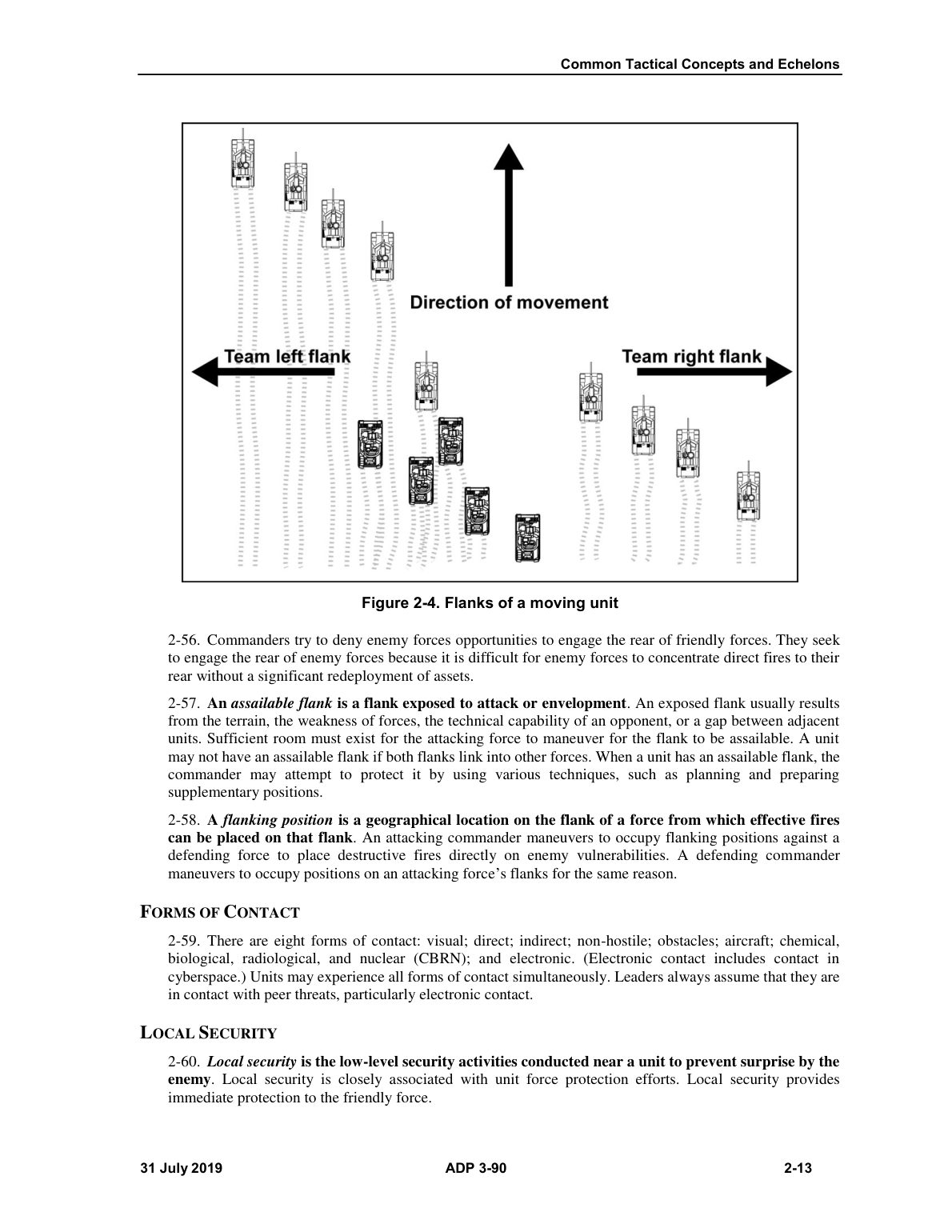
Figure 2-4. Flanks of a moving unit
2-56. Commanders try to deny enemy forces opportunities to engage the rear of friendly forces. They seek
to engage the rear of enemy forces because it is difficult for enemy forces to concentrate direct fires to their
rear without a significant redeployment of assets.
2-57. An assailable flank is a flank exposed to attack or envelopment. An exposed flank usually results
from the terrain, the weakness of forces, the technical capability of an opponent, or a gap between adjacent
units. Sufficient room must exist for the attacking force to maneuver for the flank to be assailable. A unit
may not have an assailable flank if both flanks link into other forces. When a unit has an assailable flank, the
commander may attempt to protect it by using various techniques, such as planning and preparing
supplementary positions.
2-58. A flanking position is a geographical location on the flank of a force from which effective fires
can be placed on that flank. An attacking commander maneuvers to occupy flanking positions against a
defending force to place destructive fires directly on enemy vulnerabilities. A defending commander
maneuvers to occupy positions on an attacking force’s flanks for the same reason.
FORMS OF CONTACT
2-59. There are eight forms of contact: visual; direct; indirect; non-hostile; obstacles; aircraft; chemical,
biological, radiological, and nuclear (CBRN); and electronic. (Electronic contact includes contact in
cyberspace.) Units may experience all forms of contact simultaneously. Leaders always assume that they are
in contact with peer threats, particularly electronic contact.
LOCAL SECURITY
2-60. Local security is the low-level security activities conducted near a unit to prevent surprise by the
enemy. Local security is closely associated with unit force protection efforts. Local security provides
immediate protection to the friendly force.