ADP 3-90, page 33
Offense and Defense
Army Doctrine Publication: Offense and Defense
July 2019 public edition (supersedes Aug 2018); key terrain cited in S2 KOCOA
Searchable page text (OCR / PDF)
Common Tactical Concepts and Echelons
31 July 2019
ADP 3-90
2-15
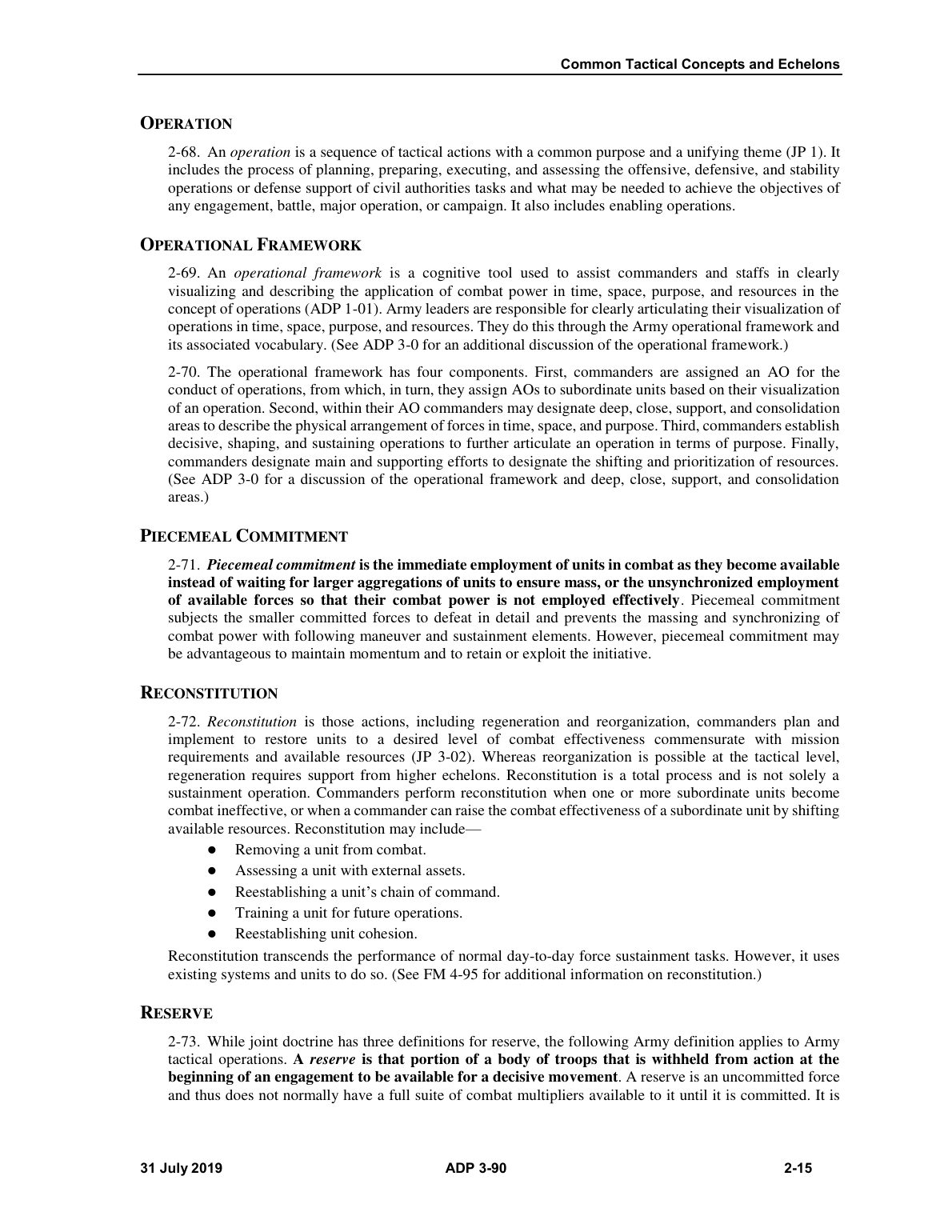
OPERATION
2-68. An operation is a sequence of tactical actions with a common purpose and a unifying theme (JP 1). It
includes the process of planning, preparing, executing, and assessing the offensive, defensive, and stability
operations or defense support of civil authorities tasks and what may be needed to achieve the objectives of
any engagement, battle, major operation, or campaign. It also includes enabling operations.
OPERATIONAL FRAMEWORK
2-69. An operational framework is a cognitive tool used to assist commanders and staffs in clearly
visualizing and describing the application of combat power in time, space, purpose, and resources in the
concept of operations (ADP 1-01). Army leaders are responsible for clearly articulating their visualization of
operations in time, space, purpose, and resources. They do this through the Army operational framework and
its associated vocabulary. (See ADP 3-0 for an additional discussion of the operational framework.)
2-70. The operational framework has four components. First, commanders are assigned an AO for the
conduct of operations, from which, in turn, they assign AOs to subordinate units based on their visualization
of an operation. Second, within their AO commanders may designate deep, close, support, and consolidation
areas to describe the physical arrangement of forces in time, space, and purpose. Third, commanders establish
decisive, shaping, and sustaining operations to further articulate an operation in terms of purpose. Finally,
commanders designate main and supporting efforts to designate the shifting and prioritization of resources.
(See ADP 3-0 for a discussion of the operational framework and deep, close, support, and consolidation
areas.)
PIECEMEAL COMMITMENT
2-71. Piecemeal commitment is the immediate employment of units in combat as they become available
instead of waiting for larger aggregations of units to ensure mass, or the unsynchronized employment
of available forces so that their combat power is not employed effectively. Piecemeal commitment
subjects the smaller committed forces to defeat in detail and prevents the massing and synchronizing of
combat power with following maneuver and sustainment elements. However, piecemeal commitment may
be advantageous to maintain momentum and to retain or exploit the initiative.
RECONSTITUTION
2-72. Reconstitution is those actions, including regeneration and reorganization, commanders plan and
implement to restore units to a desired level of combat effectiveness commensurate with mission
requirements and available resources (JP 3-02). Whereas reorganization is possible at the tactical level,
regeneration requires support from higher echelons. Reconstitution is a total process and is not solely a
sustainment operation. Commanders perform reconstitution when one or more subordinate units become
combat ineffective, or when a commander can raise the combat effectiveness of a subordinate unit by shifting
available resources. Reconstitution may include—
Removing a unit from combat.
Assessing a unit with external assets.
Reestablishing a unit’s chain of command.
Training a unit for future operations.
Reestablishing unit cohesion.
Reconstitution transcends the performance of normal day-to-day force sustainment tasks. However, it uses
existing systems and units to do so. (See FM 4-95 for additional information on reconstitution.)
RESERVE
2-73. While joint doctrine has three definitions for reserve, the following Army definition applies to Army
tactical operations. A reserve is that portion of a body of troops that is withheld from action at the
beginning of an engagement to be available for a decisive movement. A reserve is an uncommitted force
and thus does not normally have a full suite of combat multipliers available to it until it is committed. It is