ADP 3-90, page 41
Offense and Defense
Army Doctrine Publication: Offense and Defense
July 2019 public edition (supersedes Aug 2018); key terrain cited in S2 KOCOA
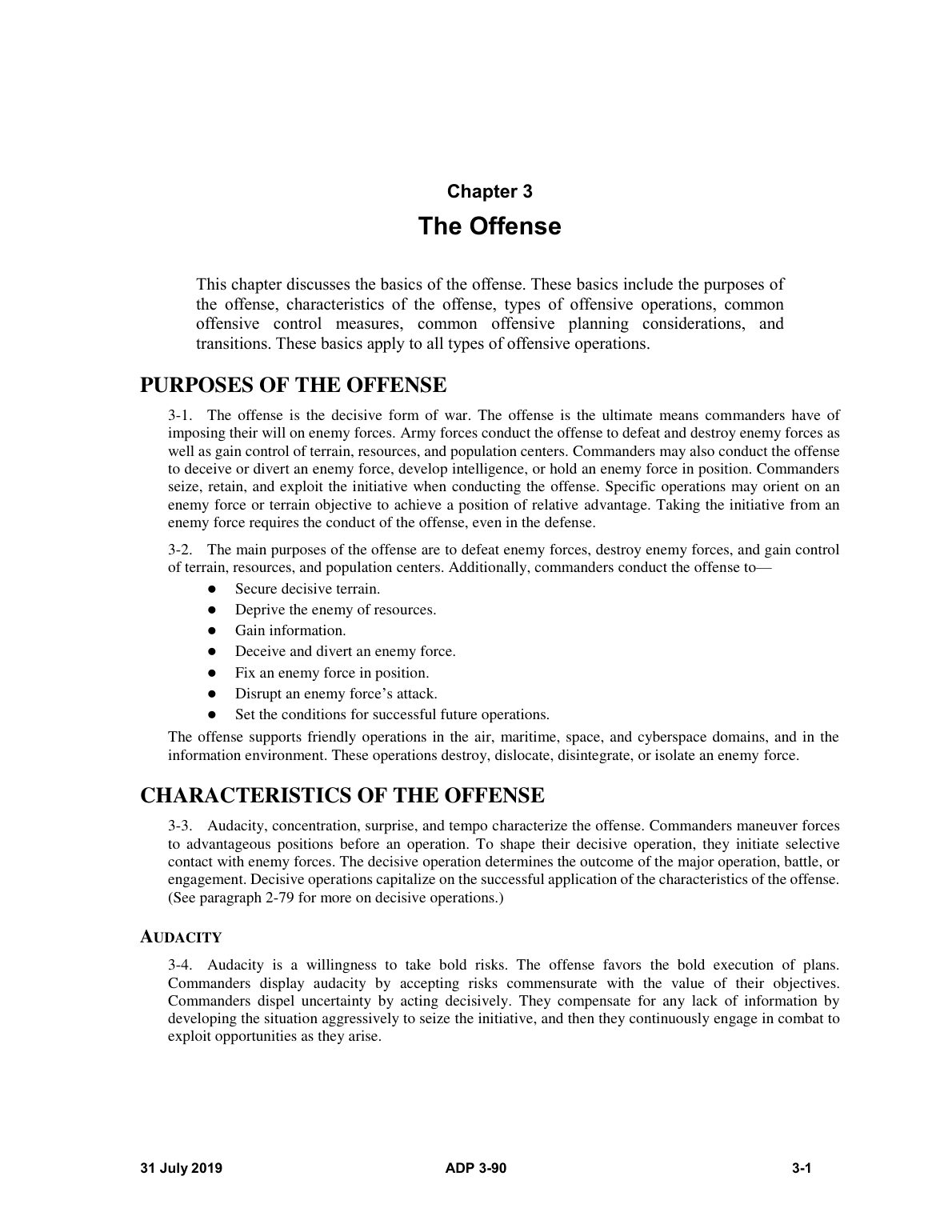
Searchable page text (OCR / PDF)
31 July 2019
ADP 3-90
3-1
Chapter 3
The Offense
This chapter discusses the basics of the offense. These basics include the purposes of
the offense, characteristics of the offense, types of offensive operations, common
offensive control measures, common offensive planning considerations, and
transitions. These basics apply to all types of offensive operations.
PURPOSES OF THE OFFENSE
3-1. The offense is the decisive form of war. The offense is the ultimate means commanders have of
imposing their will on enemy forces. Army forces conduct the offense to defeat and destroy enemy forces as
well as gain control of terrain, resources, and population centers. Commanders may also conduct the offense
to deceive or divert an enemy force, develop intelligence, or hold an enemy force in position. Commanders
seize, retain, and exploit the initiative when conducting the offense. Specific operations may orient on an
enemy force or terrain objective to achieve a position of relative advantage. Taking the initiative from an
enemy force requires the conduct of the offense, even in the defense.
3-2. The main purposes of the offense are to defeat enemy forces, destroy enemy forces, and gain control
of terrain, resources, and population centers. Additionally, commanders conduct the offense to—
Secure decisive terrain.
Deprive the enemy of resources.
Gain information.
Deceive and divert an enemy force.
Fix an enemy force in position.
Disrupt an enemy force’s attack.
Set the conditions for successful future operations.
The offense supports friendly operations in the air, maritime, space, and cyberspace domains, and in the
information environment. These operations destroy, dislocate, disintegrate, or isolate an enemy force.
CHARACTERISTICS OF THE OFFENSE
3-3. Audacity, concentration, surprise, and tempo characterize the offense. Commanders maneuver forces
to advantageous positions before an operation. To shape their decisive operation, they initiate selective
contact with enemy forces. The decisive operation determines the outcome of the major operation, battle, or
engagement. Decisive operations capitalize on the successful application of the characteristics of the offense.
(See paragraph 2-79 for more on decisive operations.)
AUDACITY
3-4. Audacity is a willingness to take bold risks. The offense favors the bold execution of plans.
Commanders display audacity by accepting risks commensurate with the value of their objectives.
Commanders dispel uncertainty by acting decisively. They compensate for any lack of information by
developing the situation aggressively to seize the initiative, and then they continuously engage in combat to
exploit opportunities as they arise.