AFDD 2-1.9, page 77
Targeting
Air Force Doctrine Document: Targeting
DTIC ADA454614 public copy
Searchable page text (OCR / PDF)
67
picture drawn from an often-overwhelming stream of data. The data are not directly
useful to commanders in most cases. Intelligence, targeting, and strategy personnel
must evaluate the data stream and glean what is useful and significant from it. This is
the most conceptually difficult part of the process, even if it consumes fewer man-hours
than monitoring, but is essential if commanders are to have assessment products they
can act upon. Even TA entails analysis, as there is sometimes considerable “art” to
determining even physical damage levels based on sensor data.
Recommend. Recommendations may range from a simple, near-immediate re-
attack call from the COD to advising a major change in campaign strategy, depending
upon the level of assessment involved. They may include such things as shifting of air
operations priority, weight of effort, and branch or sequel initiation. Even at the
operational level, they may include lesser measures such as modifying the MOE to
reflect new requirements, or utilizing new capabilities or forces.
Metrics
The SD should develop metrics to determine if air operations are properly linked to
the overall air and space strategy and the larger hierarchy of campaign and national
objectives. These metrics evaluate the results achieved during air and space
operations. Metrics can either be objective (using sensors or aircrews to directly
observe damage inflicted) or subjective (using indirect means to ascertain results)
depending on the metric applied to either the objective or task. Both qualitative and
quantitative metrics should be used to avoid unsound or distorted results. Metrics can
either be inductive (using sensors or personnel to directly observe the battlespace and
build SA cumulatively) or deductive (using indirect means to deduce results from what
was previously known of the adversary and battlespace). Measures of success are
indications that the effects achieved are influencing enemy activity in desired ways
among various target systems.
Tactical tasks identify the focus areas for application of air and space power in
support of tactical objectives. MOP evaluate the immediate activity performed to assess
tactical tasks. Paired with the tasks, MOP use performance assessment techniques to
determine “if we’re doing things right” to achieve success. MOP lend themselves to
quantitative and/or statistical analysis techniques, based on reported observations and
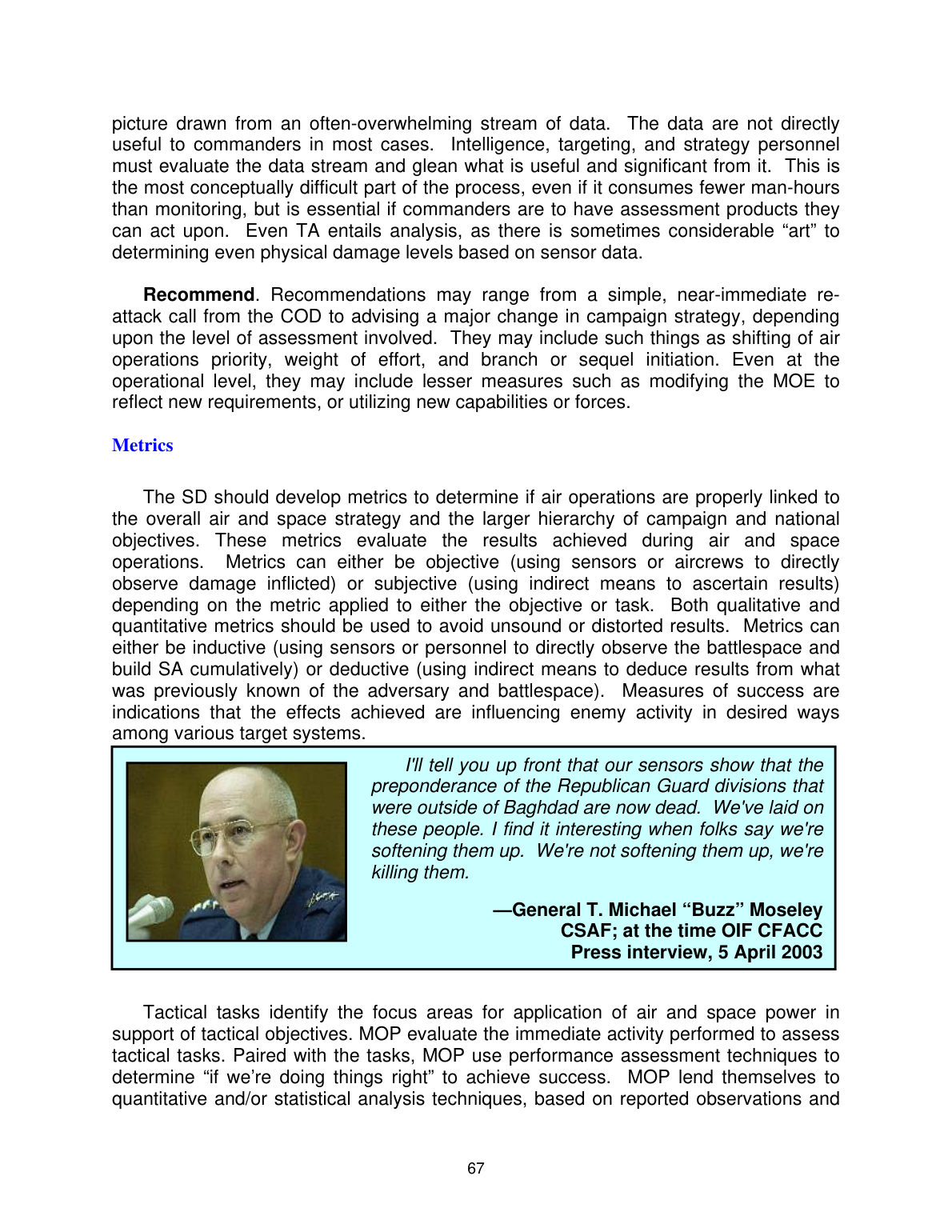
I'll tell you up front that our sensors show that the
preponderance of the Republican Guard divisions that
were outside of Baghdad are now dead. We've laid on
these people. I find it interesting when folks say we're
softening them up. We're not softening them up, we're
killing them.
—General T. Michael “Buzz” Moseley
CSAF; at the time OIF CFACC
Press interview, 5 April 2003