AFDP 3-60, page 18
Targeting
Air Force Doctrine Publication: Targeting
01 May 2026 (Wayback 2026-07-12; S2 Wire cited this URL as “JP 3-60”)
Searchable page text (OCR / PDF)
Air Force Doctrine Publication 3-60, Targeting
15
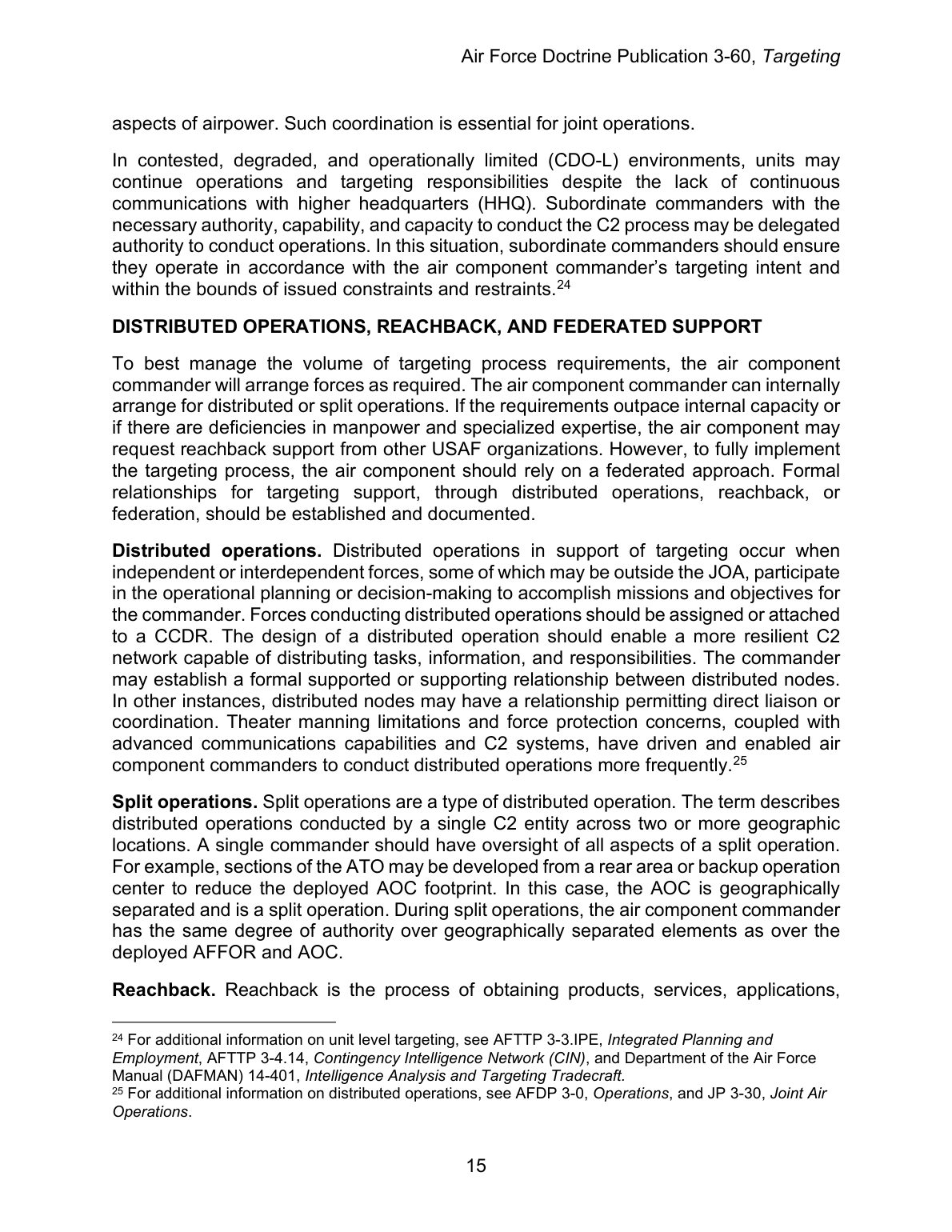
aspects of airpower. Such coordination is essential for joint operations.
In contested, degraded, and operationally limited (CDO-L) environments, units may
continue operations and targeting responsibilities despite the lack of continuous
communications with higher headquarters (HHQ). Subordinate commanders with the
necessary authority, capability, and capacity to conduct the C2 process may be delegated
authority to conduct operations. In this situation, subordinate commanders should ensure
they operate in accordance with the air component commander’s targeting intent and
within the bounds of issued constraints and restraints.24
DISTRIBUTED OPERATIONS, REACHBACK, AND FEDERATED SUPPORT
To best manage the volume of targeting process requirements, the air component
commander will arrange forces as required. The air component commander can internally
arrange for distributed or split operations. If the requirements outpace internal capacity or
if there are deficiencies in manpower and specialized expertise, the air component may
request reachback support from other USAF organizations. However, to fully implement
the targeting process, the air component should rely on a federated approach. Formal
relationships for targeting support, through distributed operations, reachback, or
federation, should be established and documented.
Distributed operations. Distributed operations in support of targeting occur when
independent or interdependent forces, some of which may be outside the JOA, participate
in the operational planning or decision-making to accomplish missions and objectives for
the commander. Forces conducting distributed operations should be assigned or attached
to a CCDR. The design of a distributed operation should enable a more resilient C2
network capable of distributing tasks, information, and responsibilities. The commander
may establish a formal supported or supporting relationship between distributed nodes.
In other instances, distributed nodes may have a relationship permitting direct liaison or
coordination. Theater manning limitations and force protection concerns, coupled with
advanced communications capabilities and C2 systems, have driven and enabled air
component commanders to conduct distributed operations more frequently.25
Split operations. Split operations are a type of distributed operation. The term describes
distributed operations conducted by a single C2 entity across two or more geographic
locations. A single commander should have oversight of all aspects of a split operation.
For example, sections of the ATO may be developed from a rear area or backup operation
center to reduce the deployed AOC footprint. In this case, the AOC is geographically
separated and is a split operation. During split operations, the air component commander
has the same degree of authority over geographically separated elements as over the
deployed AFFOR and AOC.
Reachback. Reachback is the process of obtaining products, services, applications,
24 For additional information on unit level targeting, see AFTTP 3-3.IPE, Integrated Planning and
Employment, AFTTP 3-4.14, Contingency Intelligence Network (CIN), and Department of the Air Force
Manual (DAFMAN) 14-401, Intelligence Analysis and Targeting Tradecraft.
25 For additional information on distributed operations, see AFDP 3-0, Operations, and JP 3-30, Joint Air
Operations.