AFDP 3-60, page 4
Targeting
Air Force Doctrine Publication: Targeting
01 May 2026 (Wayback 2026-07-12; S2 Wire cited this URL as “JP 3-60”)
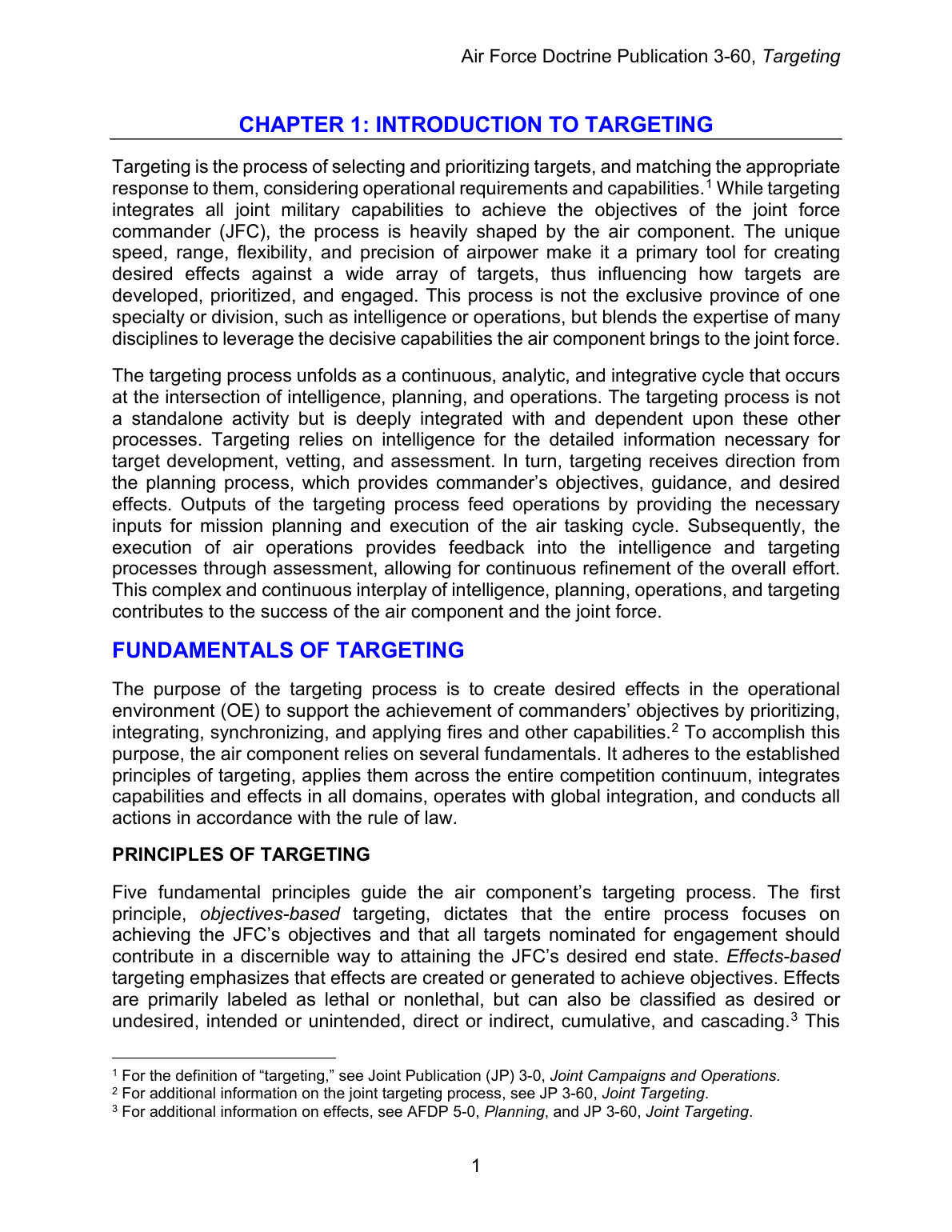
Searchable page text (OCR / PDF)
Air Force Doctrine Publication 3-60, Targeting
1
CHAPTER 1: INTRODUCTION TO TARGETING
Targeting is the process of selecting and prioritizing targets, and matching the appropriate
response to them, considering operational requirements and capabilities.1 While targeting
integrates all joint military capabilities to achieve the objectives of the joint force
commander (JFC), the process is heavily shaped by the air component. The unique
speed, range, flexibility, and precision of airpower make it a primary tool for creating
desired effects against a wide array of targets, thus influencing how targets are
developed, prioritized, and engaged. This process is not the exclusive province of one
specialty or division, such as intelligence or operations, but blends the expertise of many
disciplines to leverage the decisive capabilities the air component brings to the joint force.
The targeting process unfolds as a continuous, analytic, and integrative cycle that occurs
at the intersection of intelligence, planning, and operations. The targeting process is not
a standalone activity but is deeply integrated with and dependent upon these other
processes. Targeting relies on intelligence for the detailed information necessary for
target development, vetting, and assessment. In turn, targeting receives direction from
the planning process, which provides commander’s objectives, guidance, and desired
effects. Outputs of the targeting process feed operations by providing the necessary
inputs for mission planning and execution of the air tasking cycle. Subsequently, the
execution of air operations provides feedback into the intelligence and targeting
processes through assessment, allowing for continuous refinement of the overall effort.
This complex and continuous interplay of intelligence, planning, operations, and targeting
contributes to the success of the air component and the joint force.
FUNDAMENTALS OF TARGETING
The purpose of the targeting process is to create desired effects in the operational
environment (OE) to support the achievement of commanders’ objectives by prioritizing,
integrating, synchronizing, and applying fires and other capabilities.2 To accomplish this
purpose, the air component relies on several fundamentals. It adheres to the established
principles of targeting, applies them across the entire competition continuum, integrates
capabilities and effects in all domains, operates with global integration, and conducts all
actions in accordance with the rule of law.
PRINCIPLES OF TARGETING
Five fundamental principles guide the air component’s targeting process. The first
principle, objectives-based targeting, dictates that the entire process focuses on
achieving the JFC’s objectives and that all targets nominated for engagement should
contribute in a discernible way to attaining the JFC’s desired end state. Effects-based
targeting emphasizes that effects are created or generated to achieve objectives. Effects
are primarily labeled as lethal or nonlethal, but can also be classified as desired or
undesired, intended or unintended, direct or indirect, cumulative, and cascading.3 This
1 For the definition of “targeting,” see Joint Publication (JP) 3-0, Joint Campaigns and Operations.
2 For additional information on the joint targeting process, see JP 3-60, Joint Targeting.
3 For additional information on effects, see AFDP 5-0, Planning, and JP 3-60, Joint Targeting.