ATP 2-33.4, page 19
Intelligence Analysis
Army Techniques Publication: Intelligence Analysis
2014 public edition (Archive.org)
Searchable page text (OCR / PDF)
Analytic Skills
support critical thinking. Key critical thinking attributes include human traits such as intellectual courage,
integrity, and humility. Creative thinking involves creating something new or original.
2-14. Analysts use thinking to transform information into intelligence. Critical thinking can improve many
tasks and processes across Army operations, especially the conduct of intelligence analysis. Critical
thinking includes the intellectually disciplined activity of actively and skillfully analyzing and synthesizing
information. The key distinction in critical thinking is a reflective and self-disciplined approach to thinking.
2-15. For the analyst, the first step in building critical thinking skills is to begin a course of personal study
and practice with a goal of improving the ability to reason. This means moving outside the Army body of
doctrine and other Army professional writing when beginning this study. The vast majority of the body of
thought concerning critical thinking is spread throughout various civilian professions, particularly in
academia. The discussion in this publication is intended to be an introduction that serves as a glimpse of
what should become a professional endeavor.
2-16. The Army has used many different sources in its doctrinal discussions of critical thinking. Among
those most cited, as well as those used in the development of this discussion, are Dr. Richard Paul and Dr.
Linda Elder of the Foundation for Critical Thinking. This foundation has developed many products useful
to Army leaders and Soldiers in developing critical thinking skills. Of these, the elements of thought,
intellectual standards, and intellectual traits are the most useful tools analysts can initially apply to further
their critical thinking skills. These skills can also aid in avoiding the common pitfalls of undisciplined
thinking. These analytic pitfalls—logic fallacies, biases, and misusing analogies—are discussed beginning
at paragraph 2-32.
ELEMENTS OF THOUGHT
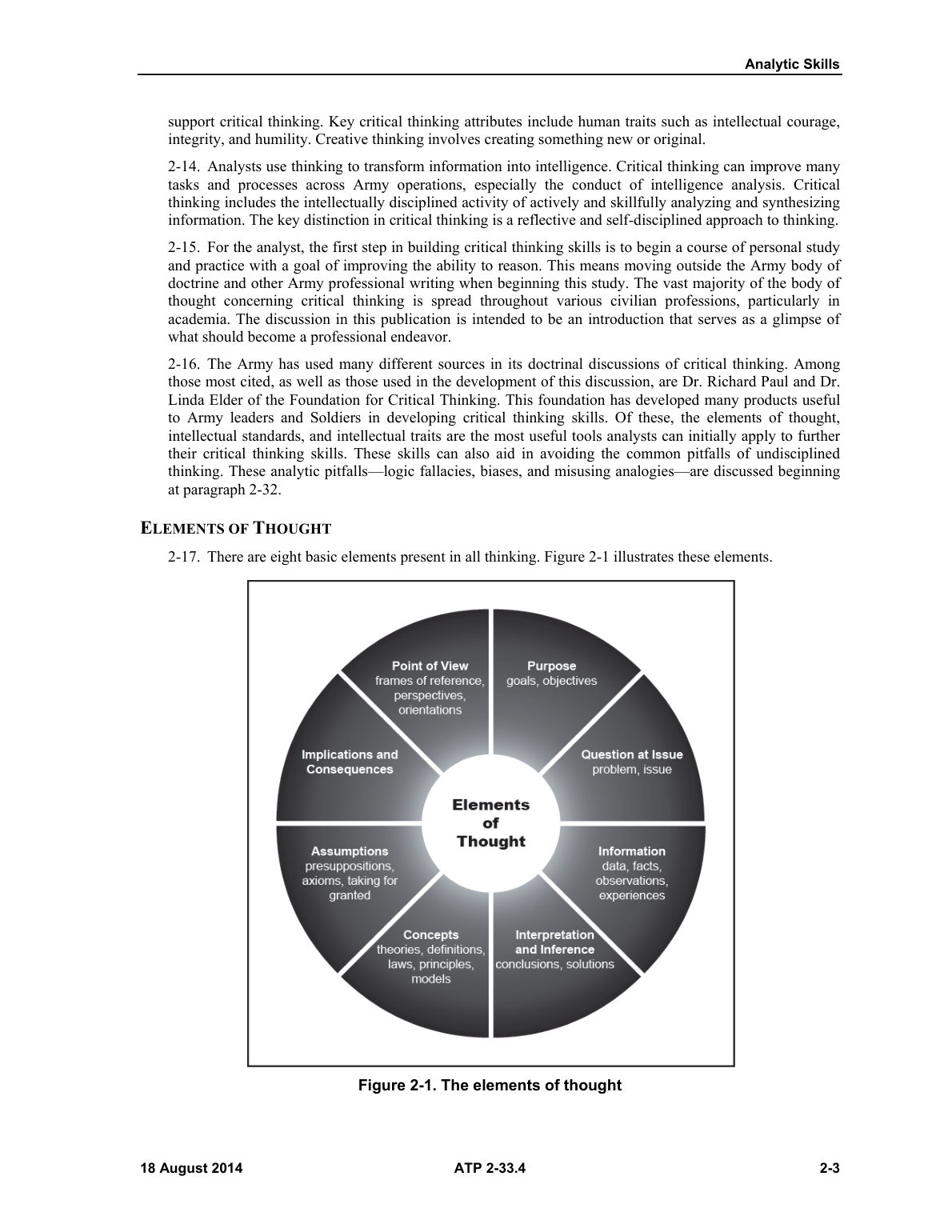
2-17. There are eight basic elements present in all thinking. Figure 2-1 illustrates these elements.
Point of View Purpose
frames of reference, J goals, objectives
perspectives,
orientations
Implications and Question at Issue
Consequences problem, issue
Elements
: of
Assumptions Thought Information
presuppositions, 4 data, facts,
axioms, taking for 4 observations,
granted . experiences
Concepts Interpretation’
theories, definitions, | and Inference
laws, principles, [[conclusions, solutions
models
Figure 2-1. The elements of thought
18 August 2014 ATP 2-33.4 2-3
Analytic Skills
18 August 2014
ATP 2-33.4
2-3
support critical thinking. Key critical thinking attributes include human traits such as intellectual courage,
integrity, and humility. Creative thinking involves creating something new or original.
2-14. Analysts use thinking to transform information into intelligence. Critical thinking can improve many
tasks and processes across Army operations, especially the conduct of intelligence analysis. Critical
thinking includes the intellectually disciplined activity of actively and skillfully analyzing and synthesizing
information. The key distinction in critical thinking is a reflective and self-disciplined approach to thinking.
2-15. For the analyst, the first step in building critical thinking skills is to begin a course of personal study
and practice with a goal of improving the ability to reason. This means moving outside the Army body of
doctrine and other Army professional writing when beginning this study. The vast majority of the body of
thought concerning critical thinking is spread throughout various civilian professions, particularly in
academia. The discussion in this publication is intended to be an introduction that serves as a glimpse of
what should become a professional endeavor.
2-16. The Army has used many different sources in its doctrinal discussions of critical thinking. Among
those most cited, as well as those used in the development of this discussion, are Dr. Richard Paul and Dr.
Linda Elder of the Foundation for Critical Thinking. This foundation has developed many products useful
to Army leaders and Soldiers in developing critical thinking skills. Of these, the elements of thought,
intellectual standards, and intellectual traits are the most useful tools analysts can initially apply to further
their critical thinking skills. These skills can also aid in avoiding the common pitfalls of undisciplined
thinking. These analytic pitfalls—logic fallacies, biases, and misusing analogies—are discussed beginning
at paragraph 2-32.
ELEMENTS OF THOUGHT
2-17. There are eight basic elements present in all thinking. Figure 2-1 illustrates these elements.
Figure 2-1. The elements of thought