ATP 2-33.4, page 20
Intelligence Analysis
Army Techniques Publication: Intelligence Analysis
2014 public edition (Archive.org)
Searchable page text (OCR / PDF)
Chapter 2
2-18. Whenever we think, we think for a purpose within a point of view based on assumptions leading to
implications and consequences. We use concepts, ideas, and theories to interpret data, facts, and
experiences in order to answer questions, solve problems, and resolve issues. These eight elements help
describe how critical thinking works:
e Element 1—Purpose. All thinking has a purpose. Critical thinkers will state the purpose clearly.
Being able to distinguish the purpose from other related purposes is an important skill critical
thinkers possess. Checking periodically to ensure staying on target with the purpose is also
important.
e@ Element 2—Question at Issue. All thinking is an attempt to figure something out, to settle
some question, or to solve some problem. A critical thinker is able to state questions clearly and
precisely, express the questions in several ways to clarify their meaning and scope, and break the
questions into sub-questions.
e Element 3—Information. All thinking is based on data, information, and evidence. Critical
thinkers should support their conclusions with relevant information and be open to actively
searching for information that supports as well as contradicts a position. All information should
be accurate, clear, and relevant to the situation being analyzed.
© Element 4—Interpretation and Inference. All thinking contains interpretations and inferences
by which to draw conclusions and give meaning to data. Critical thinkers should be careful to
infer only what the evidence implies and to crosscheck inferences with each other. They should
clearly identify the assumptions and concepts which led to the inferences being made.
Alternative inferences or conclusions should be considered. Developing and communicating
well-reasoned inferences is the most important part of what intelligence analysts provide because
of the role it plays in aiding situational understanding and decisionmaking.
© Element 5—Concepts. All thinking is expressed through, and shaped by, concepts. A concept is
a generalized idea of a thing or a class of things. People do not always share the same concept of
a thing. For example, the concept of happiness means something different to each of us. This is
because happiness comes in many different forms. For a star athlete happiness may be winning
and for a mother happiness may be seeing her children do well. Critical thinkers identify the
meaning they ascribe to the key concepts used in their arguments and determine if others in their
group ascribe different meanings to those concepts to ensure effective communication.
© Element 6—Assumptions. All thinking is based, in part, on assumption. An assumption is a
proposition accepted to be true without the availability of fact to support it. Assumptions are
layered throughout our thinking and are a necessary part of critical thinking. The availability of
fact determines the amount of assumption an analyst must use in analysis. Critical thinkers
clearly identify their assumptions and work to determine if they are justifiable.
Element 7—Implications and Consequences. All thinking leads somewhere or has
implications and consequences. Analysts should take the time to think through the implications
and consequences that follow from their reasoning. They should search for negative as well as
positive implications.
© Element 8—Point of View. All thinking is done from some point of view. To think critically
analysts must recognize a point of view, seek other points of view, and look at them fair-
mindedly for their strengths and weaknesses.
CHECKLIST FOR REASONING
2-19. By applying the eight elements of thought, analysts can develop a checklist for reasoning.
Developing and using a checklist, as shown in table 2-1, can help analysts focus their efforts to a specific
problem and avoid wasting time on irrelevant issues or distractions.
2-4 ATP 2-33.4 18 August 2014
Chapter 2
2-4
ATP 2-33.4
18 August 2014
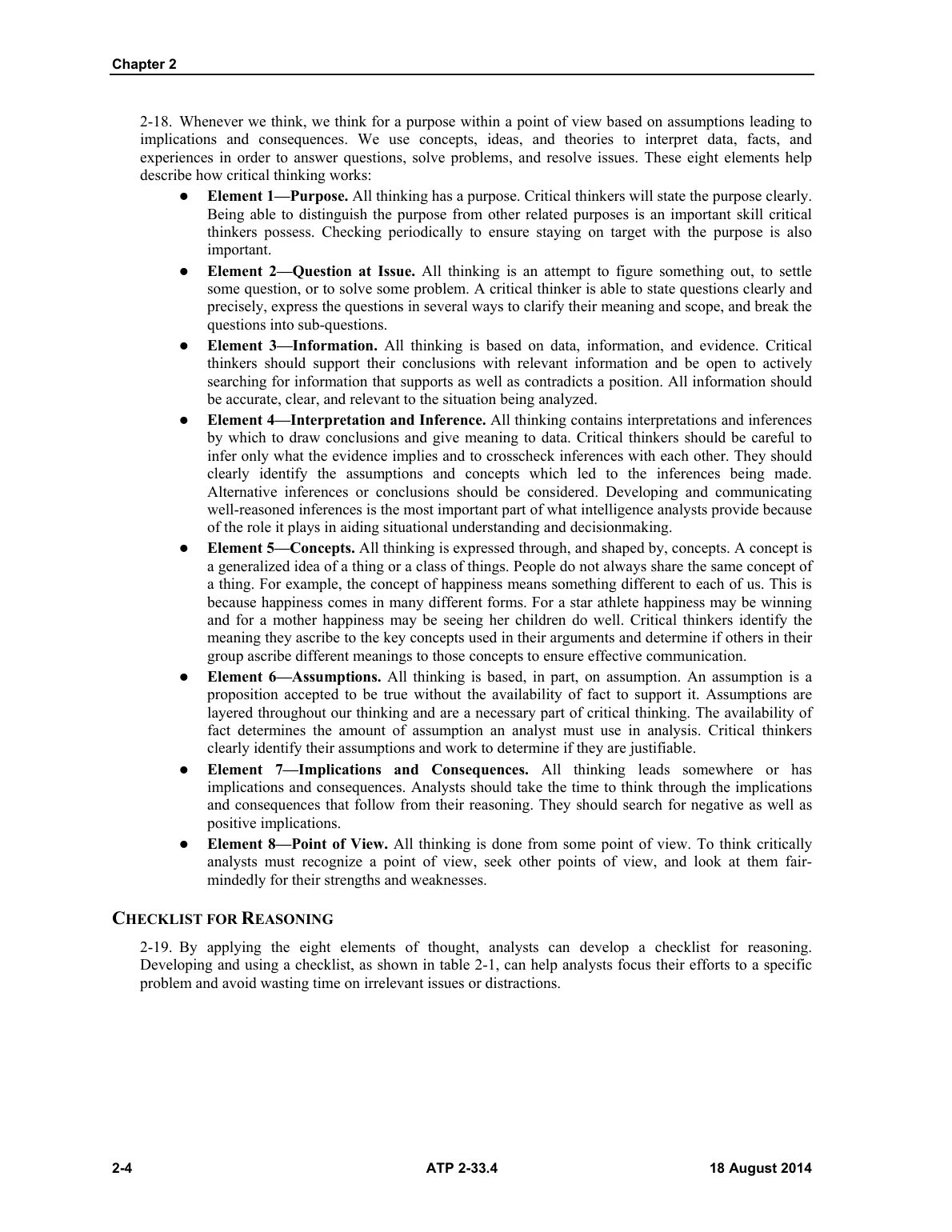
2-18. Whenever we think, we think for a purpose within a point of view based on assumptions leading to
implications and consequences. We use concepts, ideas, and theories to interpret data, facts, and
experiences in order to answer questions, solve problems, and resolve issues. These eight elements help
describe how critical thinking works:
Element 1—Purpose. All thinking has a purpose. Critical thinkers will state the purpose clearly.
Being able to distinguish the purpose from other related purposes is an important skill critical
thinkers possess. Checking periodically to ensure staying on target with the purpose is also
important.
Element 2—Question at Issue. All thinking is an attempt to figure something out, to settle
some question, or to solve some problem. A critical thinker is able to state questions clearly and
precisely, express the questions in several ways to clarify their meaning and scope, and break the
questions into sub-questions.
Element 3—Information. All thinking is based on data, information, and evidence. Critical
thinkers should support their conclusions with relevant information and be open to actively
searching for information that supports as well as contradicts a position. All information should
be accurate, clear, and relevant to the situation being analyzed.
Element 4—Interpretation and Inference. All thinking contains interpretations and inferences
by which to draw conclusions and give meaning to data. Critical thinkers should be careful to
infer only what the evidence implies and to crosscheck inferences with each other. They should
clearly identify the assumptions and concepts which led to the inferences being made.
Alternative inferences or conclusions should be considered. Developing and communicating
well-reasoned inferences is the most important part of what intelligence analysts provide because
of the role it plays in aiding situational understanding and decisionmaking.
Element 5—Concepts. All thinking is expressed through, and shaped by, concepts. A concept is
a generalized idea of a thing or a class of things. People do not always share the same concept of
a thing. For example, the concept of happiness means something different to each of us. This is
because happiness comes in many different forms. For a star athlete happiness may be winning
and for a mother happiness may be seeing her children do well. Critical thinkers identify the
meaning they ascribe to the key concepts used in their arguments and determine if others in their
group ascribe different meanings to those concepts to ensure effective communication.
Element 6—Assumptions. All thinking is based, in part, on assumption. An assumption is a
proposition accepted to be true without the availability of fact to support it. Assumptions are
layered throughout our thinking and are a necessary part of critical thinking. The availability of
fact determines the amount of assumption an analyst must use in analysis. Critical thinkers
clearly identify their assumptions and work to determine if they are justifiable.
Element 7—Implications and Consequences. All thinking leads somewhere or has
implications and consequences. Analysts should take the time to think through the implications
and consequences that follow from their reasoning. They should search for negative as well as
positive implications.
Element 8—Point of View. All thinking is done from some point of view. To think critically
analysts must recognize a point of view, seek other points of view, and look at them fair-
mindedly for their strengths and weaknesses.
CHECKLIST FOR REASONING
2-19. By applying the eight elements of thought, analysts can develop a checklist for reasoning.
Developing and using a checklist, as shown in table 2-1, can help analysts focus their efforts to a specific
problem and avoid wasting time on irrelevant issues or distractions.