ATP 2-33.4, page 21
Intelligence Analysis
Army Techniques Publication: Intelligence Analysis
2014 public edition (Archive.org)
Searchable page text (OCR / PDF)
Analytic Skills
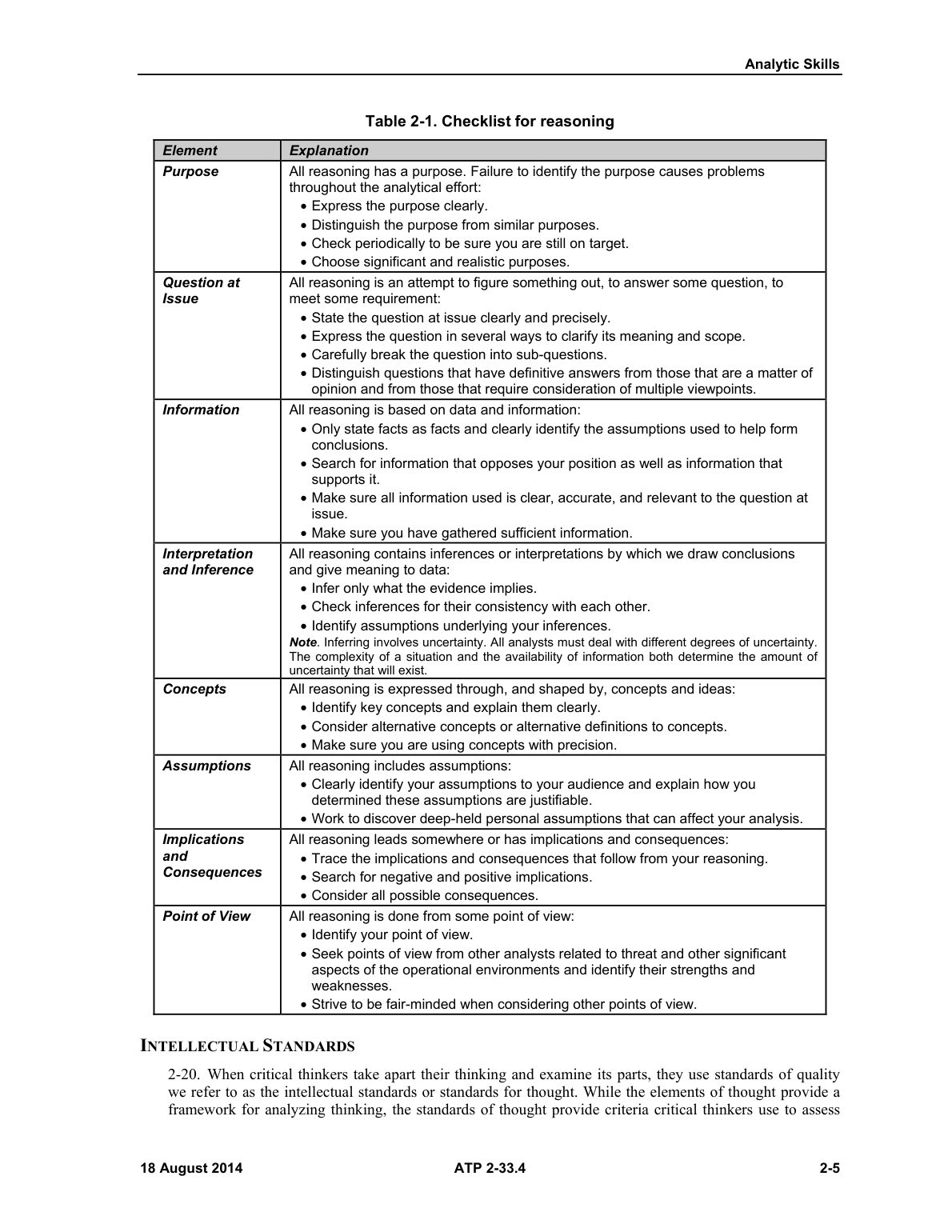
Table 2-1. Checklist for reasoning
[Element | Explanation —~—=SCSCSC~C~“‘“‘SCS*SC‘“‘“‘(CS*SS
Purpose All reasoning has a purpose. Failure to identify the purpose causes problems
throughout the analytical effort:
« Express the purpose clearly.
* Distinguish the purpose from similar purposes.
* Check periodically to be sure you are still on target.
* Choose significant and realistic purposes.
Question at All reasoning is an attempt to figure something out, to answer some question, to
Issue meet some requirement:
* State the question at issue clearly and precisely.
« Express the question in several ways to clarify its meaning and scope.
« Carefully break the question into sub-questions.
Distinguish questions that have definitive answers from those that are a matter of
opinion and from those that require consideration of multiple viewpoints.
Information All reasoning is based on data and information:
* Only state facts as facts and clearly identify the assumptions used to help form
conclusions.
* Search for information that opposes your position as well as information that
supports it.
Make sure all information used is clear, accurate, and relevant to the question at
issue.
* Make sure you have gathered sufficient information.
Interpretation | All reasoning contains inferences or interpretations by which we draw conclusions
and Inference _| and give meaning to data:
« Infer only what the evidence implies.
* Check inferences for their consistency with each other.
« Identify assumptions underlying your inferences.
Note. Inferring involves uncertainty. All analysts must deal with different degrees of uncertainty.
The complexity of a situation and the availability of information both determine the amount of
uncertainty that will exist.
Concepts All reasoning is expressed through, and shaped by, concepts and ideas:
* Identify key concepts and explain them clearly.
* Consider alternative concepts or alternative definitions to concepts.
* Make sure you are using concepts with precision.
‘Assumptions All reasoning includes assumptions:
* Clearly identify your assumptions to your audience and explain how you
determined these assumptions are justifiable.
* Work to discover deep-held personal assumptions that can affect your analysis.
Implications All reasoning leads somewhere or has implications and consequences:
and « Trace the implications and consequences that follow from your reasoning.
Consequences « Search for negative and positive implications.
* Consider all possible consequences.
Point of View All reasoning is done from some point of view:
« Identify your point of view.
* Seek points of view from other analysts related to threat and other significant
aspects of the operational environments and identify their strengths and
weaknesses.
* Strive to be fair-minded when considering other points of view.
INTELLECTUAL STANDARDS
2-20. When critical thinkers take apart their thinking and examine its parts, they use standards of quality
we refer to as the intellectual standards or standards for thought. While the elements of thought provide a
framework for analyzing thinking, the standards of thought provide criteria critical thinkers use to assess
18 August 2014 ATP 2-33.4 2-5
Analytic Skills
18 August 2014
ATP 2-33.4
2-5
Table 2-1. Checklist for reasoning
Element
Explanation
Purpose
All reasoning has a purpose. Failure to identify the purpose causes problems
throughout the analytical effort:
• Express the purpose clearly.
• Distinguish the purpose from similar purposes.
• Check periodically to be sure you are still on target.
• Choose significant and realistic purposes.
Question at
Issue
All reasoning is an attempt to figure something out, to answer some question, to
meet some requirement:
• State the question at issue clearly and precisely.
• Express the question in several ways to clarify its meaning and scope.
• Carefully break the question into sub-questions.
• Distinguish questions that have definitive answers from those that are a matter of
opinion and from those that require consideration of multiple viewpoints.
Information
All reasoning is based on data and information:
• Only state facts as facts and clearly identify the assumptions used to help form
conclusions.
• Search for information that opposes your position as well as information that
supports it.
• Make sure all information used is clear, accurate, and relevant to the question at
issue.
• Make sure you have gathered sufficient information.
Interpretation
and Inference
All reasoning contains inferences or interpretations by which we draw conclusions
and give meaning to data:
• Infer only what the evidence implies.
• Check inferences for their consistency with each other.
• Identify assumptions underlying your inferences.
Note. Inferring involves uncertainty. All analysts must deal with different degrees of uncertainty.
The complexity of a situation and the availability of information both determine the amount of
uncertainty that will exist.
Concepts
All reasoning is expressed through, and shaped by, concepts and ideas:
• Identify key concepts and explain them clearly.
• Consider alternative concepts or alternative definitions to concepts.
• Make sure you are using concepts with precision.
Assumptions
All reasoning includes assumptions:
• Clearly identify your assumptions to your audience and explain how you
determined these assumptions are justifiable.
• Work to discover deep-held personal assumptions that can affect your analysis.
Implications
and
Consequences
All reasoning leads somewhere or has implications and consequences:
• Trace the implications and consequences that follow from your reasoning.
• Search for negative and positive implications.
• Consider all possible consequences.
Point of View
All reasoning is done from some point of view:
• Identify your point of view.
• Seek points of view from other analysts related to threat and other significant
aspects of the operational environments and identify their strengths and
weaknesses.
• Strive to be fair-minded when considering other points of view.
INTELLECTUAL STANDARDS
2-20. When critical thinkers take apart their thinking and examine its parts, they use standards of quality
we refer to as the intellectual standards or standards for thought. While the elements of thought provide a
framework for analyzing thinking, the standards of thought provide criteria critical thinkers use to assess