ATP 2-33.4, page 36
Intelligence Analysis
Army Techniques Publication: Intelligence Analysis
2014 public edition (Archive.org)
Searchable page text (OCR / PDF)
Chapter 3
3-24. The following can assist when using an threat intentions matrix:
e@ Use the weighted ranking technique for more detailed insight if time allows.
e@ Color-code your entries using red for those from the adversarial point of view and blue for those
from the analyst’s point of view.
EVENT MAPPING
3-25. Event mapping uses a brainstorming diagram to represent the scenarios in hypotheses linked around
a central word or short phrase representing the issue or problem to be analyzed.
3-26. Use this technique when a nonlinear method is desired to generate, visualize, structure, and delineate
the events in a scenario or hypotheses related to the intelligence issue or problem. The addition of colors
can represent key players in each scenario, such as economics, military, opposition group, science, and
culture, as well as internal and external political pressures. It is also easy to annotate indicators of change to
use in the formation of collection plans.
Facts
3-27. The diagram with connections between events in a scenario on a radial diagram encourages a
brainstorming approach to the event mapping. The large amount of association in event maps promotes
creativity in generating new ideas and associations not previously considered. The elements are arranged
intuitively according to the importance of the concepts and are organized into groups, branches, or areas.
The uniform graphic formulation of the semantic structure of information on the method of gathering
knowledge may aid recall of existing memories. An analyst can mitigate some bias as scenario event
hypotheses are mapped in radials around the issue or problem without the implied prioritization that comes
from hierarchy or sequential arrangements, anchoring, and other cognitive bias.
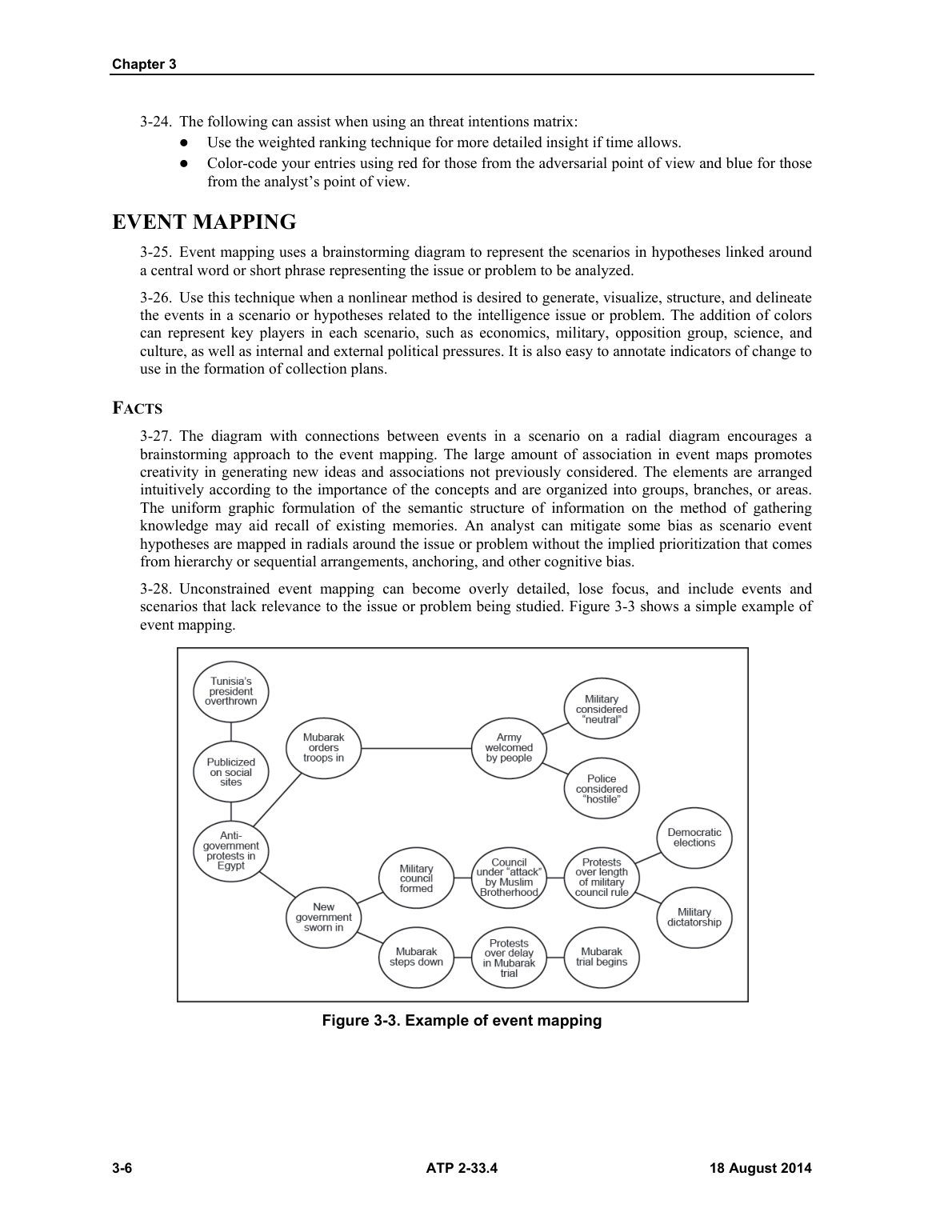
3-28. Unconstrained event mapping can become overly detailed, lose focus, and include events and
scenarios that lack relevance to the issue or problem being studied. Figure 3-3 shows a simple example of
event mapping.
Brakired Ss
it
overthrown Military
considered
“neutral”
Mubarak An
orders welcotied
Publicized troops in by people
‘on social Police
sles considered
hostile”
‘Anti- Democratic
goverment elections
protests in
Egypt Military finder atiack\__( overtengin
council by Muslim ‘of militar
formed grothernoog/ \ council ue
New
Military
government
‘sworn in, dictatorship
Mubarak over ony Mubarak
steps down in Mubarak trial begins
‘rial
Figure 3-3. Example of event mapping
3-6 ATP 2-33.4 18 August 2014
Chapter 3
3-6
ATP 2-33.4
18 August 2014
3-24. The following can assist when using an threat intentions matrix:
Use the weighted ranking technique for more detailed insight if time allows.
Color-code your entries using red for those from the adversarial point of view and blue for those
from the analyst’s point of view.
EVENT MAPPING
3-25. Event mapping uses a brainstorming diagram to represent the scenarios in hypotheses linked around
a central word or short phrase representing the issue or problem to be analyzed.
3-26. Use this technique when a nonlinear method is desired to generate, visualize, structure, and delineate
the events in a scenario or hypotheses related to the intelligence issue or problem. The addition of colors
can represent key players in each scenario, such as economics, military, opposition group, science, and
culture, as well as internal and external political pressures. It is also easy to annotate indicators of change to
use in the formation of collection plans.
FACTS
3-27. The diagram with connections between events in a scenario on a radial diagram encourages a
brainstorming approach to the event mapping. The large amount of association in event maps promotes
creativity in generating new ideas and associations not previously considered. The elements are arranged
intuitively according to the importance of the concepts and are organized into groups, branches, or areas.
The uniform graphic formulation of the semantic structure of information on the method of gathering
knowledge may aid recall of existing memories. An analyst can mitigate some bias as scenario event
hypotheses are mapped in radials around the issue or problem without the implied prioritization that comes
from hierarchy or sequential arrangements, anchoring, and other cognitive bias.
3-28. Unconstrained event mapping can become overly detailed, lose focus, and include events and
scenarios that lack relevance to the issue or problem being studied. Figure 3-3 shows a simple example of
event mapping.
Figure 3-3. Example of event mapping