ATP 2-33.4, page 38
Intelligence Analysis
Army Techniques Publication: Intelligence Analysis
2014 public edition (Archive.org)
Searchable page text (OCR / PDF)
Chapter 3
Facts
3-33. Use an event tree to clarify alternative event sequences with potential future or at least unknown
outcomes related to an intelligence problem. Event trees work best when there are multiple, mutually
exclusive options that cover the spectrum of reasonable alternatives available.
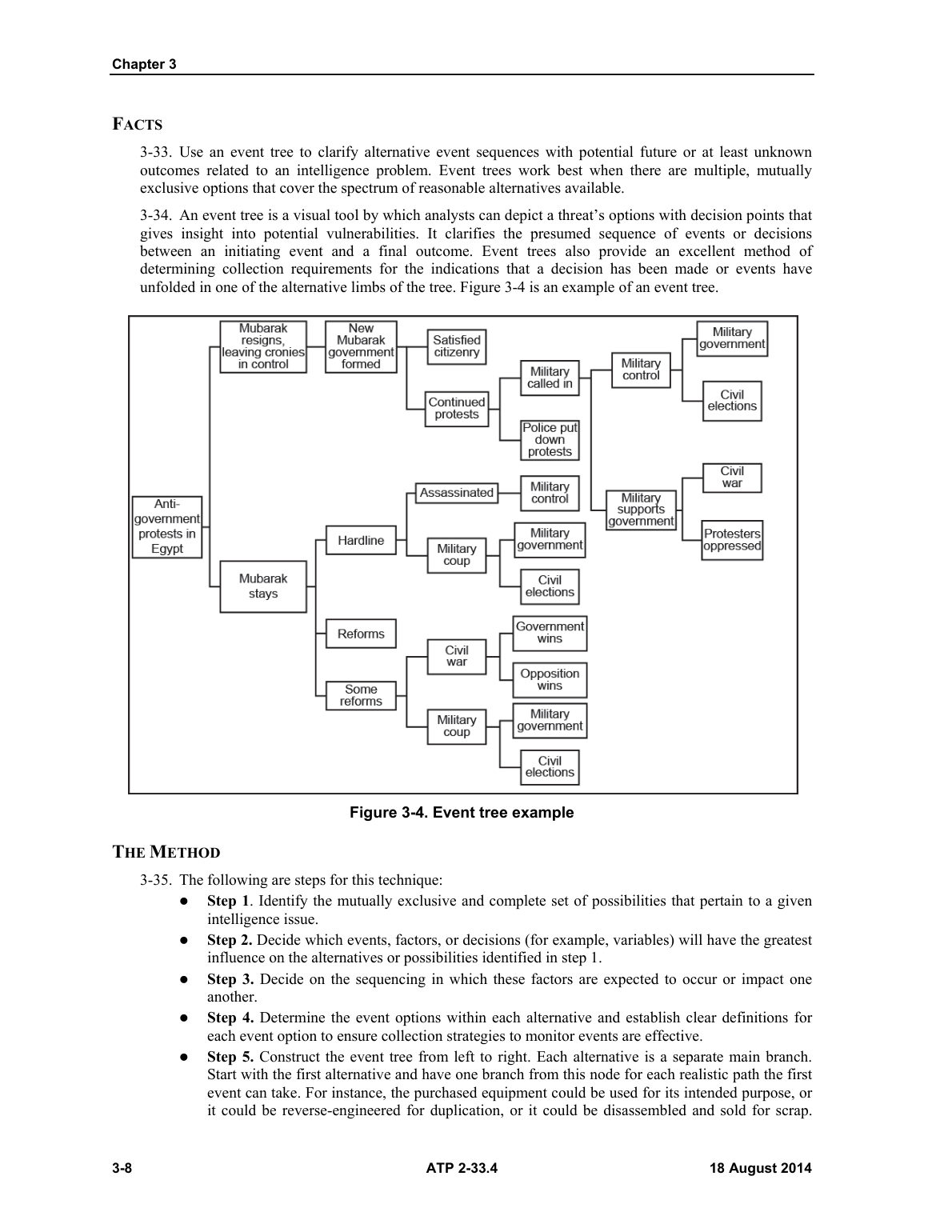
3-34. An event tree is a visual tool by which analysts can depict a threat’s options with decision points that
gives insight into potential vulnerabilities. It clarifies the presumed sequence of events or decisions
between an initiating event and a final outcome. Event trees also provide an excellent method of
determining collection requirements for the indications that a decision has been made or events have
unfolded in one of the alternative limbs of the tree. Figure 3-4 is an example of an event tree.
Mubarak New
resigns, Mubarak Satisfied government
leaving cronies goverment citizenry
in control formed Military
Military control
called in Ga
ivi
‘Continued
Police pul
down
protests
Civil
Military wor
or tenes | | amy
‘supports
lgovernment| mz government!
protests in [ Haraine | lilitary Protesters}
Eoynt Hardine Miltary government loppressed
coup
Mubarak Civil
stays elections
(Government!
Civil
war
Opposition
Some wins
reforms.
Military
Military
Civil
elections
Figure 3-4. Event tree example
THE METHOD
3-35. The following are steps for this technique:
e@ Step 1. Identify the mutually exclusive and complete set of possibilities that pertain to a given
intelligence issue.
@ Step 2. Decide which events, factors, or decisions (for example, variables) will have the greatest
influence on the alternatives or possibilities identified in step 1.
e@ Step 3. Decide on the sequencing in which these factors are expected to occur or impact one
another.
e@ Step 4. Determine the event options within each alternative and establish clear definitions for
each event option to ensure collection strategies to monitor events are effective.
e Step 5. Construct the event tree from left to right. Each alternative is a separate main branch.
Start with the first alternative and have one branch from this node for each realistic path the first
event can take. For instance, the purchased equipment could be used for its intended purpose, or
it could be reverse-engineered for duplication, or it could be disassembled and sold for scrap.
3-8 ATP 2-33.4 18 August 2014
Chapter 3
3-8
ATP 2-33.4
18 August 2014
FACTS
3-33. Use an event tree to clarify alternative event sequences with potential future or at least unknown
outcomes related to an intelligence problem. Event trees work best when there are multiple, mutually
exclusive options that cover the spectrum of reasonable alternatives available.
3-34. An event tree is a visual tool by which analysts can depict a threat’s options with decision points that
gives insight into potential vulnerabilities. It clarifies the presumed sequence of events or decisions
between an initiating event and a final outcome. Event trees also provide an excellent method of
determining collection requirements for the indications that a decision has been made or events have
unfolded in one of the alternative limbs of the tree. Figure 3-4 is an example of an event tree.
Figure 3-4. Event tree example
THE METHOD
3-35. The following are steps for this technique:
Step 1. Identify the mutually exclusive and complete set of possibilities that pertain to a given
intelligence issue.
Step 2. Decide which events, factors, or decisions (for example, variables) will have the greatest
influence on the alternatives or possibilities identified in step 1.
Step 3. Decide on the sequencing in which these factors are expected to occur or impact one
another.
Step 4. Determine the event options within each alternative and establish clear definitions for
each event option to ensure collection strategies to monitor events are effective.
Step 5. Construct the event tree from left to right. Each alternative is a separate main branch.
Start with the first alternative and have one branch from this node for each realistic path the first
event can take. For instance, the purchased equipment could be used for its intended purpose, or
it could be reverse-engineered for duplication, or it could be disassembled and sold for scrap.