ATP 2-33.4, page 39
Intelligence Analysis
Army Techniques Publication: Intelligence Analysis
2014 public edition (Archive.org)
Searchable page text (OCR / PDF)
Basic Structured Analytic Techniques
Proceed down each event option node until the end state for that sub-branch is reached. Then
move to the next alternative and repeat the process.
e@ Step 6. Determine what would indicate a decision has been made at each decision point for each
option to use in generating an integrated collection plan.
e@ Step 7. Assess the implications or after effects of each alternative on the intelligence problem.
3-36. The following can assist when using an event tree:
e@ Use this technique in conjunction with weighted ranking, hypothesis review techniques, and
subjective probability to gain added insights.
e Leverage the expertise of a group of analysts during the construction of an event tree to ensure
all important events, factors, and decision options are considered.
SUBJECTIVE PROBABILITY
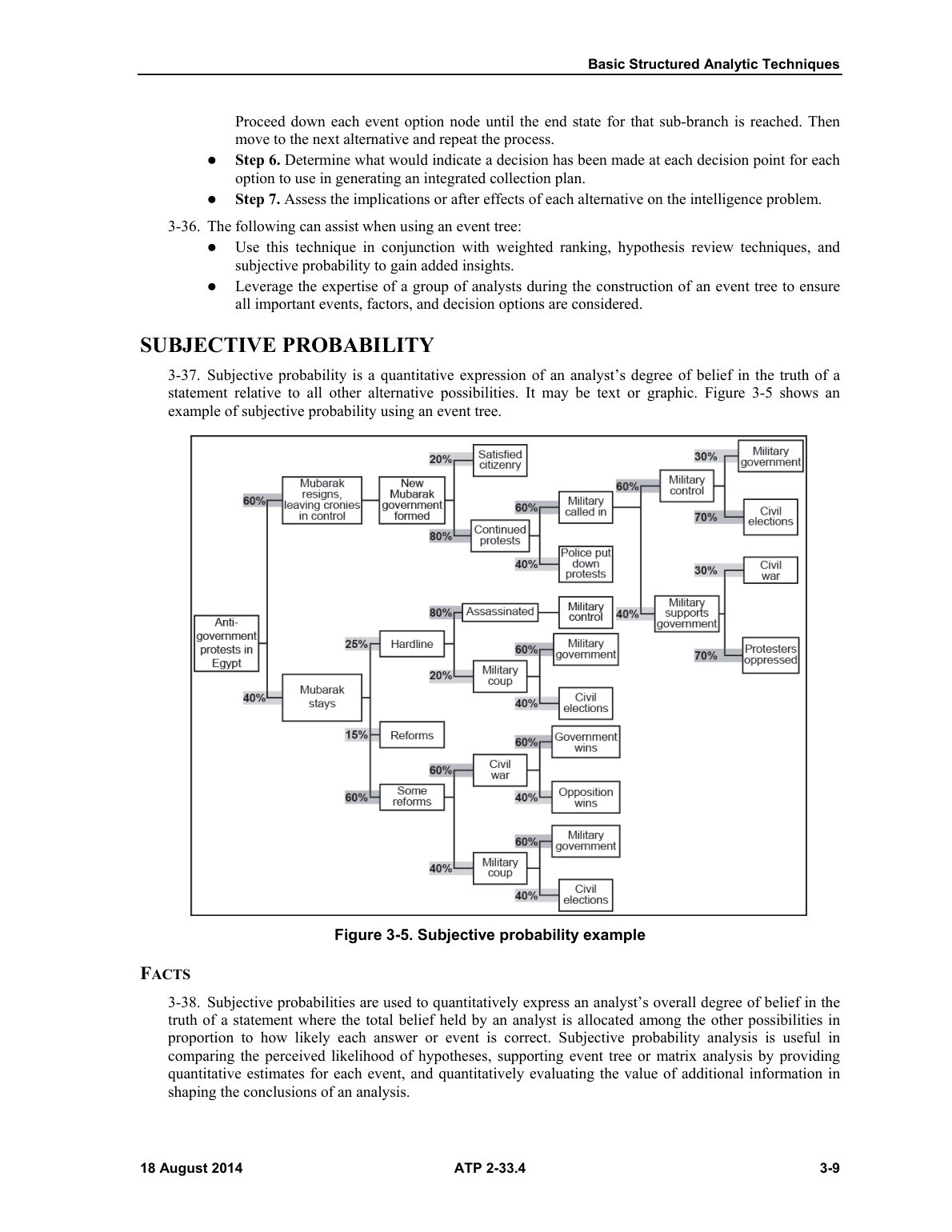
3-37. Subjective probability is a quantitative expression of an analyst’s degree of belief in the truth of a
statement relative to all other alternative possibilities. It may be text or graphic. Figure 3-5 shows an.
example of subjective probability using an event tree.
Satisfied Military
20% Giizenry 30% (| government
Mubarak New Military
resigns, Mubarak BO%F| control
60% leaving cronies} —] government} 60% Military: Cw
in control formed sated 70%! eicctions
[Continued
80% protests
Police put]
40%! 9, Civil
Millit
Anti- lgovernment}
lgovernment|
25% Hardline Military
Egypt I lgovernment| 70%! oppressed
40%! Civil
1% Goverment
Lai wins
Civil
Some oO ith
ws ws
Military
me
Miltary
w
Civil
ms
Figure 3-5. Subjective probability example
Facts
3-38. Subjective probabilities are used to quantitatively express an analyst’s overall degree of belief in the
truth of a statement where the total belief held by an analyst is allocated among the other possibilities in
proportion to how likely each answer or event is correct. Subjective probability analysis is useful in
comparing the perceived likelihood of hypotheses, supporting event tree or matrix analysis by providing
quantitative estimates for each event, and quantitatively evaluating the value of additional information in
shaping the conclusions of an analysis.
18 August 2014 ATP 2-33.4 3-9
Basic Structured Analytic Techniques
18 August 2014
ATP 2-33.4
3-9
Proceed down each event option node until the end state for that sub-branch is reached. Then
move to the next alternative and repeat the process.
Step 6. Determine what would indicate a decision has been made at each decision point for each
option to use in generating an integrated collection plan.
Step 7. Assess the implications or after effects of each alternative on the intelligence problem.
3-36. The following can assist when using an event tree:
Use this technique in conjunction with weighted ranking, hypothesis review techniques, and
subjective probability to gain added insights.
Leverage the expertise of a group of analysts during the construction of an event tree to ensure
all important events, factors, and decision options are considered.
SUBJECTIVE PROBABILITY
3-37. Subjective probability is a quantitative expression of an analyst’s degree of belief in the truth of a
statement relative to all other alternative possibilities. It may be text or graphic. Figure 3-5 shows an
example of subjective probability using an event tree.
Figure 3-5. Subjective probability example
FACTS
3-38. Subjective probabilities are used to quantitatively express an analyst’s overall degree of belief in the
truth of a statement where the total belief held by an analyst is allocated among the other possibilities in
proportion to how likely each answer or event is correct. Subjective probability analysis is useful in
comparing the perceived likelihood of hypotheses, supporting event tree or matrix analysis by providing
quantitative estimates for each event, and quantitatively evaluating the value of additional information in
shaping the conclusions of an analysis.