ATP 2-33.4, page 58
Intelligence Analysis
Army Techniques Publication: Intelligence Analysis
2014 public edition (Archive.org)
Searchable page text (OCR / PDF)
Chapter 5
5-4
ATP 2-33.4
18 August 2014
overprotective about their ideas and do not accept the ideas of others. Fearful people are reticent
and evasive, only presenting safe ideas.
COMPARISON
5-13. Comparison is used to understand current events by comparing them with historical precedents in the
same country or with similar events in other countries. It differs from applying theory in that conclusions
are drawn from a small number of cases, whereas applying theory is generated from examining a large
number of cases. This approach is useful when faced with ambiguous situations because it looks at how the
country handled similar situations in the past or how similar countries handled similar situations.
5-14. Comparison analysis helps to work out the importance of a number of options relative to each other.
It is very useful when the analyst lacks objective data to base this on.
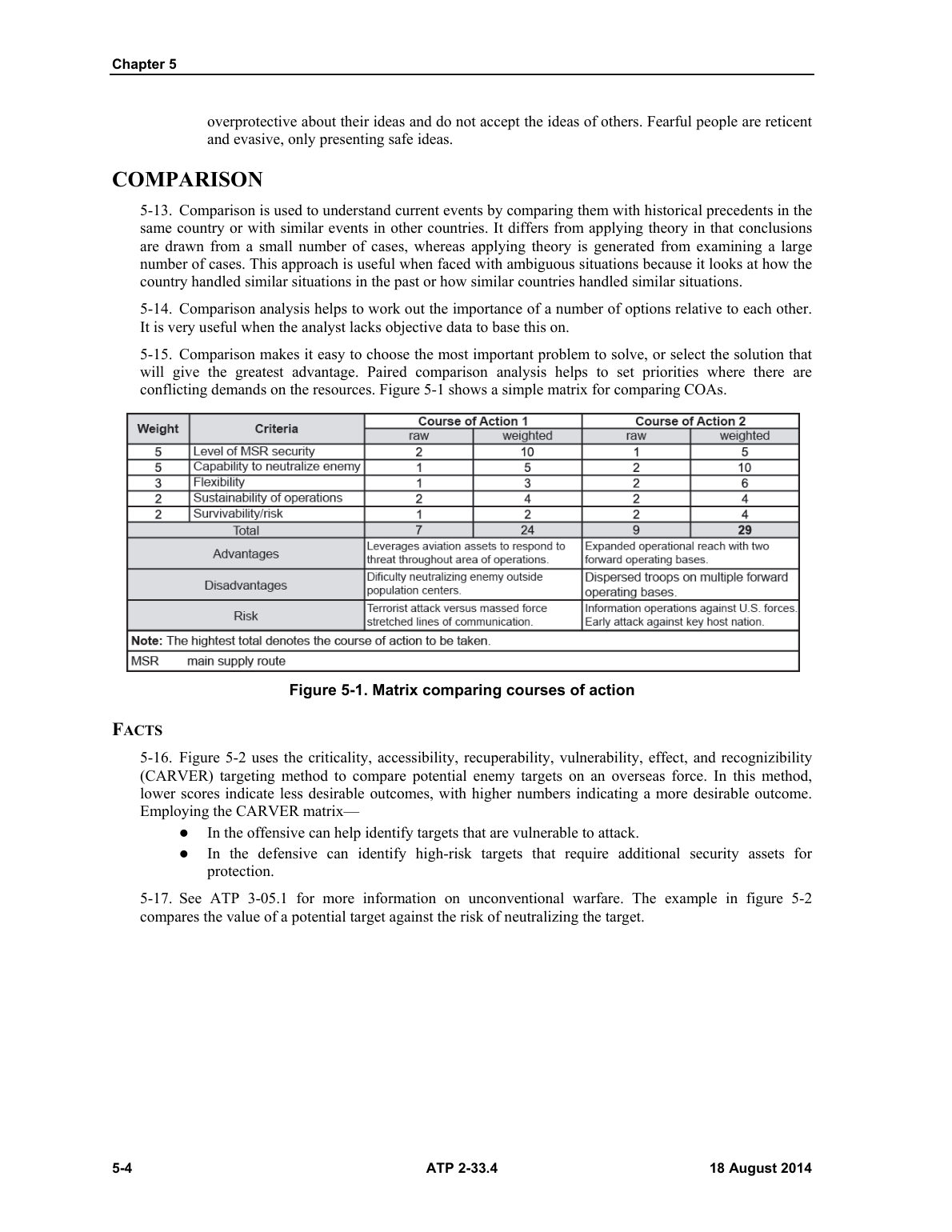
5-15. Comparison makes it easy to choose the most important problem to solve, or select the solution that
will give the greatest advantage. Paired comparison analysis helps to set priorities where there are
conflicting demands on the resources. Figure 5-1 shows a simple matrix for comparing COAs.
Figure 5-1. Matrix comparing courses of action
FACTS
5-16. Figure 5-2 uses the criticality, accessibility, recuperability, vulnerability, effect, and recognizibility
(CARVER) targeting method to compare potential enemy targets on an overseas force. In this method,
lower scores indicate less desirable outcomes, with higher numbers indicating a more desirable outcome.
Employing the CARVER matrix—
In the offensive can help identify targets that are vulnerable to attack.
In the defensive can identify high-risk targets that require additional security assets for
protection.
5-17. See ATP 3-05.1 for more information on unconventional warfare. The example in figure 5-2
compares the value of a potential target against the risk of neutralizing the target.