ATP 2-33.4, page 61
Intelligence Analysis
Army Techniques Publication: Intelligence Analysis
2014 public edition (Archive.org)
Searchable page text (OCR / PDF)
Core Army Analytic Techniques
18 August 2014
ATP 2-33.4
5-7
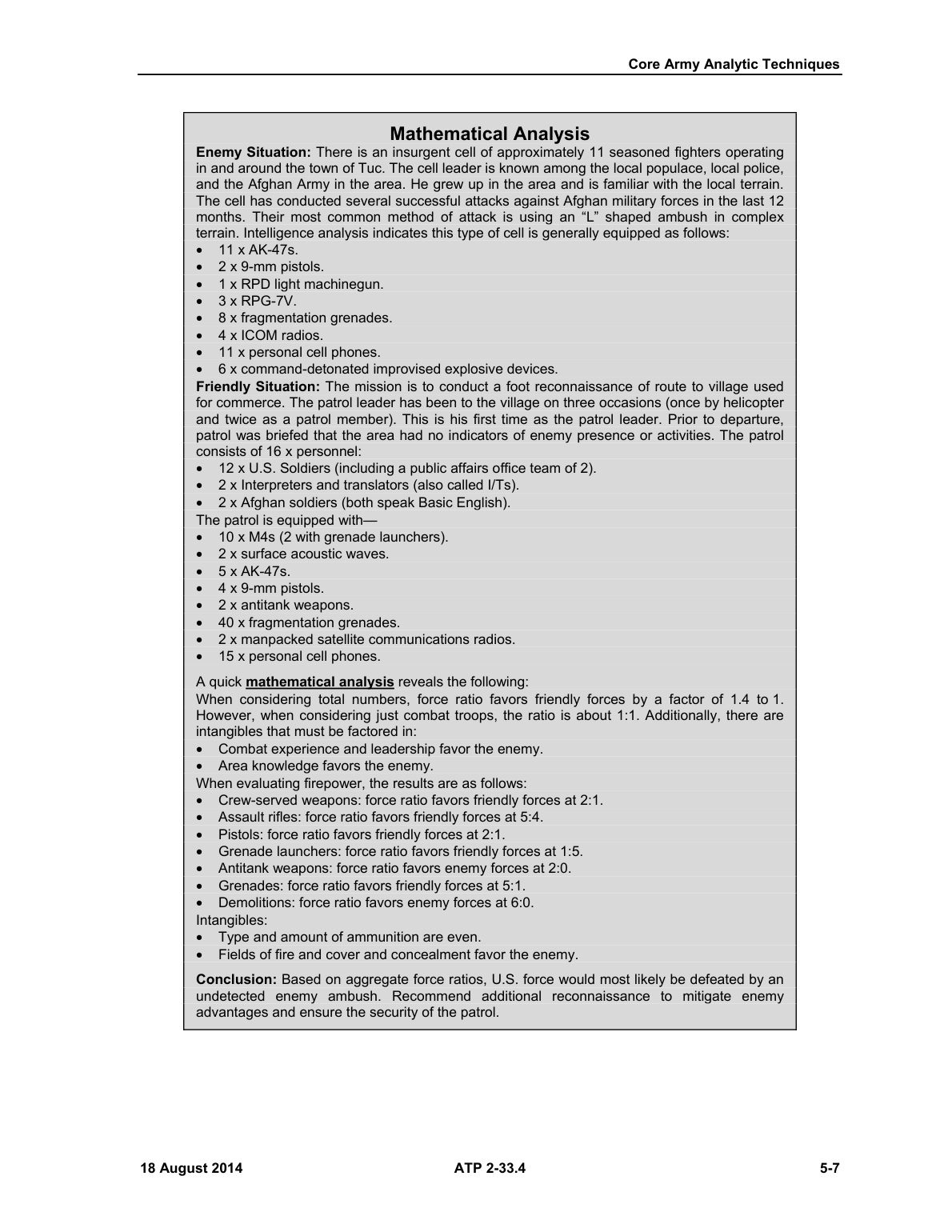
Mathematical Analysis
Enemy Situation: There is an insurgent cell of approximately 11 seasoned fighters operating
in and around the town of Tuc. The cell leader is known among the local populace, local police,
and the Afghan Army in the area. He grew up in the area and is familiar with the local terrain.
The cell has conducted several successful attacks against Afghan military forces in the last 12
months. Their most common method of attack is using an “L” shaped ambush in complex
terrain. Intelligence analysis indicates this type of cell is generally equipped as follows:
•
11 x AK-47s.
•
2 x 9-mm pistols.
•
1 x RPD light machinegun.
•
3 x RPG-7V.
•
8 x fragmentation grenades.
•
4 x ICOM radios.
•
11 x personal cell phones.
•
6 x command-detonated improvised explosive devices.
Friendly Situation: The mission is to conduct a foot reconnaissance of route to village used
for commerce. The patrol leader has been to the village on three occasions (once by helicopter
and twice as a patrol member). This is his first time as the patrol leader. Prior to departure,
patrol was briefed that the area had no indicators of enemy presence or activities. The patrol
consists of 16 x personnel:
•
12 x U.S. Soldiers (including a public affairs office team of 2).
•
2 x Interpreters and translators (also called I/Ts).
•
2 x Afghan soldiers (both speak Basic English).
The patrol is equipped with—
•
10 x M4s (2 with grenade launchers).
•
2 x surface acoustic waves.
•
5 x AK-47s.
•
4 x 9-mm pistols.
•
2 x antitank weapons.
•
40 x fragmentation grenades.
•
2 x manpacked satellite communications radios.
•
15 x personal cell phones.
A quick mathematical analysis reveals the following:
When considering total numbers, force ratio favors friendly forces by a factor of 1.4 to 1.
However, when considering just combat troops, the ratio is about 1:1. Additionally, there are
intangibles that must be factored in:
•
Combat experience and leadership favor the enemy.
•
Area knowledge favors the enemy.
When evaluating firepower, the results are as follows:
•
Crew-served weapons: force ratio favors friendly forces at 2:1.
•
Assault rifles: force ratio favors friendly forces at 5:4.
•
Pistols: force ratio favors friendly forces at 2:1.
•
Grenade launchers: force ratio favors friendly forces at 1:5.
•
Antitank weapons: force ratio favors enemy forces at 2:0.
•
Grenades: force ratio favors friendly forces at 5:1.
•
Demolitions: force ratio favors enemy forces at 6:0.
Intangibles:
•
Type and amount of ammunition are even.
•
Fields of fire and cover and concealment favor the enemy.
Conclusion: Based on aggregate force ratios, U.S. force would most likely be defeated by an
undetected enemy ambush. Recommend additional reconnaissance to mitigate enemy
advantages and ensure the security of the patrol.