ATP 2-33.4, page 70
Intelligence Analysis
Army Techniques Publication: Intelligence Analysis
2014 public edition (Archive.org)
Searchable page text (OCR / PDF)
Chapter 5
5-16
ATP 2-33.4
18 August 2014
commanders and staffs visualize how various systems work internally and interact with each
other. They establish the interconnectivity between nodes that allows them to work together as a
system—to behave in a specific way (accomplish a task or perform a function).
5-58. Both nodes and links are symbolic representations meant to simplify the complexity of the real
world; they are useful in identifying centers of gravity, critical nodes, and other lines of effort the command
may wish to influence or change during an operation.
5-59. Enemy networks do not exist in a vacuum. They interact with each other, their supporters in the
population, and, less directly, with their supporters obscured in the power structure. They also interact with
political, security, economic, and real estate key leaders as well as the general population. Networks are
notably resistant to the loss of any one or even several nodes, so the focus of targeting is to identify not just
who or what to target but, if targeted, what loss will cause the most damage to the network. The ultimate
success is to remove sufficient critical nodes simultaneously or nearly, so the network cannot automatically
re-route linkages but suffers catastrophic failure.
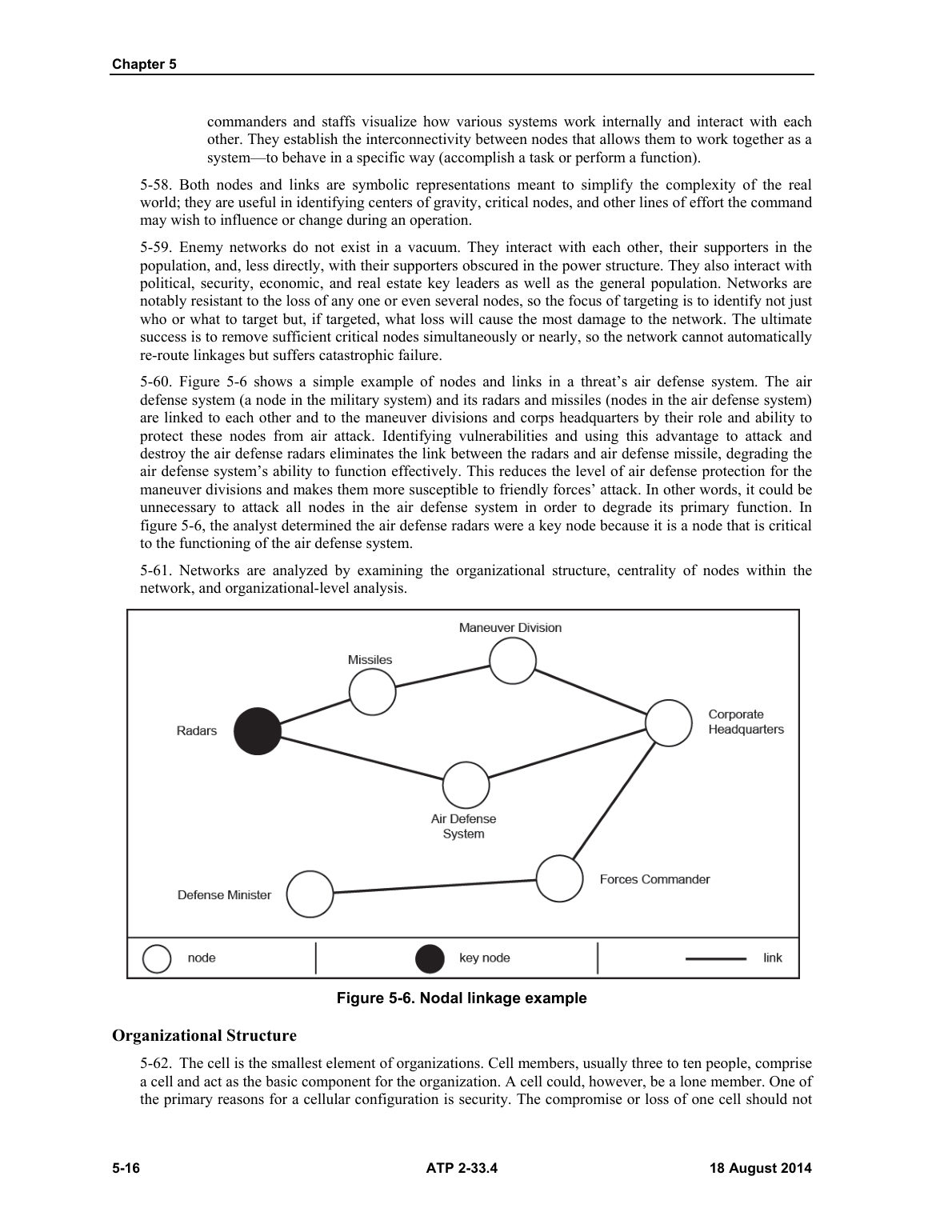
5-60. Figure 5-6 shows a simple example of nodes and links in a threat’s air defense system. The air
defense system (a node in the military system) and its radars and missiles (nodes in the air defense system)
are linked to each other and to the maneuver divisions and corps headquarters by their role and ability to
protect these nodes from air attack. Identifying vulnerabilities and using this advantage to attack and
destroy the air defense radars eliminates the link between the radars and air defense missile, degrading the
air defense system’s ability to function effectively. This reduces the level of air defense protection for the
maneuver divisions and makes them more susceptible to friendly forces’ attack. In other words, it could be
unnecessary to attack all nodes in the air defense system in order to degrade its primary function. In
figure 5-6, the analyst determined the air defense radars were a key node because it is a node that is critical
to the functioning of the air defense system.
5-61. Networks are analyzed by examining the organizational structure, centrality of nodes within the
network, and organizational-level analysis.
Figure 5-6. Nodal linkage example
Organizational Structure
5-62. The cell is the smallest element of organizations. Cell members, usually three to ten people, comprise
a cell and act as the basic component for the organization. A cell could, however, be a lone member. One of
the primary reasons for a cellular configuration is security. The compromise or loss of one cell should not