ATP 2-33.4, page 71
Intelligence Analysis
Army Techniques Publication: Intelligence Analysis
2014 public edition (Archive.org)
Searchable page text (OCR / PDF)
Core Army Analytic Techniques
18 August 2014
ATP 2-33.4
5-17
compromise the identity, location, or actions of other cells. Compartmenting functions within
organizational structure makes it difficult to penetrate the entire organization. Personnel within one cell are
often unaware of the existence of other cells and cannot provide sensitive information to infiltrators or
captors.
5-63. Cells may be based on family or employment relationships, on a geographic basis, or by specific
functions such as direct action or intelligence. The organization may also form multifunctional cells. Cell
members remain in close contact with each other, given allowance and guidance by a directing authority, in
order to provide motivational support and enhance security procedures. The cell leader is normally the only
person who communicates and coordinates with higher levels and other cells. Organizations may form only
one cell or may form several cells that operate in local or regional areas, across national borders, or among
several countries in transnational operations.
5-64. There are two basic ways for organizations to be structured: organizations may use hierarchical or
networked structures. A group may also employ either type or a combination of the two models; and the
structure may change at different levels of the organization.
Hierarchical structure:
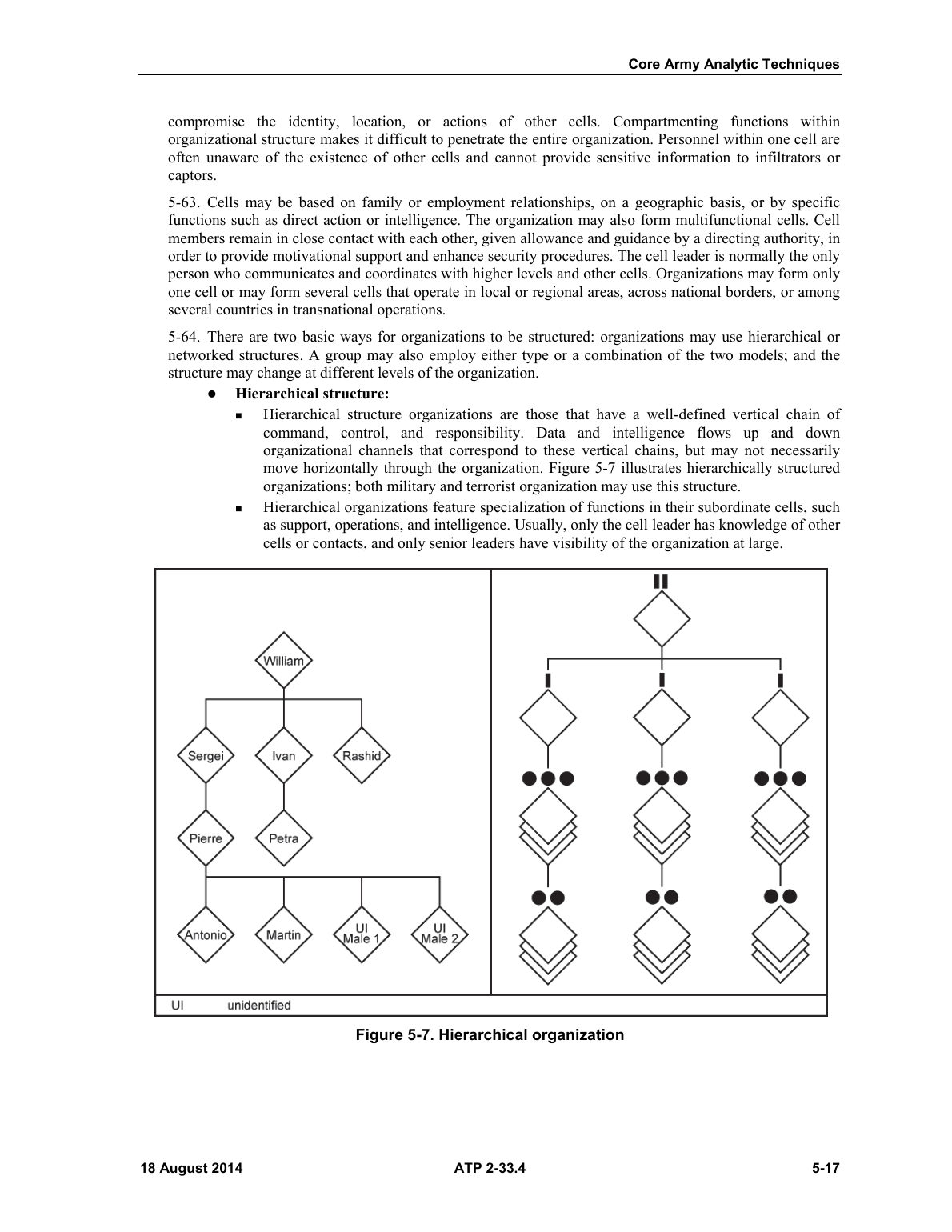
Hierarchical structure organizations are those that have a well-defined vertical chain of
command, control, and responsibility. Data and intelligence flows up and down
organizational channels that correspond to these vertical chains, but may not necessarily
move horizontally through the organization. Figure 5-7 illustrates hierarchically structured
organizations; both military and terrorist organization may use this structure.
Hierarchical organizations feature specialization of functions in their subordinate cells, such
as support, operations, and intelligence. Usually, only the cell leader has knowledge of other
cells or contacts, and only senior leaders have visibility of the organization at large.
Figure 5-7. Hierarchical organization