ATP 2-33.4, page 84
Intelligence Analysis
Army Techniques Publication: Intelligence Analysis
2014 public edition (Archive.org)
Searchable page text (OCR / PDF)
Chapter 5
5-30
ATP 2-33.4
18 August 2014
THE METHOD
5-116. There is some latitude in preparing pattern analysis plot sheets. The methodology is the same as
chronologies and timelines, with the following specific techniques employed for the pattern analysis plot
wheel:
Different symbols are used for each type of incident. All symbols are tracked in a legend.
All incidents are marked on the time-wheel matrix and the calendar.
Noteworthy events may be annotated with footnotes. If the analyst uses this method, the symbol
must be marked on both the time-wheel matrix and the calendar; the footnote is then described
separately below the calendar or in a location near the pattern analysis plot sheet.
INCIDENT OVERLAY
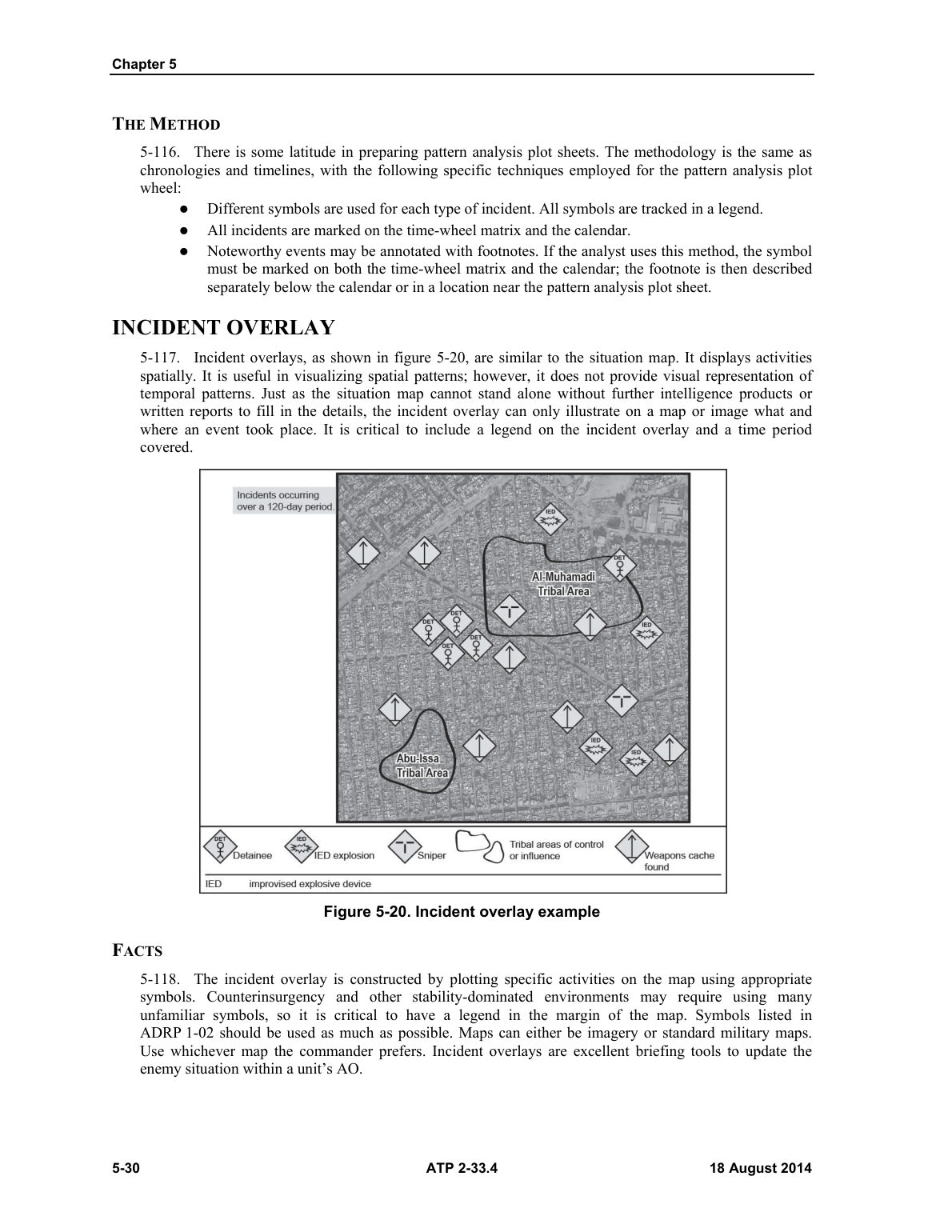
5-117. Incident overlays, as shown in figure 5-20, are similar to the situation map. It displays activities
spatially. It is useful in visualizing spatial patterns; however, it does not provide visual representation of
temporal patterns. Just as the situation map cannot stand alone without further intelligence products or
written reports to fill in the details, the incident overlay can only illustrate on a map or image what and
where an event took place. It is critical to include a legend on the incident overlay and a time period
covered.
Figure 5-20. Incident overlay example
FACTS
5-118. The incident overlay is constructed by plotting specific activities on the map using appropriate
symbols. Counterinsurgency and other stability-dominated environments may require using many
unfamiliar symbols, so it is critical to have a legend in the margin of the map. Symbols listed in
ADRP 1-02 should be used as much as possible. Maps can either be imagery or standard military maps.
Use whichever map the commander prefers. Incident overlays are excellent briefing tools to update the
enemy situation within a unit’s AO.