ATP 2-33.4, page 9
Intelligence Analysis
Army Techniques Publication: Intelligence Analysis
2014 public edition (Archive.org)
Searchable page text (OCR / PDF)
Introduction
ATP 2-33.4 discusses doctrinal techniques: non-prescriptive ways or methods for performing missions,
functions, or tasks as they apply to intelligence analysis. The intelligence warfighting function focuses first
on the threat network and second on the neutral network. ATP 2-33.4—
Discusses analysis techniques performed by all intelligence Soldiers and civilians in each of the
intelligence disciplines.
e Describes the steps involved in implementing the analytic techniques presented.
e Describes critical thinking in detail.
Note. Critical thinking is a deliberate process of thought used to objectively evaluate data.
Critical thinking is the process of analyzing and assessing thinking with a view to improving it.
Critical thinking presupposes knowledge of the most basic structures in thinking (the elements of
thought) and the most basic intellectual standards for thinking (universal intellectual standards).
Critical thinking is key to the analysis conducted to better understand situations.
ATP 2-33.4 does not contain—
© Fundamentals on intelligence and the Army’s intelligence warfighting function. ADP 2-0 and
ADRP 2-0 describe this doctrine.
¢ Techniques used to perform intelligence preparation of the battlefield (IPB). FM 2-01.3 contains
this doctrine.
¢ Information on how tasks specific to individual intelligence disciplines are conducted. Discipline-
specific publications contain this doctrine.
e Information on manning documents or intelligence support to the various echelons. This
information is contained in publications on intelligence support to brigade combat teams, corps,
divisions, and echelons above corps.
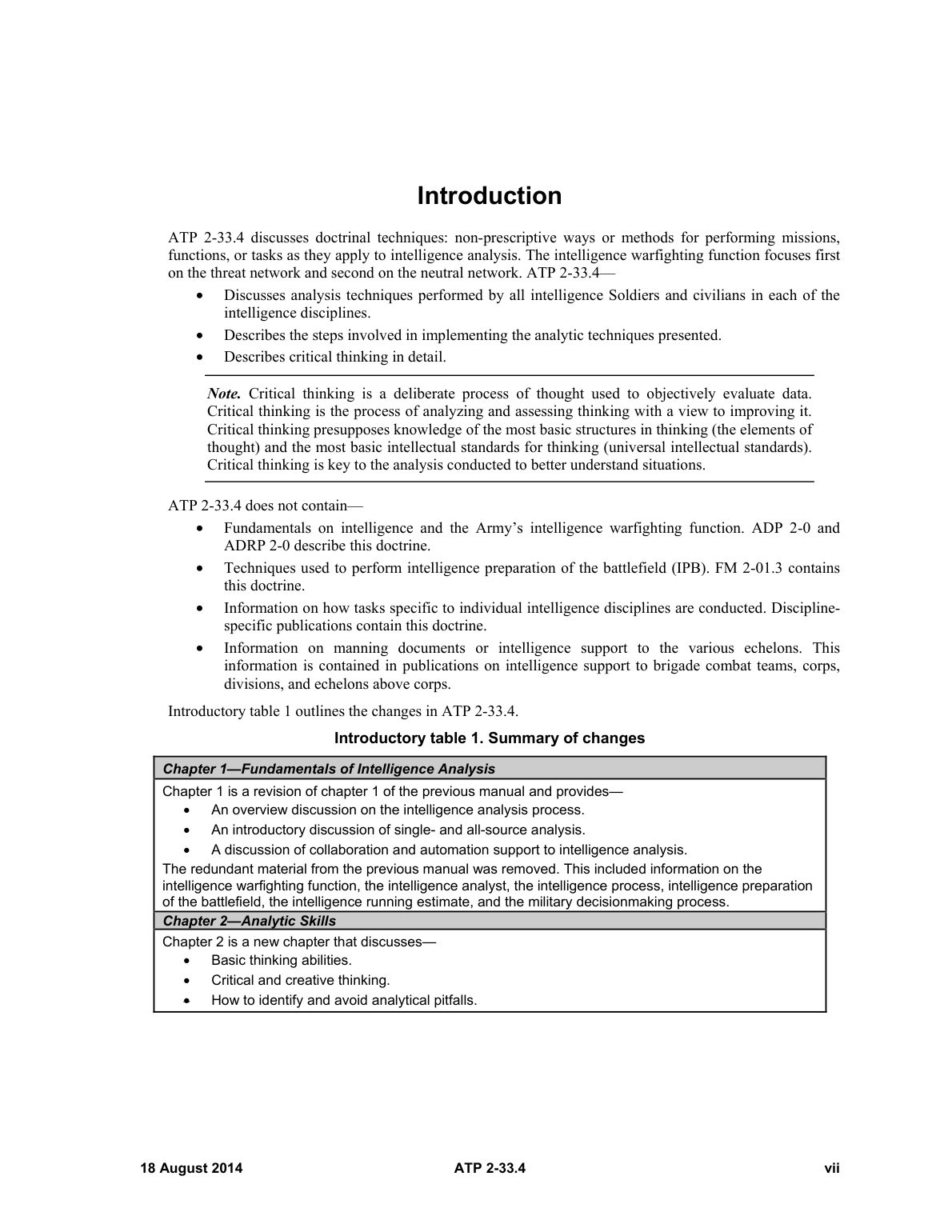
Introductory table 1 outlines the changes in ATP 2-33.4.
Introductory table 1. Summary of changes
Chapter 1—Fundamentals of Intelligence Analysis
Chapter 1 is a revision of chapter 1 of the previous manual and provides—
« Anoverview discussion on the intelligence analysis process.
* — Anintroductory discussion of single- and all-source analysis.
* Adiscussion of collaboration and automation support to intelligence analysis.
The redundant material from the previous manual was removed. This included information on the
intelligence warfighting function, the intelligence analyst, the intelligence process, intelligence preparation
of the battlefield, the intelligence running estimate, and the military decisionmaking process.
Chapter 2—Analytic Skills
Chapter 2 is a new chapter that discusses—
* Basic thinking abilities.
* — Critical and creative thinking.
Howto identify and avoid analytical pitfalls.
18 August 2014 ATP 2-33.4 vii
18 August 2014
ATP 2-33.4
vii
Introduction
ATP 2-33.4 discusses doctrinal techniques: non-prescriptive ways or methods for performing missions,
functions, or tasks as they apply to intelligence analysis. The intelligence warfighting function focuses first
on the threat network and second on the neutral network. ATP 2-33.4—
•
Discusses analysis techniques performed by all intelligence Soldiers and civilians in each of the
intelligence disciplines.
•
Describes the steps involved in implementing the analytic techniques presented.
•
Describes critical thinking in detail.
Note. Critical thinking is a deliberate process of thought used to objectively evaluate data.
Critical thinking is the process of analyzing and assessing thinking with a view to improving it.
Critical thinking presupposes knowledge of the most basic structures in thinking (the elements of
thought) and the most basic intellectual standards for thinking (universal intellectual standards).
Critical thinking is key to the analysis conducted to better understand situations.
ATP 2-33.4 does not contain—
•
Fundamentals on intelligence and the Army’s intelligence warfighting function. ADP 2-0 and
ADRP 2-0 describe this doctrine.
•
Techniques used to perform intelligence preparation of the battlefield (IPB). FM 2-01.3 contains
this doctrine.
•
Information on how tasks specific to individual intelligence disciplines are conducted. Discipline-
specific publications contain this doctrine.
•
Information on manning documents or intelligence support to the various echelons. This
information is contained in publications on intelligence support to brigade combat teams, corps,
divisions, and echelons above corps.
Introductory table 1 outlines the changes in ATP 2-33.4.
Introductory table 1. Summary of changes
Chapter 1—Fundamentals of Intelligence Analysis
Chapter 1 is a revision of chapter 1 of the previous manual and provides—
•
An overview discussion on the intelligence analysis process.
•
An introductory discussion of single- and all-source analysis.
•
A discussion of collaboration and automation support to intelligence analysis.
The redundant material from the previous manual was removed. This included information on the
intelligence warfighting function, the intelligence analyst, the intelligence process, intelligence preparation
of the battlefield, the intelligence running estimate, and the military decisionmaking process.
Chapter 2—Analytic Skills
Chapter 2 is a new chapter that discusses—
•
Basic thinking abilities.
•
Critical and creative thinking.
•
How to identify and avoid analytical pitfalls.