GhostNet 1.5, page 30
GhostNet Guide
S2 Underground field guide: GhostNet Guide
Version 1.5 — Stopgap Comms Solutions (CC BY-NC-SA 4.0)
Searchable page text (OCR / PDF)
30
GhostNet ALE Frequency List
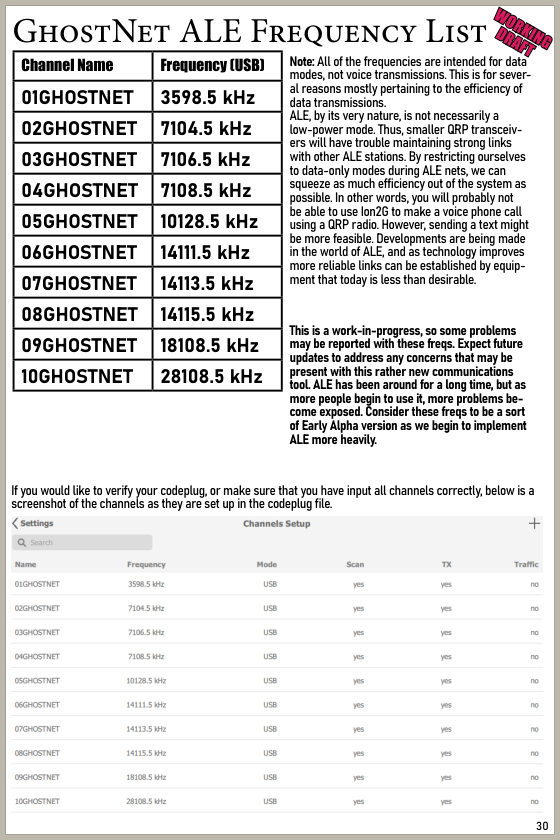
If you would like to verify your codeplug, or make sure that you have input all channels correctly, below is a
screenshot of the channels as they are set up in the codeplug file.
Channel Name
Frequency (USB)
01GHOSTNET
3598.5 kHz
02GHOSTNET
7104.5 kHz
03GHOSTNET
7106.5 kHz
04GHOSTNET
7108.5 kHz
05GHOSTNET
10128.5 kHz
06GHOSTNET
14111.5 kHz
07GHOSTNET
14113.5 kHz
08GHOSTNET
14115.5 kHz
09GHOSTNET
18108.5 kHz
10GHOSTNET
28108.5 kHz
Note: All of the frequencies are intended for data
modes, not voice transmissions. This is for sever-
al reasons mostly pertaining to the efficiency of
data transmissions.
ALE, by its very nature, is not necessarily a
low-power mode. Thus, smaller QRP transceiv-
ers will have trouble maintaining strong links
with other ALE stations. By restricting ourselves
to data-only modes during ALE nets, we can
squeeze as much efficiency out of the system as
possible. In other words, you will probably not
be able to use Ion2G to make a voice phone call
using a QRP radio. However, sending a text might
be more feasible. Developments are being made
in the world of ALE, and as technology improves
more reliable links can be established by equip-
ment that today is less than desirable.
This is a work-in-progress, so some problems
may be reported with these freqs. Expect future
updates to address any concerns that may be
present with this rather new communications
tool. ALE has been around for a long time, but as
more people begin to use it, more problems be-
come exposed. Consider these freqs to be a sort
of Early Alpha version as we begin to implement
ALE more heavily.
WORKING
WORKING
DRAFT
DRAFT