JP 3-0, page 112
Joint Operations
Joint Publication: Joint Operations
11 August 2011 public edition
Searchable page text (OCR / PDF)
Chapter V
V-6
JP 3-0
objectives that cannot be attained all at once by arranging smaller, related operations in a
logical sequence. Phasing also helps commanders mitigate risk in the more dangerous or
difficult portions of an operation.
b. Application. The JFC’s vision of how the operation should unfold drives
subsequent decisions regarding phasing. In turn, phasing helps the commander and staff
synchronize the CONOPS and organize tasks assigned to subordinate commanders. By
arranging operations and activities into phases, the JFC can better integrate and
synchronize subordinate operations in time, space, and purpose. Each phase should
represent a natural subdivision of the campaign/operation’s intermediate objectives.
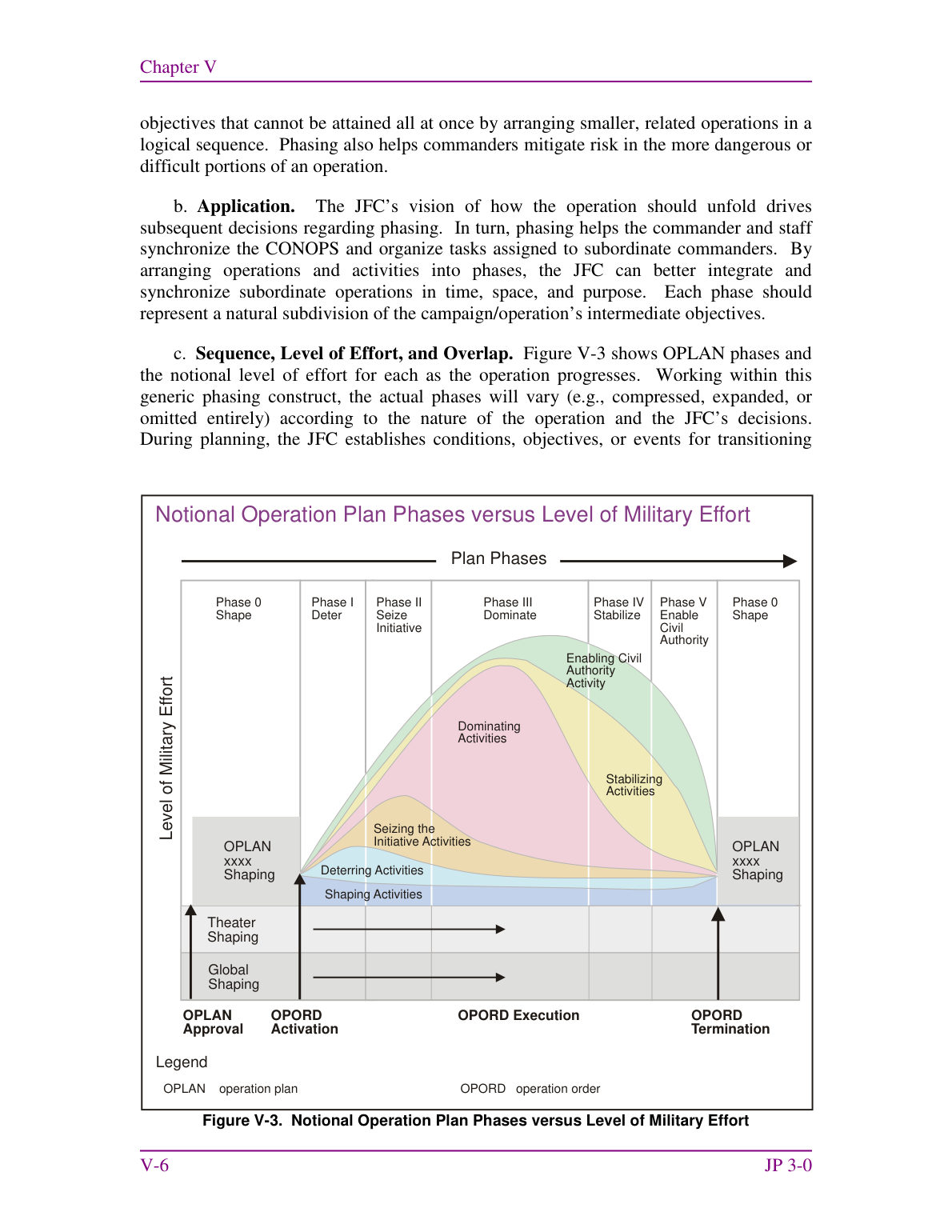
c. Sequence, Level of Effort, and Overlap. Figure V-3 shows OPLAN phases and
the notional level of effort for each as the operation progresses. Working within this
generic phasing construct, the actual phases will vary (e.g., compressed, expanded, or
omitted entirely) according to the nature of the operation and the JFC’s decisions.
During planning, the JFC establishes conditions, objectives, or events for transitioning
Figure V-3. Notional Operation Plan Phases versus Level of Military Effort
Notional Operation Plan Phases versus Level of Military Effort
Legend
OPLAN
operation plan
OPORD
operation order
Level of Military Effort
Stabilizing
Activities
Seizing the
Initiative Activities
Deterring Activities
Dominating
Activities
Enabling Civil
Authority
Activity
Shaping Activities
Theater
Shaping
OPLAN
Approval
OPORD
Termination
OPORD
Activation
OPORD Execution
Global
Shaping
Phase 0
Shape
Phase I
Deter
Phase II
Seize
Initiative
Phase III
Dominate
Phase IV
Stabilize
Phase V
Enable
Civil
Authority
Phase 0
Shape
Plan Phases
OPLAN
xxxx
Shaping
OPLAN
xxxx
Shaping