JP 3-0, page 130
Joint Operations
Joint Publication: Joint Operations
11 August 2011 public edition
Searchable page text (OCR / PDF)
Chapter V
V-24
JP 3-0
(5) Conflict prevention consists of diplomatic and other actions taken in
advance of a predictable crisis to prevent or limit violence, deter parties, and reach an
agreement before armed hostilities. These actions are normally conducted under Chapter
VI, Pacific Settlement of Disputes, of the UN Charter. However, military deployments
designed to deter and coerce parties will need to be credible, and this may require a
combat posture and an enforcement mandate under the principles of Chapter VII, Action
with Respect to Threats to the Peace, Breaches of the Peace, and Acts of Aggression, of
the UN Charter. Conflict prevention activities include diplomatic initiatives, efforts
designed to reform a country’s security sector and make it more accountable to
democratic control, and deployment of forces designed to prevent a dispute or contain it
from escalating to hostilities. Other conflict prevention activities may include military
fact-finding missions, consultations, warnings, inspections, and monitoring. Military
forces used for conflict prevention should be focused on support to political and
developmental efforts to ameliorate the causes of tension and unrest. Military activities
will be tailored to meet political and development demands.
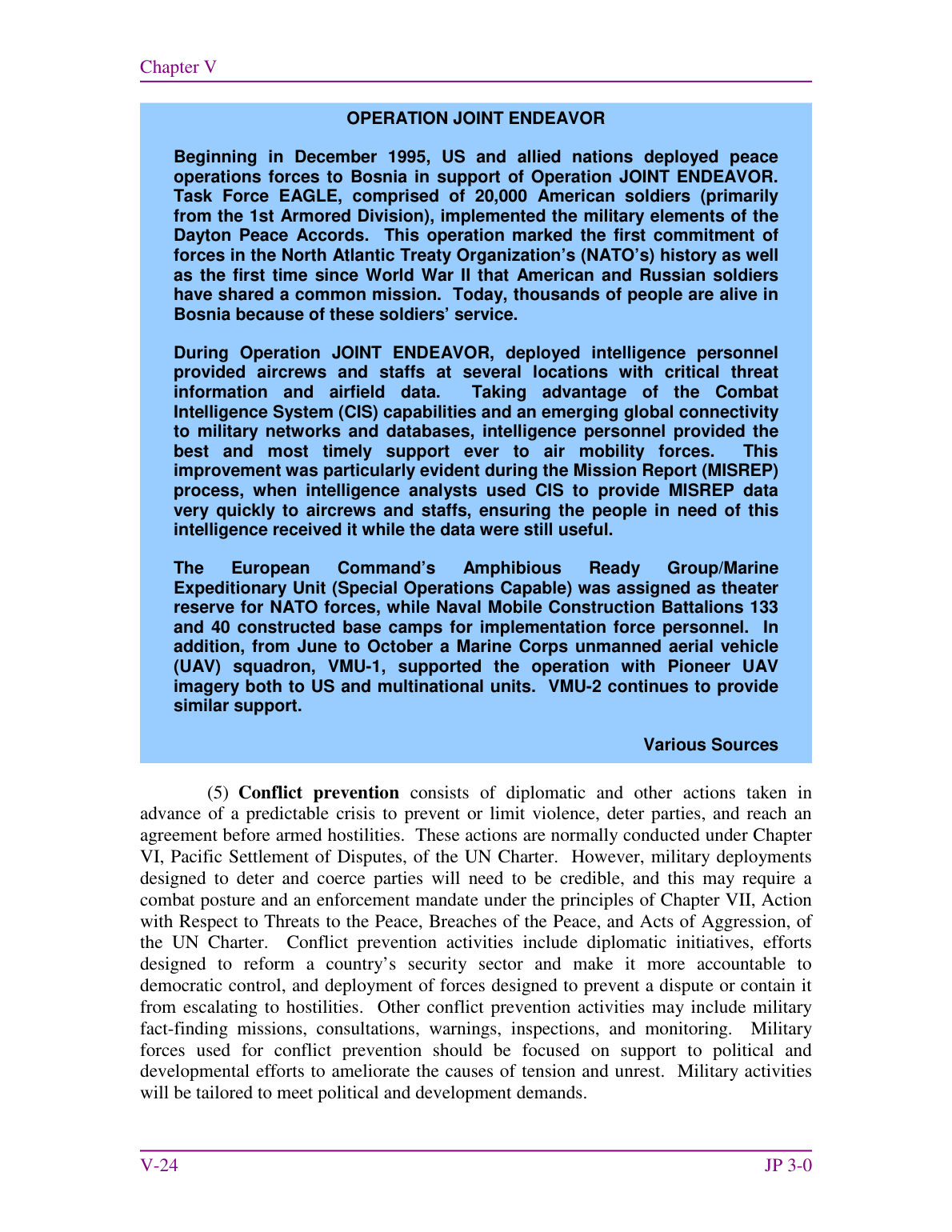
OPERATION JOINT ENDEAVOR
Beginning in December 1995, US and allied nations deployed peace
operations forces to Bosnia in support of Operation JOINT ENDEAVOR.
Task Force EAGLE, comprised of 20,000 American soldiers (primarily
from the 1st Armored Division), implemented the military elements of the
Dayton Peace Accords. This operation marked the first commitment of
forces in the North Atlantic Treaty Organization’s (NATO’s) history as well
as the first time since World War II that American and Russian soldiers
have shared a common mission. Today, thousands of people are alive in
Bosnia because of these soldiers’ service.
During Operation JOINT ENDEAVOR, deployed intelligence personnel
provided aircrews and staffs at several locations with critical threat
information and airfield data. Taking advantage of the Combat
Intelligence System (CIS) capabilities and an emerging global connectivity
to military networks and databases, intelligence personnel provided the
best and most timely support ever to air mobility forces. This
improvement was particularly evident during the Mission Report (MISREP)
process, when intelligence analysts used CIS to provide MISREP data
very quickly to aircrews and staffs, ensuring the people in need of this
intelligence received it while the data were still useful.
The
European
Command’s
Amphibious
Ready
Group/Marine
Expeditionary Unit (Special Operations Capable) was assigned as theater
reserve for NATO forces, while Naval Mobile Construction Battalions 133
and 40 constructed base camps for implementation force personnel. In
addition, from June to October a Marine Corps unmanned aerial vehicle
(UAV) squadron, VMU-1, supported the operation with Pioneer UAV
imagery both to US and multinational units. VMU-2 continues to provide
similar support.
Various Sources